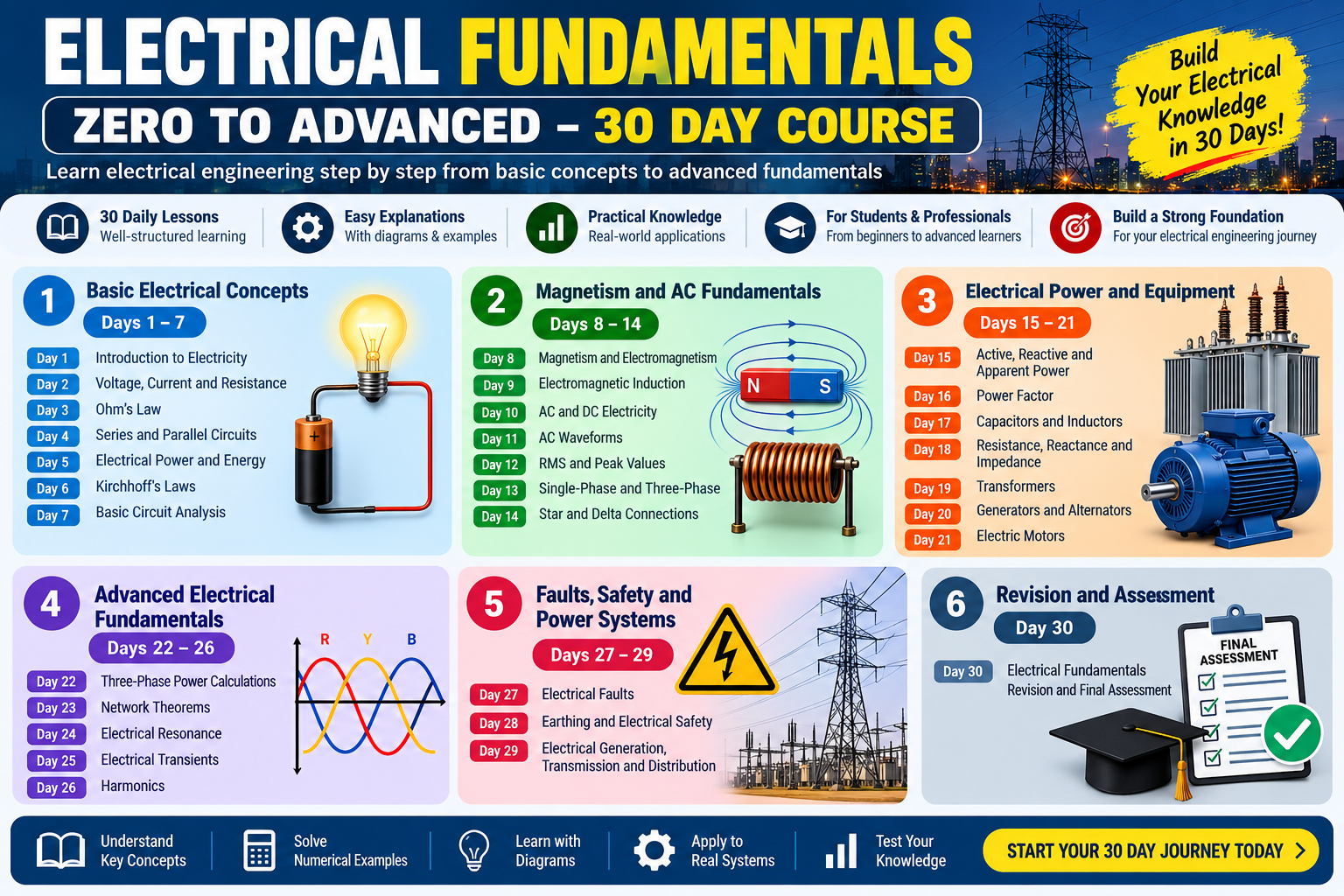
Electrical Fundamentals: Zero to Advanced – Complete 30-Day Course
Table of Contents
Welcome to the Electrical Fundamentals course at Electrical Designer World! This free 30-day course is designed to help students, beginners, technicians, and aspiring electrical engineers understand electricity from the basics to advanced fundamental concepts.
If you have ever wondered how voltage, current, resistance, electrical power, transformers, generators, and motors work, this course will help you build a strong foundation step by step.
Instead of learning isolated formulas, you will understand the principles behind electrical engineering, how electrical quantities are related, and how these concepts apply to real electrical systems.
Start from Day 1, follow the lessons in sequence, practise the worked examples, and test your knowledge as you progress.
What Are Electrical Fundamentals?
Electrical fundamentals are the basic principles that explain how electricity behaves in electrical circuits and systems. They include voltage, current, resistance, Ohm’s law, electrical power, magnetism, alternating current (AC), direct current (DC), three-phase systems, transformers, generators, motors, and electrical safety.
Understanding these concepts helps you analyse circuits, perform electrical calculations, understand electrical equipment, and build the technical knowledge required for further electrical engineering studies.
This course starts with simple concepts and gradually introduces more advanced topics so that you can develop your understanding in a logical order.
What Will You Learn in This 30-Day Electrical Fundamentals Course?
By completing this course, you will learn how to:
- Explain voltage, current, resistance, and electrical energy.
- Apply Ohm’s law to calculate unknown electrical quantities.
- Analyse basic series and parallel circuits.
- Understand Kirchhoff’s laws and fundamental circuit analysis.
- Explain magnetic fields and electromagnetic induction.
- Understand AC waveforms, RMS values, and peak values.
- Differentiate single-phase and three-phase electricity.
- Understand star and delta connections.
- Calculate active power, reactive power, apparent power, and power factor.
- Understand the operating principles of transformers, generators, and electric motors.
- Apply basic three-phase power calculations and network theorems.
- Understand harmonics, electrical faults, earthing, and electrical safety.
- Explain how electrical energy is generated, transmitted, and distributed.
Complete 30-Day Electrical Fundamentals Course
Follow the lessons in order. Each lesson will have its own dedicated article containing explanations, formulas, practical examples, diagrams, and revision questions where relevant.
Module 1: Basic Electrical Concepts — Days 1–7
Build your foundation by understanding electricity, electrical quantities, and circuit behaviour.
Day 1: Introduction to Electricity
Learn what electricity is, how electric charge behaves, and the difference between conductors, insulators, and basic electrical systems.
Day 2: Voltage, Current and Resistance
Understand voltage, current, and resistance, their units of measurement, and how these quantities are related.
Learn Ohm’s law and use the formula V = IR to calculate voltage, current, and resistance through practical examples.
Day 4: Series and Parallel Circuits
Understand how components behave in series and parallel circuits, including equivalent resistance and the distribution of voltage and current.
Day 5: Electrical Power and Energy
Learn how to calculate electrical power and energy, understand watts and kilowatt-hours, and distinguish power from energy consumption.
Study Kirchhoff’s Current Law (KCL) and Kirchhoff’s Voltage Law (KVL), including their application in analysing electrical circuits.
Bring together Ohm’s law, series and parallel circuits, and Kirchhoff’s laws to solve basic electrical circuit problems.
Module 2: Magnetism and AC Fundamentals — Days 8–14
Understand the magnetic principles behind electrical machines and the behaviour of alternating current.
Day 8: Magnetism and Electromagnetism
Learn about magnetic fields, magnetic flux, electromagnets, and the relationship between electric current and magnetism.
Day 9: Electromagnetic Induction
Understand how a changing magnetic field can induce voltage and how electromagnetic induction is used in electrical equipment.
Compare alternating current and direct current, their characteristics, their sources, and their common applications.
Learn how an AC waveform changes with time, including frequency, time period, amplitude, and phase angle.
Understand instantaneous, peak, peak-to-peak, and RMS values, and learn how to calculate RMS voltage and current for a sinusoidal waveform.
Day 13: Single-Phase and Three-Phase Electricity
Understand the differences between single-phase and three-phase supplies, including phase relationships and common applications.
Day 14: Star and Delta Connections
Learn the principles of star and delta connections, line and phase quantities, and the relationship between line voltage and phase voltage.
Module 3: Electrical Power and Equipment — Days 15–21
Explore electrical power, circuit components, and the basic operating principles of important electrical machines.
Day 15: Active, Reactive and Apparent Power
Understand real power (kW), reactive power (kVAR), and apparent power (kVA), including the relationship between them.
Day 16: Power Factor
Learn what power factor means, why it matters in electrical systems, and how it affects current, power demand, and equipment sizing.
Day 17: Capacitors and Inductors
Understand capacitance, inductance, energy storage, and the behaviour of capacitors and inductors in electrical circuits.
Day 18: Resistance, Reactance and Impedance
Learn the differences between resistance, inductive reactance, capacitive reactance, and impedance in AC circuits.
Day 19: Transformers
Understand the working principle of transformers, turns ratio, voltage transformation, current relationships, and transformer ratings.
Day 20: Generators and Alternators
Learn how generators convert mechanical energy into electrical energy and how alternators produce AC voltage.
Day 21: Electric Motors
Understand the basic operating principles of electric motors, the role of magnetic fields, and the differences between common motor types.
Module 4: Advanced Electrical Fundamentals — Days 22–26
Develop your analytical skills and explore concepts that explain the behaviour of more complex electrical circuits.
Day 22: Three-Phase Power Calculations
Learn how to calculate three-phase active power, reactive power, and apparent power using line voltage, line current, and power factor.
Day 23: Network Theorems
Study important circuit analysis techniques, including Thevenin’s theorem, Norton’s theorem, the superposition theorem, and related methods.
Day 24: Electrical Resonance
Understand resonance in AC circuits, resonant frequency, and the behaviour of inductive and capacitive reactance.
Day 25: Electrical Transients
Learn how voltage and current change temporarily when a circuit is switched or disturbed, including basic RC and RL circuit behaviour.
Day 26: Harmonics
Understand harmonic distortion, its sources, its effects on electrical equipment, and why harmonic control matters in electrical systems.
Module 5: Faults, Safety and Power Systems — Days 27–29
Connect fundamental electrical theory with electrical faults, protection concepts, safety, and the wider power system.
Day 27: Electrical Faults
Learn about short circuits, open circuits, earth faults, overloads, and the basic principles of fault behaviour in electrical systems.
Day 28: Earthing and Electrical Safety
Understand the purpose of earthing, electric shock hazards, protective devices, and the basic principles of safe electrical work.
Day 29: Electrical Generation, Transmission and Distribution
Follow the journey of electrical energy from generating stations through transmission networks and distribution systems to end users.
Module 6: Revision and Assessment — Day 30
Day 30: Electrical Fundamentals Revision and Final Assessment
Review the key concepts from all 30 lessons. Test your understanding through numerical problems, formula-based questions, concept checks, and practical electrical engineering scenarios.
Use this final lesson to identify topics that need more revision before progressing to more advanced electrical engineering subjects.
How to Study This Course Effectively
For the best learning experience, follow this simple routine:
- Study one lesson at a time. Understand the concept before moving to the next topic.
- Write down important formulas. Record the formula, the meaning of each symbol, and the units.
- Solve numerical examples. Practise calculating electrical quantities instead of only reading explanations.
- Study diagrams carefully. Use circuit diagrams and illustrations to understand how electrical quantities interact.
- Revise regularly. Review previous lessons when you encounter related concepts.
- Complete the final assessment. Check whether you can apply what you have learned without relying entirely on notes.
Recommended Resources for Further Learning
Alongside this course, you can explore these authoritative educational resources:
- OpenStax Physics — free educational material covering physics principles relevant to electricity and magnetism.
- Schneider Electric Electrical Installation Guide — technical reference material on electrical installations, power distribution, and electrical design concepts.
- U.S. Department of Energy — information about electricity, energy systems, and power generation.
Use these resources to deepen your understanding of the concepts introduced in the course.
Frequently Asked Questions
1. Can beginners learn electrical fundamentals from zero?
Yes. This course starts with basic electrical concepts and progressively introduces more advanced topics. A beginner can follow the lessons in sequence and practise the worked examples to develop a strong foundation.
2. How long does it take to complete the course?
The course is organised into 30 daily lessons. If you study one lesson each day, you can complete the planned sequence in 30 days. You can also spend additional time revising difficult concepts.
3. Is this electrical fundamentals course free?
Yes. The course is designed as a free educational learning resource on Electrical Designer World.
4. Do I need prior electrical engineering knowledge?
No advanced knowledge is required to begin. Basic mathematics will help with formulas and numerical problems, and each lesson builds on concepts introduced earlier.
5. What should I study after completing this course?
After building a solid foundation, you can explore more specialised subjects such as electrical circuit design, electrical machines, power systems, protection, and electrical engineering design. Choose the next subject based on your learning goals.
6. What is the difference between electrical fundamentals and electrical design?
Electrical fundamentals explain the principles of electricity, circuits, power, and equipment. Electrical design applies these principles to engineering tasks such as equipment selection, load calculations, protection coordination, cable sizing, and electrical system design.
Start Learning Electrical Fundamentals Today
Electrical engineering becomes easier when you understand the principles behind the formulas and equipment.
This 30-day Electrical Fundamentals course is designed to help you progress step by step, from understanding basic electrical quantities to analysing circuits and exploring electrical power systems.
Start with Day 1, practise every concept, and continue through all 30 lessons to build a strong foundation in electrical engineering.
Continue learning with more educational resources at Electrical Designer World, your learning destination for electrical engineering concepts and practical knowledge.