
Day 5: Electrical Power and Energy – Formulas and Solved Examples
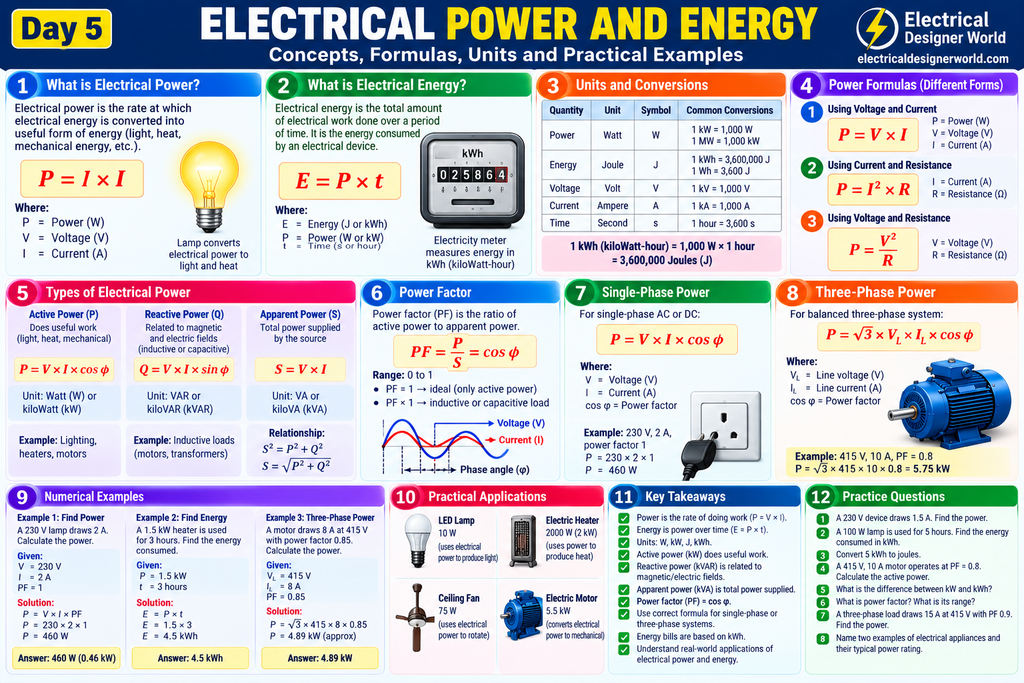
Welcome to Day 5 of the Electrical Fundamentals – Zero to Advanced course at Electrical Designer World!
In Day 1, we learned the basics of electricity. In Day 2, we studied voltage, current and resistance. In Day 3, we applied Ohm’s law, and in Day 4, we explored series and parallel circuits.
Today, we will learn about electrical power and energy, two fundamental concepts used to understand how electrical devices operate and how much electricity they consume.
Have you ever wondered why a 2,000 W heater consumes more electricity than a 10 W LED lamp when both operate for the same amount of time? Or why your electricity bill is measured in kilowatt-hours (kWh) rather than kilowatts (kW)?
The answers become clear when you understand electrical power and energy.
In this lesson, you will learn the definitions, formulas, units, numerical examples, and practical applications of electrical power and energy.
- Day 5: Electrical Power and Energy – Formulas and Solved Examples
- 1. What Is Electrical Power?
- 2. What Is Electrical Energy?
- 3. Difference Between Electrical Power and Energy
- 4. Electrical Power Formula
- 5. Relationship Between Power, Voltage and Current
- 6. Electrical Energy Formula
- 7. Understanding Watts, Kilowatts and Kilowatt-Hours
- 8. Solved Numerical Examples
- 9. Electrical Power in AC Circuits
- 10. Active, Reactive and Apparent Power
- 11. Practical Applications of Electrical Power and Energy
- Frequently Asked Questions
- Day 5 Practice Questions
- Conclusion
1. What Is Electrical Power?
Electrical power is the rate at which electrical energy is transferred or converted into another form of energy.
For example:
- An LED lamp converts electrical energy into light and heat.
- An electric heater converts electrical energy into heat.
- An electric motor converts electrical energy into mechanical energy.
- A fan converts electrical energy into mechanical motion and air movement.
The SI unit of power is the watt (W), and the symbol commonly used for power is P.
One watt equals one joule of energy transferred per second.
P = E / t
Where:
- P = Power in watts (W)
- E = Energy transferred in joules (J)
- t = Time in seconds (s)
Example
If a device transfers 600 joules of energy in 10 seconds:
P = 600 / 10
Power = 60 W
This means the device transfers energy at an average rate of 60 joules per second.
2. What Is Electrical Energy?
Electrical energy is the amount of energy transferred or consumed by an electrical device over a period of time.
The energy consumed depends on both the power of the device and how long it operates.
For example, a 1,000 W heater operating for two hours consumes more electrical energy than the same heater operating for 30 minutes.
Electrical energy is commonly measured in:
- Joules (J)
- Watt-hours (Wh)
- Kilowatt-hours (kWh)
Electricity meters commonly measure household and commercial electricity consumption in kilowatt-hours.
What is one kilowatt-hour?
One kilowatt-hour is the energy consumed by a device operating at a constant power of 1 kilowatt for one hour.
1 kWh = 1 kW × 1 hour
Since 1 kW = 1,000 W and 1 hour = 3,600 seconds:
1 kWh = 1,000 × 3,600 J
1 kWh = 3,600,000 J = 3.6 MJ
This is why the kilowatt-hour is a convenient unit for measuring electrical energy consumption.
3. Difference Between Electrical Power and Energy
Power and energy are related, but they describe different quantities.
| Property | Electrical power | Electrical energy |
|---|---|---|
| Meaning | Rate of energy transfer | Total energy transferred |
| Common symbol | P | E |
| SI unit | Watt (W) | Joule (J) |
| Common practical unit | kW | kWh |
| Depends on | Energy transfer per unit time | Power and operating duration |
| Example | A 1,000 W heater | Energy consumed by the heater over several hours |
Practical example
Consider two heaters:
- Heater A: 1,000 W
- Heater B: 2,000 W
If both operate continuously for one hour at their rated power:
Heater A:
E = 1 kW × 1 hour
Energy = 1 kWh
Heater B:
E = 2 kW × 1 hour
Energy = 2 kWh
Heater B consumes twice as much electrical energy over the same operating time, assuming both operate continuously at their rated power.
Actual consumption depends on operating conditions, thermostat cycling, efficiency, and the way the equipment is used.
4. Electrical Power Formula
For a DC circuit, electrical power is calculated using:
P = V × I
Where:
- P = Power in watts (W)
- V = Voltage in volts (V)
- I = Current in amperes (A)
This formula also applies directly to a resistive AC load when voltage and current are expressed as RMS values and the power factor is 1. For general AC circuits, the power factor must be considered.
Example
A 12 V DC device draws 3 A of current. Calculate its electrical input power.
Given:
V = 12 V
I = 3 A
Using the formula:
P = V × I
P = 12 × 3
Power = 36 W
The device receives 36 W of electrical input power under these conditions.
5. Relationship Between Power, Voltage and Current
Electrical power can also be calculated using Ohm’s law.
For an ohmic resistor:
P = V × I
Ohm’s law states:
V = I × R
Substituting this relationship into the power equation gives additional formulas.
Formula 1: Power using current and resistance
P = I² × R
Use this formula when current and resistance are known.
Formula 2: Power using voltage and resistance
P = V² / R
Use this formula when voltage and resistance are known.
Example 1: Calculate power using current and resistance
A 4 Ω resistor carries a current of 3 A.
P = I² × R
P = 3² × 4
P = 9 × 4
Power = 36 W
Example 2: Calculate power using voltage and resistance
A 12 V supply is connected across a 6 Ω resistor.
P = V² / R
P = 12² / 6
P = 144 / 6
Power = 24 W
These formulas are useful for calculating power dissipated by resistors and other components that can be represented by an appropriate resistive model.
6. Electrical Energy Formula
Electrical energy can be calculated from power and time.
E = P × t
Where:
- E = Energy
- P = Power
- t = Operating time
The units must be consistent.
For energy in joules, power should be expressed in watts and time in seconds.
For energy in kilowatt-hours, power should be expressed in kilowatts and time in hours.
Example
A 1.5 kW heater operates for 3 hours.
Given:
P = 1.5 kW
t = 3 hours
E = P × t
E = 1.5 × 3
Energy = 4.5 kWh
This is the electrical energy consumed if the heater operates continuously at 1.5 kW for the full three hours.
Another example: LED lamp
A 10 W LED lamp operates for 8 hours.
Convert watts to kilowatts:
10 W = 0.01 kW
Energy:
E = 0.01 × 8
Energy = 0.08 kWh
This illustrates why low-power devices generally consume less energy than high-power devices when used for the same duration.
7. Understanding Watts, Kilowatts and Kilowatt-Hours
Electrical power and energy use different units. Confusing them can lead to errors in calculations.
Watt (W)
The watt is the SI unit of power.
1 W = 1 joule per second.
Kilowatt (kW)
A kilowatt is equal to 1,000 watts.
1 kW = 1,000 W
For example:
2,000 W = 2 kW
Watt-hour (Wh)
A watt-hour is a unit of energy representing one watt of power sustained for one hour.
Kilowatt-hour (kWh)
A kilowatt-hour is a practical unit of electrical energy.
1 kWh = 1,000 Wh
Remember:
- kW measures power.
- kWh measures energy.
For example, a 2 kW heater operating for 3 hours consumes 6 kWh of electrical energy if it operates continuously at that power.
8. Solved Numerical Examples
Example 1: Calculate electrical power
A 230 V appliance draws 2 A of current and operates with a power factor of 1. Calculate its input power.
Given:
V = 230 V
I = 2 A
PF = 1
For a single-phase AC circuit:
P = V × I × PF
P = 230 × 2 × 1
Power = 460 W = 0.46 kW
For an appliance with a different power factor, the real power would be calculated using P = V × I × PF for sinusoidal single-phase conditions.
Example 2: Calculate energy consumption
A 1.5 kW heater operates for 4 hours.
E = P × t
E = 1.5 × 4
Energy = 6 kWh
Example 3: Calculate electricity cost
A 2 kW heater operates for 3 hours each day for 30 days. Assume an illustrative electricity rate of ₹8 per kWh.
Daily energy consumption:
E = 2 × 3
E = 6 kWh per day
Monthly energy consumption:
E = 6 × 30
E = 180 kWh
Estimated energy charge:
Cost = 180 × ₹8
Estimated cost = ₹1,440
This is an illustrative energy charge only. Actual electricity bills may include fixed charges, slab-based rates, taxes, and other adjustments.
Example 4: Calculate power using resistance
A 10 Ω resistor carries a current of 4 A.
P = I² × R
P = 4² × 10
P = 16 × 10
Power = 160 W
Example 5: Calculate energy in joules
A 100 W device operates for 60 seconds.
E = P × t
E = 100 × 60
Energy = 6,000 J
Example 6: Calculate three-phase electrical power
A balanced three-phase motor operates at:
- Line voltage = 415 V
- Line current = 10 A
- Power factor = 0.8
For a balanced three-phase system:
P = √3 × Vₗ × Iₗ × PF
P = √3 × 415 × 10 × 0.8
P ≈ 5,750 W
Real power ≈ 5.75 kW
This calculation gives the motor’s electrical real input power under the stated conditions, not necessarily its mechanical output power. Motor efficiency must be considered to determine mechanical output power.
9. Electrical Power in AC Circuits
In AC systems, voltage and current can vary continuously with time. For sinusoidal voltage and current, the phase relationship between them affects the real power transferred.
For a single-phase sinusoidal AC circuit:
P = V × I × cos φ
Where:
- P = Active power in watts (W)
- V = RMS voltage
- I = RMS current
- cos φ = Power factor for sinusoidal conditions
For a balanced three-phase sinusoidal system:
P = √3 × Vₗ × Iₗ × cos φ
Where:
- Vₗ = Line-to-line RMS voltage
- Iₗ = Line current
- cos φ = Power factor
These formulas are widely used in electrical engineering calculations.
For non-sinusoidal systems with significant harmonics, the relationship between real power and RMS voltage and current requires more careful treatment than simply using the displacement power factor.
10. Active, Reactive and Apparent Power
AC electrical systems can involve three related power quantities.
Active power (P)
Active power is the average power transferred to perform useful work or converted into forms such as heat, light, and mechanical output.
Its units are watts (W) or kilowatts (kW).
Reactive power (Q)
Reactive power is associated with the periodic exchange of energy between the source and reactive elements such as inductors and capacitors.
It is measured in volt-amperes reactive (var) or kilovolt-amperes reactive (kVAR).
Apparent power (S)
Apparent power is calculated using RMS voltage and current.
For a single-phase circuit:
S = V × I
It is measured in volt-amperes (VA) or kilovolt-amperes (kVA).
For a balanced three-phase circuit:
S = √3 × Vₗ × Iₗ
For sinusoidal conditions:
PF = P / S = cos φ
The power triangle relates active, reactive, and apparent power under sinusoidal conditions:
S² = P² + Q²
These quantities are important when understanding power factor, transformer ratings, generator capacity, and electrical system loading.
11. Practical Applications of Electrical Power and Energy
Household appliances
The rated power of a lamp, heater, refrigerator, or fan helps describe its electrical input requirements under specified operating conditions.
Electricity bills
Electricity consumption is commonly recorded in kWh. Multiplying consumption by the applicable energy rate gives an estimate of the energy charge.
Electric motors
Motor input power depends on voltage, current, power factor, and the operating conditions. The motor’s mechanical output power is lower than its electrical input power when losses are present.
Transformers and generators
Transformers and generators are commonly rated in kVA or MVA because their capacity is associated with voltage and current. Active power in kW also depends on power factor.
EPC electrical design
Understanding electrical power and energy provides a foundation for load calculations, transformer selection, generator sizing, cable calculations, and power distribution design.
Practical design must also account for demand, efficiency, operating conditions, protection, applicable standards, and equipment ratings.
Frequently Asked Questions
1. What is electrical power?
Electrical power is the rate at which electrical energy is transferred or converted. Its SI unit is the watt.
2. What is electrical energy?
Electrical energy is the total energy transferred or consumed over a period of time. It can be measured in joules or kilowatt-hours.
3. What is the formula for electrical power?
For a DC circuit, P = V × I. For a single-phase sinusoidal AC circuit, real power is P = V × I × cos φ.
4. What is the difference between kW and kWh?
Kilowatts measure power, while kilowatt-hours measure energy. A 2 kW appliance operating for 3 hours consumes 6 kWh if it operates continuously at that power.
5. How many joules are there in one kWh?
One kilowatt-hour equals 3,600,000 joules, or 3.6 megajoules.
6. How do you calculate electricity cost?
Multiply the energy consumed in kWh by the applicable rate per kWh. Additional charges may apply.
7. What is power factor?
Power factor describes the relationship between active power and apparent power. For sinusoidal conditions, it equals cos φ.
8. What is the next lesson in this course?
Day 6 covers Kirchhoff’s laws, including Kirchhoff’s Current Law and Kirchhoff’s Voltage Law, with circuit diagrams and worked examples.
Day 5 Practice Questions
Test your understanding of electrical power and energy.
- A 230 V appliance draws 2 A at unity power factor. Calculate its real power.
- A 2 kW heater operates for 3 hours. Calculate the energy consumed in kWh.
- Convert 5 kWh into joules.
- A 12 V DC device draws 4 A. Calculate its electrical input power.
- A 100 W lamp operates for 5 hours. Calculate its energy consumption in kWh.
- A balanced three-phase load operates at 415 V, 10 A, and a power factor of 0.8. Calculate its real power.
- Explain the difference between active power, reactive power, and apparent power.
- A 1.5 kW appliance operates for 4 hours daily for 30 days. Calculate its monthly energy consumption.
- If the electricity rate is ₹8 per kWh, estimate the energy charge for the consumption in Question 8.
- Write two formulas for calculating resistive power using voltage, current, and resistance.
Answer Key
- P = 230 × 2 × 1 = 460 W.
- E = 2 × 3 = 6 kWh.
- 5 × 3,600,000 = 18,000,000 J.
- P = 12 × 4 = 48 W.
- E = 0.1 × 5 = 0.5 kWh.
- P = √3 × 415 × 10 × 0.8 ≈ 5.75 kW.
- Active power performs net work, reactive power is associated with energy exchange in reactive elements, and apparent power is based on RMS voltage and current.
- E = 1.5 × 4 × 30 = 180 kWh.
- Cost = 180 × ₹8 = ₹1,440.
- P = I² × R and P = V² / R.
Further Reading: Electrical Power and Energy
Explore these resources to develop a deeper understanding of electrical power, energy consumption, and electrical systems:
- OpenStax Physics — learn the fundamental principles of energy, work, and power.
- U.S. Department of Energy — explore electricity generation, energy use, and efficiency.
- Schneider Electric Electrical Installation Guide — study practical electrical installation and power distribution concepts.
Conclusion
Electrical power and energy help us understand how electrical devices operate and how much electricity they consume.
Remember these fundamental formulas:
- DC electrical power: P = V × I
- Resistive power: P = I² × R or P = V² / R
- Electrical energy: E = P × t
- Single-phase sinusoidal AC real power: P = V × I × cos φ
- Balanced three-phase real power: P = √3 × Vₗ × Iₗ × cos φ
Practise the numerical examples until you can select the correct formula, use consistent units, and interpret the result.
Continue learning:
- Explore the Electrical Fundamentals – 30-Day Course
- Read Day 2: Voltage, Current and Resistance
- Read Day 3: Ohm’s Law
- Read Day 4: Series and Parallel Circuits
- Day 6: Kirchhoff’s Laws — add the link after publishing the next lesson.
Keep learning step by step with Electrical Designer World!