
Day 1: Introduction to Electricity – A Beginner’s Guide
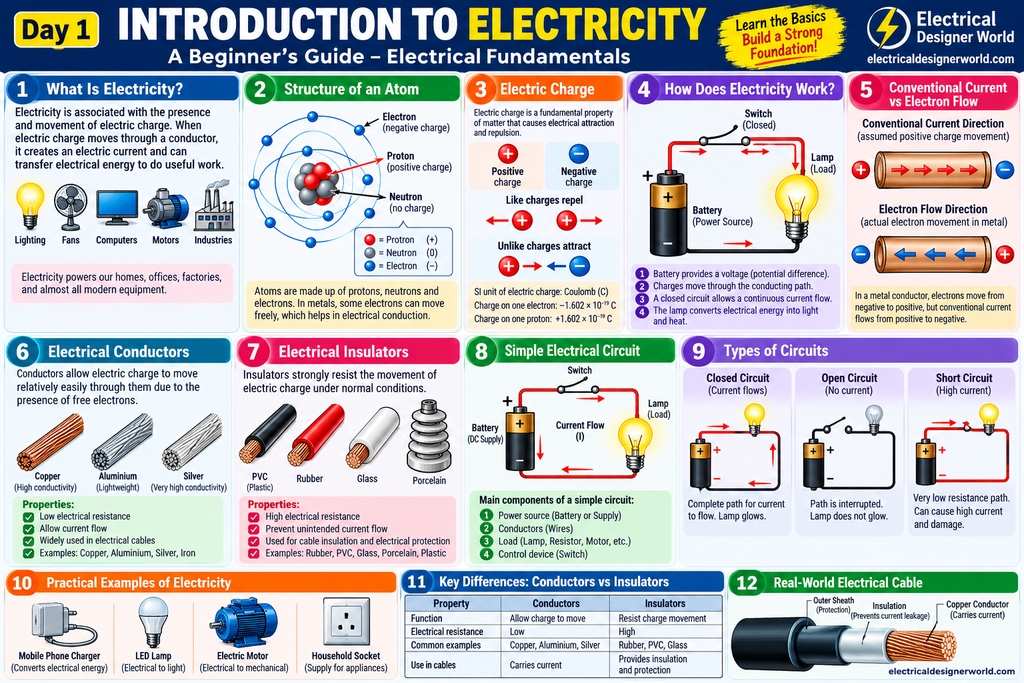
Table of Contents
Welcome to Day 1 of the Electrical Fundamentals – Zero to Advanced course at Electrical Designer World!
This introduction to electricity is the starting point for anyone who wants to understand electrical engineering from the basics. Whether you are a student, beginner, technician, or aspiring electrical engineer, learning how electricity works will help you understand the electrical concepts covered throughout this 30-day course.
Electricity powers our homes, offices, factories, electrical equipment, computers, lighting systems, and industrial machines. But what exactly is electricity? How does it move through a wire? Why do we use copper cables, and why are electrical wires covered with insulation?
In this lesson, we will answer these questions using simple explanations, practical examples, and basic scientific principles.
Table of Contents
- What Is Electricity?
- Understanding the Structure of an Atom
- What Is Electric Charge?
- How Does Electricity Work?
- What Are Electrical Conductors?
- What Are Electrical Insulators?
- What Is an Electrical Circuit?
- Practical Examples of Electricity
- Key Differences Between Conductors and Insulators
- Frequently Asked Questions
- Day 1 Practice Questions
1. What Is Electricity?
Electricity is associated with the presence and movement of electric charge. Electric charge is a fundamental property of matter, and its movement through a conductor can produce electric current.
To understand electricity, we first need to understand three basic concepts:
- Electric charge: A property of matter that produces electrical forces.
- Voltage: The electric potential difference between two points.
- Current: The rate at which electric charge passes a given point.
These concepts are related, but they do not mean the same thing. We will study voltage and current in detail in Day 2.
For example, when you switch on a lamp connected to a suitable power supply, an electric current flows through the circuit and the lamp converts electrical energy into light and heat.
Electricity can exist as static charge or as moving charge in an electrical circuit. Static electricity involves accumulated electric charge, while electric current describes the movement of charge.
2. Understanding the Structure of an Atom
Everything around us is made of matter. Copper wires, plastic insulation, batteries, switches, and electrical equipment are all made of atoms.
An atom contains three main types of subatomic particles.
Protons
Protons carry a positive electric charge and are located in the nucleus of an atom.
Neutrons
Neutrons have no net electric charge and are also located in the nucleus.
Electrons
Electrons carry a negative electric charge and occupy regions around the nucleus. In conducting materials such as copper, some electrons can move relatively freely through the material.
This movement of charge carriers is important for understanding electric current.
Simple atomic structure example
Imagine a copper wire containing an enormous number of copper atoms. Some electrons in the copper can move through the material when an electric field is established by a suitable power source.
This is one reason copper is widely used for electrical wiring.
Important point: Electric current in a metal wire is associated with electron movement, but conventional current is defined in the direction that positive charge would move. Therefore, conventional current and electron drift have opposite directions in a metal conductor.
3. What Is Electric Charge?
Electric charge is a fundamental property that causes electrical attraction and repulsion.
There are two types of electric charge:
- Positive charge
- Negative charge
The basic rules are simple:
- Like charges repel each other.
- Unlike charges attract each other.
- A neutral object has equal amounts of positive and negative charge.
The SI unit of electric charge is the coulomb (C).
For example, electrons carry negative charge, while protons carry positive charge. When electrons are transferred from one object to another, the objects can become electrically charged.
Electric charge is the foundation for understanding voltage, current, electric fields, and electrical circuits.
For additional reading, explore the OpenStax explanation of electric charge and conservation of charge.
4. How Does Electricity Work?
Consider a simple circuit consisting of a battery, two connecting wires, and a lamp.
When the circuit is complete, the battery establishes an electric potential difference across the circuit. This produces an electric field that causes charge carriers in the conducting wires to drift, creating an electric current.
The lamp then converts electrical energy into light and heat.
The basic process can be understood in four steps:
- Power source: The battery or another power source provides an electrical potential difference.
- Conducting path: Wires provide a path through which charge carriers can move.
- Closed circuit: The conducting path must form a complete circuit for a sustained current to flow in a simple DC circuit.
- Electrical load: The lamp or other device converts electrical energy into useful output or other forms of energy.
If the circuit is open, the conducting path is interrupted and a sustained current cannot flow through the complete circuit.
This basic principle applies to many electrical systems, from battery-powered devices to industrial electrical equipment.
5. What Are Electrical Conductors?
Electrical conductors are materials that allow electric charge to move relatively easily through them.
In metals, mobile electrons are the primary charge carriers responsible for electrical conduction.
Common examples include:
- Copper
- Aluminium
- Silver
- Iron
Copper is widely used in electrical cables because it has high electrical conductivity and is suitable for many wiring applications.
Aluminium is also used in electrical power transmission and distribution because of its lower density and other practical properties.
Practical example
Inside a typical electrical cable, the metal conductor carries current between the power source and the connected equipment.
The conductor must be selected appropriately for the intended current, installation conditions, voltage drop, and applicable electrical standards.
Understanding conductors will be important when we study resistance, Ohm’s law, and electrical power in later lessons.
6. What Are Electrical Insulators?
Electrical insulators are materials that strongly resist the movement of electric charge under normal operating conditions.
Common examples include:
- Rubber
- PVC
- Glass
- Porcelain
- Many plastics
Electrical insulation is essential because it helps prevent unintended current paths and protects people and equipment from electric shock and electrical faults.
Practical example
A typical insulated copper cable contains two important parts:
- Copper conductor: Carries electric current.
- Insulating material: Surrounds the conductor and helps prevent unintended electrical contact.
The insulation must be suitable for the operating voltage, temperature, environment, and installation conditions.
An insulator is not perfect under every condition. Excessive voltage, heat, physical damage, contamination, or ageing can cause insulation failure.
For a more detailed explanation, read OpenStax’s guide to electrical conductors and insulators.
7. What Is an Electrical Circuit?
An electrical circuit is an arrangement of electrical components connected to provide a path for current.
A basic electrical circuit contains four main elements:
- Power source: Supplies electrical energy, such as a battery.
- Conductors: Connect the components and provide a path for current.
- Load: Uses electrical energy, such as a lamp or resistor.
- Control device: A switch can open or close the circuit.
Closed circuit
When the circuit is closed, a complete conducting path exists. If a suitable voltage is applied, current can flow through the circuit.
Open circuit
When the circuit is open, the conducting path is interrupted. In a simple series circuit, the load stops operating because the sustained current path is broken.
Short circuit
A short circuit is an unintended low-impedance connection between points at different electrical potentials. It can produce dangerously high current, so suitable circuit protection is essential.
We will explore electrical circuits in more detail in the upcoming lessons on Ohm’s law and series and parallel circuits.
8. Practical Examples of Electricity
Electricity becomes easier to understand when we connect theory with everyday applications.
Example 1: A mobile phone charger
A charger receives electrical energy from a power source and converts it into a form suitable for charging a battery. Its electronic components control the charging process.
Example 2: A household lamp
When the lamp circuit is switched on, electric current flows through the lamp’s electrical path, allowing electrical energy to be converted into light and heat.
Example 3: An electric motor
An electric motor converts electrical energy into mechanical energy. Motors are widely used in pumps, fans, compressors, and industrial machinery.
Example 4: An electrical cable
A cable contains conductors that carry current and insulation that helps prevent unintended contact. Both conductor properties and insulation performance are important for safe operation.
These examples show why understanding electrical fundamentals is essential before studying electrical machines, power systems, and electrical design.
9. Difference Between Electrical Conductors and Insulators
| Property | Conductors | Insulators |
|---|---|---|
| Main function | Allow charge to move relatively easily | Strongly resist charge movement |
| Common examples | Copper, aluminium, silver | Rubber, PVC, glass |
| Electrical resistance | Generally low | Generally high |
| Typical cable application | Carries current | Surrounds and isolates the conductor |
| Main purpose | Electrical conduction | Electrical isolation and protection |
The electrical behaviour of real materials depends on factors such as temperature, composition, moisture, and applied electric field.
10. Why Is Learning Electricity Important?
A strong understanding of electricity helps you progress to more advanced electrical engineering subjects.
Once you understand electric charge, conductors, insulators, and basic circuits, you will be better prepared to learn:
- Voltage, current, and resistance
- Ohm’s law and circuit calculations
- Electrical power and energy
- AC and DC systems
- Single-phase and three-phase electricity
- Transformers, generators, and motors
- Electrical faults and safety
This is why our Electrical Fundamentals course begins with basic concepts before moving towards advanced topics.
Frequently Asked Questions
What is electricity in simple words?
Electricity is associated with electric charge. When charge moves through a conducting path, it can produce electric current and transfer electrical energy.
What is the difference between electricity and electric current?
Electricity is a broad term associated with electric charge and electrical phenomena. Electric current specifically describes the rate of flow of electric charge through a given cross-section.
Why is copper used in electrical wires?
Copper has high electrical conductivity, making it effective for carrying current. Its mechanical properties and established manufacturing applications also make it suitable for many electrical wiring systems.
Why are electrical wires covered with insulation?
Insulation helps prevent unintended electrical contact, reduces the risk of electric shock, and helps protect conductors from environmental and mechanical influences.
Can electricity flow through an insulator?
Insulators strongly resist electric current under normal conditions, but they can conduct or break down when subjected to sufficiently severe electrical or environmental conditions.
What should I learn after this introduction to electricity?
The next lesson covers voltage, current, and resistance. These three concepts form the foundation for understanding Ohm’s law and electrical circuit calculations.
Day 1 Practice Questions
Test your understanding before moving to Day 2.
- What are the three main subatomic particles in an atom?
- What are the two types of electric charge?
- Name three common electrical conductor materials.
- Name three common electrical insulating materials.
- What is the function of a battery in a simple circuit?
- What is the difference between an open circuit and a closed circuit?
- Why is copper commonly used in electrical cables?
- What is the purpose of insulation around a conductor?
Answer Key
- Protons, neutrons, and electrons.
- Positive and negative.
- Copper, aluminium, and silver.
- Rubber, PVC, and glass.
- It provides an electrical potential difference that can drive current in a connected circuit.
- An open circuit has an interrupted conducting path; a closed circuit provides a complete path.
- Copper has high electrical conductivity and suitable practical properties.
- Insulation helps prevent unintended electrical contact and supports electrical safety.
Conclusion
This introduction to electricity has explained the basic concepts behind electric charge, atomic structure, conductors, insulators, and electrical circuits.
Remember that electricity is not simply the movement of electrons in every situation. Electric charge can exist in different forms, and electric current describes the rate at which charge moves. In metal conductors, electron movement is responsible for the current, while conventional current is defined in the opposite direction.
These fundamentals will help you understand the electrical formulas and equipment covered in the rest of this course.
Continue your learning:
- Explore the complete Electrical Fundamentals 30-Day Course
- Day 2: Voltage, Current and Resistance — add the link to the Day 2 article once it is published.
Keep learning with Electrical Designer World, and continue building your electrical engineering knowledge one lesson at a time.