
Day 3: Ohm’s Law – Formula, Calculations and Practical Examples
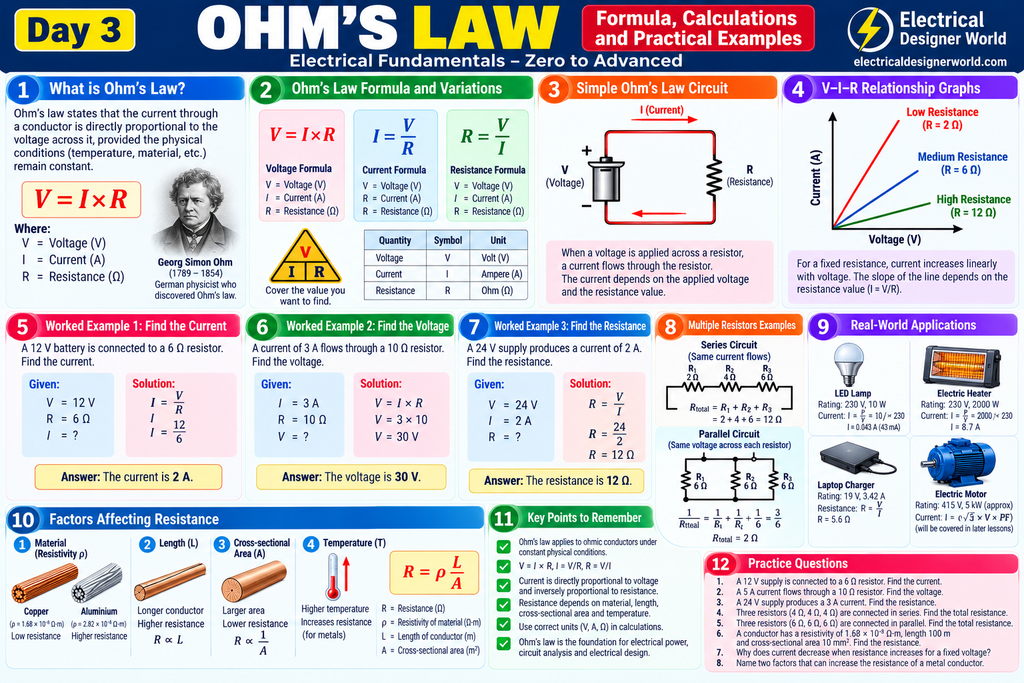
Welcome to Day 3 of the Electrical Fundamentals – Zero to Advanced course at Electrical Designer World!
In Day 1, we learned about electricity and electric charge. In Day 2, we explored voltage, current and resistance. Today, we will connect these three concepts through one of the most important principles in electrical engineering: Ohm’s law.
Ohm’s law helps us calculate voltage, current, and resistance in electrical circuits. It is widely used when analysing basic circuits, understanding electrical components, performing calculations, and developing the foundation needed for electrical engineering design.
If you are learning electrical engineering from the beginning, mastering Ohm’s law will make future topics such as electrical power, series and parallel circuits, and cable calculations much easier.
Table of Contents
1. What Is Ohm’s Law?
Ohm’s law states that the current through an ohmic conductor is directly proportional to the voltage across it, provided its physical conditions, including temperature, remain constant.
In simple terms, when the resistance remains constant, increasing the applied voltage increases the current proportionally.
For example, if a 6-ohm resistor is connected to a 12-volt supply, the current through it is 2 amperes. If the voltage increases to 24 volts while the resistance remains 6 ohms, the current increases to 4 amperes.
This relationship is fundamental to understanding electrical circuits.
Who discovered Ohm’s law?
Ohm’s law is named after Georg Simon Ohm, a German physicist who investigated the relationship between voltage, current, and resistance.
His work helped establish an important foundation for modern electrical circuit analysis.
2. Ohm’s Law Formula
The main Ohm’s law formula is:
V = I × R
Where:
- V = Voltage in volts (V)
- I = Current in amperes (A)
- R = Resistance in ohms (Ω)
The formula can be rearranged to calculate any one of these quantities when the other two are known.
Formula 1: Calculate voltage
V = I × R
Use this formula when current and resistance are known.
Example: A current of 3 A flows through a 10 Ω resistor.
V = 3 × 10
Voltage = 30 V
Formula 2: Calculate current
I = V / R
Use this formula when voltage and resistance are known.
Example: A 12 V supply is connected across a 6 Ω resistor.
I = 12 / 6
Current = 2 A
Formula 3: Calculate resistance
R = V / I
Use this formula when voltage and current are known.
Example: A voltage of 24 V produces a current of 2 A through a resistor.
R = 24 / 2
Resistance = 12 Ω
Remember these three formulas because you will use them repeatedly throughout electrical engineering.
3. Understanding the Ohm’s Law Triangle
The Ohm’s law triangle is a simple memory aid that helps beginners select the correct formula.
Imagine a triangle divided into three sections:
- Voltage (V) at the top.
- Current (I) at the bottom left.
- Resistance (R) at the bottom right.
Cover the quantity you want to calculate.
If you cover voltage, the remaining quantities are multiplied:
V = I × R
If you cover current, voltage is divided by resistance:
I = V / R
If you cover resistance, voltage is divided by current:
R = V / I
The triangle is useful for remembering formulas, but always check the units and the circuit conditions before calculating.
4. How Voltage, Current and Resistance Are Related
Ohm’s law explains how voltage, current and resistance interact in an ohmic circuit.
Relationship 1: Voltage increases, current increases
If resistance remains constant, doubling the voltage doubles the current.
For example:
- Voltage = 12 V
- Resistance = 6 Ω
- Current = 2 A
If voltage increases to 24 V:
- Voltage = 24 V
- Resistance = 6 Ω
- Current = 4 A
Relationship 2: Resistance increases, current decreases
If voltage remains constant, increasing resistance reduces current.
For a 12 V supply:
| Resistance | Calculation | Current |
|---|---|---|
| 2 Ω | 12 / 2 | 6 A |
| 4 Ω | 12 / 4 | 3 A |
| 6 Ω | 12 / 6 | 2 A |
| 12 Ω | 12 / 12 | 1 A |
As resistance increases, current decreases.
Relationship 3: Current increases, voltage increases
For a fixed resistance, increasing current requires a proportional increase in voltage.
For example, through a 5 Ω resistor:
- At 1 A, voltage = 5 V.
- At 2 A, voltage = 10 V.
- At 3 A, voltage = 15 V.
These relationships apply when the resistor remains ohmic and its physical conditions remain sufficiently constant.
5. Solved Numerical Examples
Let us solve several problems using Ohm’s law.
Example 1: Calculate current
A 12 V battery is connected to a 6 Ω resistor. Find the current.
Given:
- Voltage = 12 V
- Resistance = 6 Ω
Formula:
I = V / R
Calculation:
I = 12 / 6
Answer: Current = 2 A
Example 2: Calculate voltage
A current of 4 A flows through a 5 Ω resistor. Calculate the voltage.
Given:
- Current = 4 A
- Resistance = 5 Ω
Formula:
V = I × R
Calculation:
V = 4 × 5
Answer: Voltage = 20 V
Example 3: Calculate resistance
A 24 V source supplies 3 A through a resistor. Calculate the resistance.
Given:
- Voltage = 24 V
- Current = 3 A
Formula:
R = V / I
Calculation:
R = 24 / 3
Answer: Resistance = 8 Ω
Example 4: Calculate current in a higher-resistance circuit
A 48 V supply is connected across a 16 Ω resistor. Find the current.
Formula:
I = V / R
Calculation:
I = 48 / 16
Answer: Current = 3 A
Example 5: Find voltage from current and resistance
A resistor carries 2.5 A of current and has a resistance of 8 Ω. Calculate the voltage across it.
Formula:
V = I × R
Calculation:
V = 2.5 × 8
Answer: Voltage = 20 V
Example 6: Calculate resistance from a measurement
A resistive component has 18 V across it and carries 0.5 A of current. Calculate its resistance.
Formula:
R = V / I
Calculation:
R = 18 / 0.5
Answer: Resistance = 36 Ω
These examples demonstrate how Ohm’s law can be applied to different electrical calculations.
6. Factors Affecting Resistance
Ohm’s law relates voltage, current and resistance, but the resistance of a conductor also depends on its physical properties.
For a uniform conductor:
R = ρ × L / A
Where:
- R = Resistance (Ω)
- ρ = Electrical resistivity (Ω·m)
- L = Conductor length (m)
- A = Cross-sectional area (m²)
Material
Different materials have different electrical resistivities. Copper and aluminium are commonly used in electrical conductors.
Length
A longer conductor generally has greater resistance than a shorter conductor made from the same material with the same cross-sectional area.
Cross-sectional area
A larger cross-sectional area generally reduces conductor resistance.
Temperature
For common metallic conductors over a normal operating range, resistance generally increases as temperature increases.
These factors are important when studying cable sizing, voltage drop and electrical losses. Cable selection also requires consideration of current-carrying capacity, installation conditions, fault withstand and applicable standards.
7. Ohm’s Law Graph
A voltage-current graph helps explain the relationship between voltage and current.
For an ohmic resistor at constant physical conditions, voltage is proportional to current. The graph is a straight line passing through the origin.
If voltage is plotted on the horizontal axis and current on the vertical axis:
- The line becomes steeper for a lower resistance.
- The line becomes less steep for a higher resistance.
- The slope represents 1/R.
For example, a 2 Ω resistor carries more current at a given voltage than a 6 Ω resistor.
This graph is a useful way to understand the electrical behaviour of resistors.
8. Applications of Ohm’s Law
Ohm’s law is used in many electrical engineering applications.
Electronic circuits
Engineers use Ohm’s law to calculate resistor values, determine current, and analyse basic electronic circuits.
Electrical troubleshooting
Voltage and current measurements can help identify abnormal circuit behaviour when combined with circuit specifications and suitable diagnostic procedures.
Electrical power calculations
Ohm’s law can be combined with the electrical power formula:
P = V × I
For a resistor, this gives:
P = I² × R
and
P = V² / R
These equations help calculate power dissipated by a resistor.
Electrical cable calculations
Ohm’s law helps explain voltage drop and resistive losses in conductors. Practical cable sizing, however, requires additional calculations and applicable design criteria.
Industrial electrical systems
Voltage, current and resistance calculations form part of the basic knowledge required to understand electrical loads, motors, transformers, and power distribution systems.
9. Limitations of Ohm’s Law
Ohm’s law is highly useful, but it does not describe every electrical component under every condition.
It applies directly to ohmic conductors when their relevant physical conditions remain constant.
Some components have nonlinear voltage-current relationships. Examples include:
- Diodes
- Transistors
- Incandescent lamp filaments over changing temperatures
- Certain electronic and semiconductor devices
For these components, current may not be directly proportional to voltage across the full operating range.
Also, in AC circuits containing inductors and capacitors, impedance rather than resistance alone is generally needed to relate voltage and current. The simple resistive form of Ohm’s law must be applied with the appropriate circuit model.
Understanding these limitations will help you use electrical formulas correctly.
Frequently Asked Questions
1. What is the formula for Ohm’s law?
The main formula is V = I × R, where V is voltage, I is current, and R is resistance.
2. How do you calculate current using Ohm’s law?
Divide voltage by resistance: I = V / R. For example, 12 V divided by 6 Ω gives 2 A.
3. How do you calculate voltage using Ohm’s law?
Multiply current by resistance: V = I × R. For example, 3 A multiplied by 10 Ω gives 30 V.
4. How do you calculate resistance using Ohm’s law?
Divide voltage by current: R = V / I. For example, 24 V divided by 3 A gives 8 Ω.
5. What is the unit of resistance?
The SI unit of electrical resistance is the ohm, represented by Ω.
6. Does Ohm’s law apply to all electrical components?
No. It directly describes ohmic behaviour under specified physical conditions. Components such as diodes can have nonlinear voltage-current characteristics.
7. Why is Ohm’s law important in electrical engineering?
It helps engineers calculate voltage, current and resistance, analyse basic circuits, understand resistive power losses, and build the foundation for more advanced electrical calculations.
8. What should I learn after Ohm’s law?
Day 4 of this course covers series and parallel circuits, including equivalent resistance and how voltage and current behave in different circuit arrangements.
Day 3 Practice Questions
Test your understanding of Ohm’s law.
- A 12 V supply is connected across a 4 Ω resistor. Calculate the current.
- A current of 3 A flows through a 6 Ω resistor. Calculate the voltage.
- A 48 V supply produces a current of 4 A. Calculate the resistance.
- A 24 V supply is connected across a 12 Ω resistor. Calculate the current.
- What happens to current when resistance doubles and voltage remains constant?
- Write the three forms of Ohm’s law.
- What is the relationship between conductor length and resistance when other factors remain constant?
- Name two examples of components that do not follow a linear voltage-current relationship across their full operating range.
Answer Key
- I = 12 / 4 = 3 A.
- V = 3 × 6 = 18 V.
- R = 48 / 4 = 12 Ω.
- I = 24 / 12 = 2 A.
- Current becomes half its original value in an ideal resistive circuit.
- V = I × R; I = V / R; R = V / I.
- Resistance increases with conductor length.
- Diodes and transistors.
Further Reading: Ohm’s Law and Electrical Fundamentals
- Voltage, current and resistance: Review the fundamental electrical quantities.
- Electric charge and electric fields: Learn the physics behind electricity.
- Electrical installation and distribution: Explore the Schneider Electric Electrical Installation Guide.
Conclusion
Ohm’s law is one of the most important principles in electrical engineering. It explains the relationship between voltage, current and resistance in an ohmic conductor under constant physical conditions.
Remember the three formulas:
- Voltage: V = I × R
- Current: I = V / R
- Resistance: R = V / I
Practise the numerical examples until you can select the correct formula, substitute the known values, and calculate the answer with the correct units.
Continue learning:
- Explore the Electrical Fundamentals – 30-Day Course
- Read Day 1: Introduction to Electricity
- Read Day 2: Voltage, Current and Resistance
- Day 4: Series and Parallel Circuits — add the link after publishing the next lesson.
Keep learning step by step with Electrical Designer World!