
What Is the Difference Between AC and DC?
If you are starting to learn electrical engineering, one of the first concepts you will come across is AC and DC. AC means Alternating Current, while DC means Direct Current. Many people memorize these two definitions, but understanding what actually happens to the electrons makes the difference much easier to understand.
In our previous article, we learned that voltage creates an electric field, and the electric field causes electric charges to move. The movement of electric charge is called current. The main difference between AC and DC is how the voltage behaves with time and how the direction of current changes.
What Is DC or Direct Current?
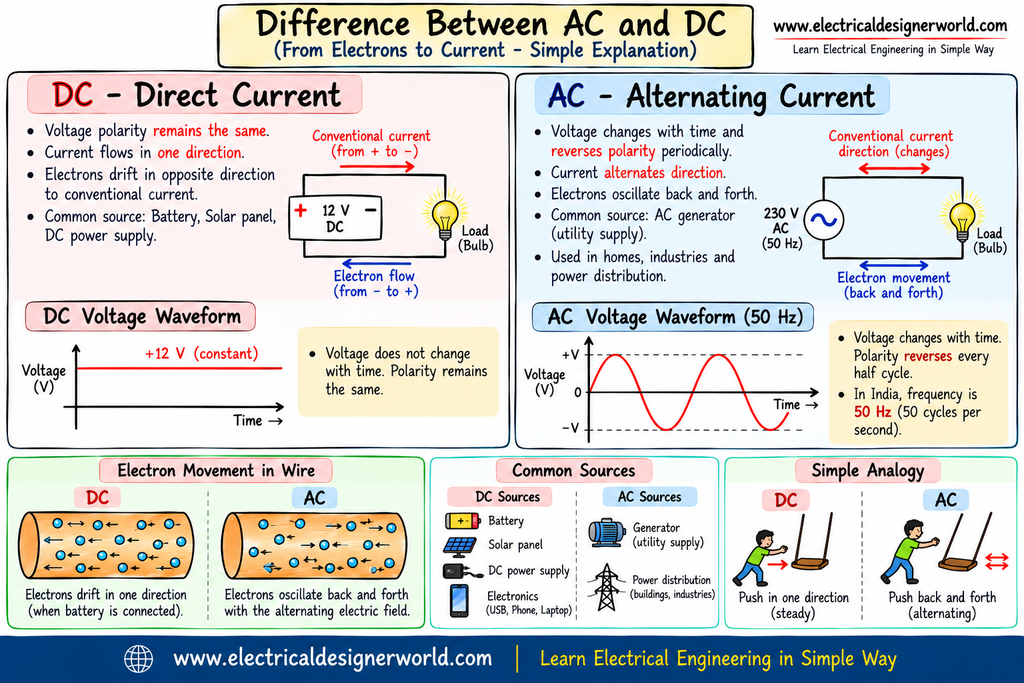
DC stands for Direct Current. In a DC electrical system, the voltage polarity normally remains in the same direction. For example, a battery has a positive terminal and a negative terminal. The positive terminal remains positive and the negative terminal remains negative.
If we connect a battery to a bulb using wires, the battery creates an electrical potential difference between its two terminals. This produces an electric field in the circuit, and the charge carriers in the wire respond to that electric field. In a simple DC circuit, the conventional current flows in one steady direction through the external circuit.
For example, a 12 V battery is a DC source. The voltage is approximately 12 V with a fixed polarity. This does not mean the electrons are created by the battery and sent all the way to the bulb. The copper wire already contains mobile electrons. The battery provides the electrical conditions that cause these electrons to have a net drift.
In a metal conductor, the direction of electron movement is opposite to the direction of conventional current. Electrical engineering normally uses conventional current direction, which is defined from positive toward negative through the external circuit.
Common examples of DC sources are batteries, solar panels, USB power supplies and DC power supplies. Many electronic circuits also operate using DC voltage.
Simple way to remember DC
Think of pushing something continuously in one direction:
→ → → → →
The direction stays the same. This is similar to the basic idea of DC.
What Is AC or Alternating Current?
AC stands for Alternating Current. Unlike DC, the voltage in an AC system changes with time and periodically reverses its polarity.
For example, an AC voltage can start at zero, increase in the positive direction, return to zero, become negative, return to zero again, and then repeat the same pattern.
The waveform can be represented simply as:
Positive → Zero → Negative → Zero → Positive
Because the voltage polarity reverses, the electric field also reverses direction. In a simple AC circuit, this causes the current direction to reverse periodically.
This is why it is called alternating current.
In an AC circuit, the electrons in the conductor do not simply travel continuously from the power station to your house. Instead, their drift motion responds to the changing electric field and reverses direction periodically.
A simple way to imagine this is:
→ ← → ← → ←
The electrons have an oscillating back-and-forth drift, while electrical energy is transferred through the electrical system to the load.
A Simple Way to Understand AC and DC
Imagine pushing a swing.
For DC, imagine pushing the swing repeatedly in the same direction:
→ → → →
The direction of the push remains the same.
For AC, imagine pushing the swing alternately in opposite directions:
→ ← → ←
The direction keeps changing.
This is not a perfect physical comparison, but it gives a simple mental picture of the difference between direct and alternating current.
What Is the Main Difference Between AC and DC?
The easiest way to remember the difference is this:
DC has a voltage polarity that remains in the same direction, so current in a simple circuit has a steady direction.
AC has a voltage that changes with time and periodically reverses polarity, so current in a simple circuit also reverses direction.
So:
DC → One direction
AC → Direction alternates
This is the basic difference between AC and DC.
What Does DC Voltage Look Like?
If we have a 12 V DC source, the voltage can be represented as a nearly constant value over time.
For example:
+12 V → +12 V → +12 V → +12 V
The voltage polarity does not continuously change from positive to negative.
This is why we describe it as direct current.
A battery is a common example. When you connect a battery to a suitable load, the battery maintains its polarity and the circuit operates using DC.
What Does AC Voltage Look Like?
AC voltage changes continuously with time.
A typical AC waveform looks approximately like a sine wave. It moves from positive voltage to zero, then to negative voltage, then back to zero and positive again.
In a simple representation:
Positive → Zero → Negative → Zero → Positive
This cycle keeps repeating.
In India, the standard AC power frequency used for the electrical grid is 50 Hz. This means the AC waveform completes 50 cycles every second.
Frequency is an important topic in electrical engineering because it affects generators, transformers, motors and many other AC systems.
Why Do We Use AC in Houses and Industries?
One major reason AC became widely used in power systems is that AC voltage can be easily changed from one voltage level to another using a transformer.
Electricity can be generated at a suitable voltage, stepped up to a much higher voltage for transmission, and then stepped down again at substations and distribution transformers.
A simplified electrical power system looks like this:
Generator → Step-Up Transformer → Transmission → Substation → Step-Down Transformer → Distribution → House or Factory
Using higher voltage for transmission allows the same amount of power to be transferred with lower current. Since conductor losses are related to the square of current, reducing current can significantly reduce resistive losses.
This is one of the important reasons high-voltage AC systems are used for electrical power transmission and distribution.
Why Do We Use DC If the Power Grid Uses AC?
Although electrical grids commonly distribute AC power, many modern electrical and electronic devices require DC.
For example, your phone battery stores energy in DC form. Electronic circuits inside many devices also operate using DC voltage.
When you plug a phone charger into a wall socket, the wall socket provides AC. The charger converts the incoming AC into a suitable DC output for the phone.
The basic process is:
AC Supply → Charger/Power Supply → DC → Electronic Circuit or Battery
The same basic principle is used in laptop chargers, battery chargers, control systems and many electronic devices.
Can AC Be Converted Into DC?
Yes. AC can be converted into DC using a process called rectification.
A simple power supply can be represented as:
AC → Rectifier → Filter → DC
Depending on the application, additional regulation and control circuits may be used.
You will find AC-to-DC conversion in phone chargers, laptop adapters, UPS systems, industrial control systems and many electronic devices.
Can DC Be Converted Into AC?
Yes. DC can also be converted into AC using an inverter.
For example, a battery provides DC power. An inverter can convert this DC into AC for suitable AC loads.
The basic process is:
Battery → DC → Inverter → AC → Load
This principle is widely used in UPS systems, solar power systems and battery energy-storage systems.
AC and DC in EPC Electrical Systems
If you are learning EPC electrical engineering, you will work with both AC and DC systems.
Most large industrial loads such as motors, pumps, compressors, HVAC equipment and many distribution systems use AC power.
For example:
AC Supply → Switchgear → Cable → Motor
On the other hand, batteries, control systems, electronic equipment and many protection systems may use DC power.
A typical UPS system may have both AC and DC sections:
AC → Rectifier → DC → Battery → Inverter → AC Load
Understanding where AC and DC are used will make electrical drawings, single-line diagrams and equipment connections easier to understand.
One Important Point About Electrons
There is a common misunderstanding that AC electricity means electrons travel from the power station all the way to your house.
That is not the best way to understand an AC circuit.
The conductors already contain mobile charge carriers. When an AC voltage is applied, the electric field changes direction periodically. The mobile electrons respond to this changing electric field, producing an alternating drift.
The electrical energy delivered to the load is not simply a matter of individual electrons traveling from the power station to the appliance. Energy is transferred through the electromagnetic system associated with the circuit.
This becomes more important when you study transformers, motors, generators and power transmission.
AC vs DC in One Simple Example
Imagine we have a battery connected to a bulb.
The battery provides DC voltage. The polarity remains the same, so the current in the simple circuit has a steady conventional direction.
Now imagine connecting the same type of bulb to an AC source. The AC voltage changes polarity periodically. The electric field changes direction, and the current through the simple resistive load also changes direction.
So the simplest comparison is:
Battery → DC → One direction
AC generator/grid → AC → Direction repeatedly changes
The Connection to Electrical Engineering
Understanding AC and DC is important because these concepts appear everywhere in electrical engineering.
A power plant generates electrical power. Transformers change voltage levels. Switchgear controls and protects the electrical system. Cables carry electrical power to different loads. Motors convert electrical energy into mechanical energy.
A simplified industrial electrical system may look like:
Generator → Transformer → Switchgear → Cable → Motor
Many electronic and control systems follow another path:
AC → Rectifier/Power Supply → DC → Control/Electronics
Solar systems may also involve both:
Solar Panel → DC → Inverter → AC → Electrical System
Once you understand the difference between AC and DC, these electrical systems become much easier to visualize.
The Easiest Way to Remember AC and DC
You don’t need to memorize a complicated definition.
Just remember the basic idea.
DC
Direct Current
The voltage polarity remains in the same direction, and current in a simple circuit has a steady direction.
DC: → → → → →
AC
Alternating Current
The voltage changes with time and periodically reverses polarity, causing current in a simple circuit to reverse direction.
AC: → ← → ← → ←
That’s the fundamental difference.
Conclusion
AC and DC are two fundamental forms of electrical current.
In DC, the voltage polarity remains in the same direction, so current in a simple circuit has a steady direction.
In AC, the voltage changes with time and periodically reverses polarity, causing the current in a simple circuit to reverse direction.
The easiest way to remember it is:
DC → Direct → One direction
AC → Alternating → Direction changes
Once you understand this basic concept, you are ready to learn the next important topic: frequency.
Frequency explains how quickly an AC waveform repeats and why electrical systems such as generators, transformers and motors are designed around specific frequencies.