
What Are the Different Types of Electrical Loads?
Table of Contents
What Are the Types of Electrical Loads?
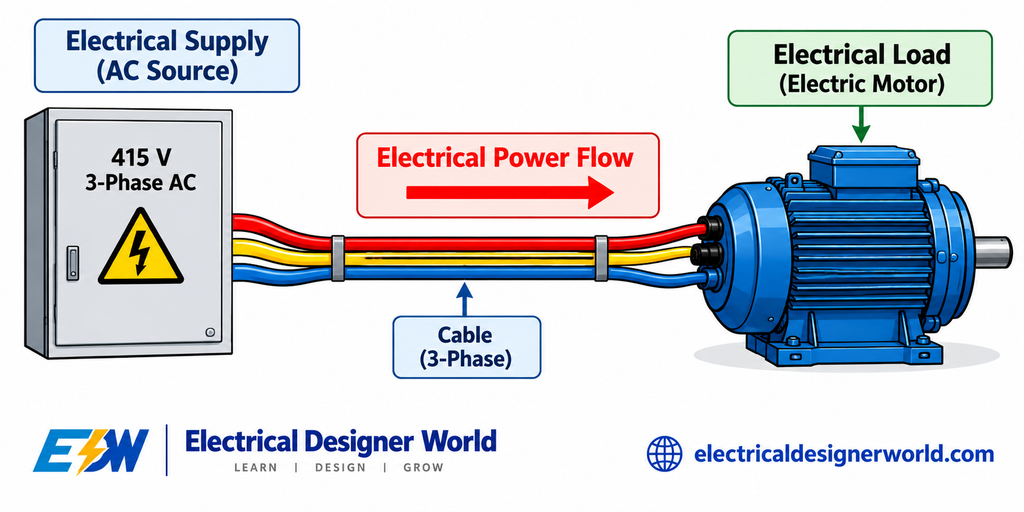
An electrical load is any equipment or device that uses electrical energy. When we connect a device to an electrical supply, it takes electrical power from the source. That device is called a load.
For example, a light uses electricity to produce light, a heater uses electricity to produce heat, and a motor uses electricity to produce rotation. All of these are electrical loads.
The three main types of electrical loads are resistive, inductive, and capacitive loads. Each type behaves differently when connected to an AC power supply. Understanding the types of electrical loads helps electrical engineering students and professionals learn about current flow, voltage, power consumption, and power factor in electrical systems.
Simple example:
Power supply → Cable → Electrical load
Different electrical equipment uses electricity in different ways. Because of this, electrical loads can be classified into different types.
The three basic types of electrical loads are:
- Resistive load
- Inductive load
- Capacitive load
Let’s understand each one in very simple terms.
What Is a Resistive Load? Examples and Working Principle
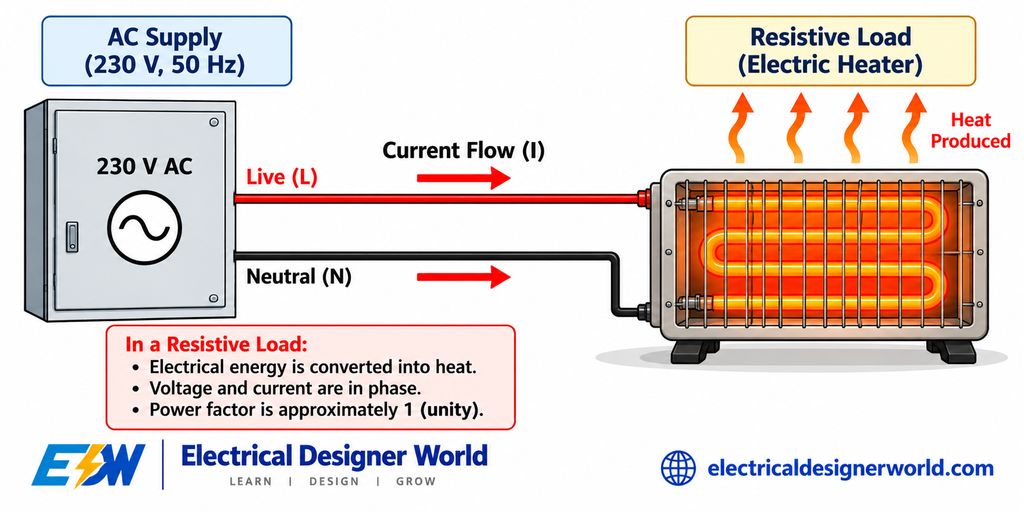
A resistive load is an electrical load where resistance is the main property. When electrical current flows through the resistance, electrical energy is mainly converted into heat.
A simple example is an electric heater. When you switch on the heater, current flows through the heating element. The resistance of the element causes it to become hot, and that heat is used for heating.
Other examples include an electric iron, toaster, electric oven and some types of lamps.
In a simple resistive load, the voltage and current are in phase. In very simple words, the voltage and current rise and fall together.
For an ideal resistive load, the power factor is approximately 1. We will understand why this happens when we discuss power factor later.
What Is an Inductive Load? Examples and Working Principle
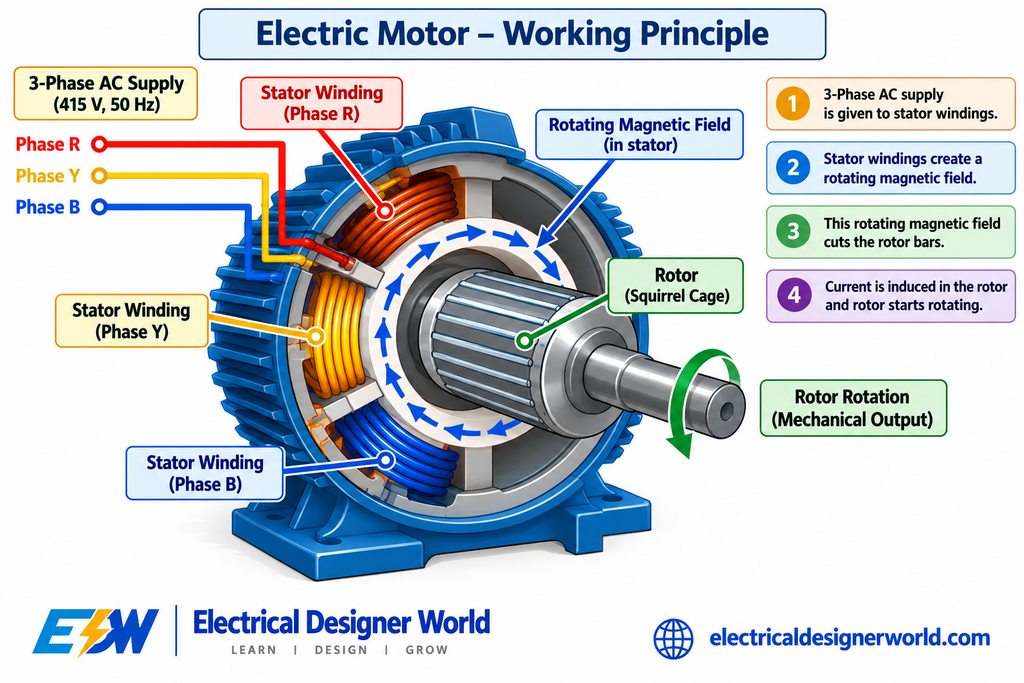
An inductive load is an electrical load that uses a magnetic field as part of its operation. Motors and transformers are common examples of inductive loads.
For example, an electric motor needs a magnetic field to rotate. When current flows through the motor windings, a magnetic field is produced. This magnetic field interacts with other magnetic fields in the motor and produces rotation.
This is why motors are considered inductive loads.
Other common inductive loads include transformers, pumps, fans, compressors, contactors and relays.
One important characteristic of an inductive load is that current lags voltage.
You don’t need to understand the mathematics immediately. Just remember:
Inductive load → Current lags voltage.
Because inductive loads require a magnetic field, they are associated with reactive power, which is measured in kVAR.
This is why motors, transformers and power factor are closely connected.
What Is a Capacitive Load?
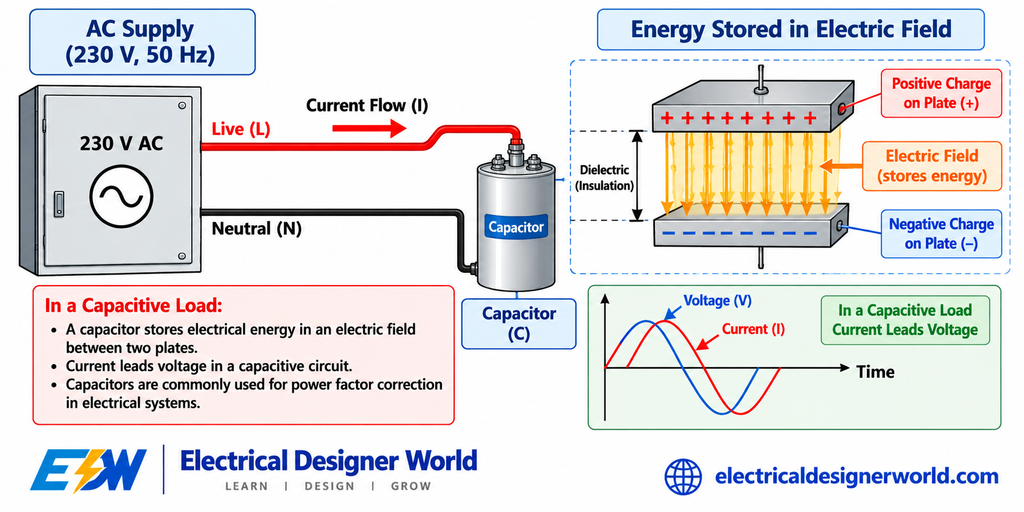
A capacitive load is an electrical load that has capacitance as its main characteristic. A capacitor can store electrical energy in an electric field.
A simple example is a capacitor bank used in an electrical system.
Capacitors are commonly used for power factor correction in industrial electrical systems.
In a capacitive circuit, current leads voltage.
This is the opposite of an inductive load.
So there is a very easy rule to remember:
Inductive → Current lags voltage
Capacitive → Current leads voltage
Comparison of Resistive, Inductive and Capacitive Loads
Now we can compare the three types in a simple way.
A resistive load mainly converts electrical energy into heat or another useful form of energy. A heater is a good example.
An inductive load uses a magnetic field as part of its operation. A motor or transformer is a good example.
A capacitive load stores energy in an electric field. A capacitor bank is a common example.
The easiest way to remember them is:
| Load | Example | Simple rule |
|---|---|---|
| Resistive | Heater | Voltage and current are in phase |
| Inductive | Motor | Current lags voltage |
| Capacitive | Capacitor | Current leads voltage |
Why Is a Motor an Inductive Load?
Let’s take a motor as an example because motors are very common in industrial and EPC projects.
Inside a motor, electrical windings are used to create magnetic fields. These magnetic fields are necessary to produce the rotating magnetic field and ultimately the mechanical rotation of the motor.
Because the motor windings have inductive characteristics, the motor draws both real power and reactive power from the electrical system.
This is one reason why motors have a power factor less than 1 under normal operating conditions.
We will connect this idea to kW, kVAR, kVA and power factor in the next article.
Why Is a Heater a Resistive Load?
An electric heater is much easier to understand.
Inside the heater is a resistance element. When current passes through this element, electrical energy is converted mainly into heat.
There is no need for a rotating magnetic field like in a motor.
For an ideal resistive load, voltage and current are in phase and the power factor is approximately 1.
Why Are Capacitors Used in Electrical Systems?
Now let’s look at the capacitor.
Many industrial loads, especially motors and transformers, have inductive characteristics. These loads require reactive power.
A capacitor can provide reactive power locally, which can help improve the overall power factor of an electrical system.
This is why you may see a capacitor bank installed in an electrical room or substation.
You don’t need to understand the complete power-factor-correction calculation yet. First remember the basic idea:
Inductive load → lagging power factor
Capacitor → helps compensate reactive power
Electrical Loads in an EPC Project
In an EPC project, you will normally find many different types of electrical loads.
For example, a plant may have motors driving pumps, compressors and fans. It may also have heaters, lighting systems, transformers, UPS systems and capacitor banks.
When engineers prepare the electrical load list, they need to understand what type of equipment is connected to the electrical system.
Understanding the type of load helps engineers determine important electrical parameters such as load current, kW, kVA, kVAR and power factor.
These values are then used in further electrical design activities such as transformer sizing, generator sizing, breaker selection and cable sizing.
The Easy Way to Remember
You don’t need to memorize complicated definitions.
Just remember these three examples:
🔥 Heater → Resistive Load
Electrical energy is mainly converted into heat.
⚙️ Motor → Inductive Load
The motor uses magnetic fields to produce rotation.
⚡ Capacitor → Capacitive Load
The capacitor stores energy in an electric field and can help compensate reactive power.
How This Connects to kW, kVAR, kVA and Power Factor
Now we are ready for the next important topic.
Different loads behave differently, so the electrical power associated with them can be described using real power, reactive power and apparent power.
This gives us four important terms:
kW → Real Power
kVAR → Reactive Power
kVA → Apparent Power
Power Factor → Relationship between kW and kVA
For example, a motor consumes real power to produce mechanical output, while its inductive characteristics also involve reactive power.
Understanding resistive, inductive and capacitive loads first makes this next topic much easier.
Conclusion
An electrical load is equipment that uses electrical energy. The three basic types of electrical loads are resistive, inductive and capacitive.
A heater is a simple example of a resistive load. A motor and transformer are common inductive loads, while a capacitor bank is an example of a capacitive load.
The easiest rule to remember is:
Resistive → Voltage and current are in phase
Inductive → Current lags voltage
Capacitive → Current leads voltage
Once you understand these three load types, you have a good foundation for understanding kW, kVAR, kVA and power factor.