
How an Alternator Generates Three-Phase AC Voltage
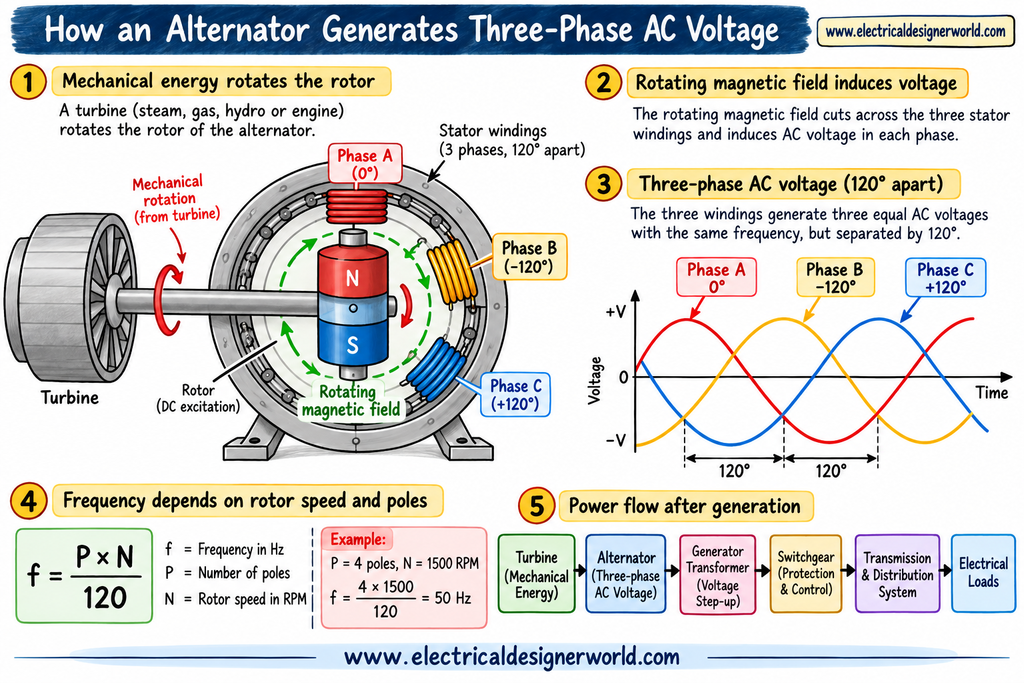
An alternator generates electrical voltage by converting mechanical energy into electrical energy. In a power plant, a turbine rotates the alternator, and the rotating magnetic field inside the alternator induces voltage in the stator windings. Unlike a single-phase alternator, a three-phase alternator has three separate stator windings positioned 120° apart electrically. This arrangement allows the alternator to generate three AC voltages that are equal in magnitude and frequency but separated from each other by 120°.
How Does an Alternator Generate Voltage?
The basic principle behind an alternator is electromagnetic induction. When a magnetic field moves relative to a conductor, it induces an electrical voltage in that conductor.
Inside an alternator, the rotor produces a rotating magnetic field, while the stator contains the stationary windings. When the rotor is rotated by a mechanical source such as a steam turbine, gas turbine, hydro turbine, or engine, its magnetic field continuously moves across the stator conductors.
This changing magnetic field induces an AC voltage in the stator windings.
Simple idea:
Mechanical energy → Rotor rotation → Rotating magnetic field → Induced voltage → Three-phase AC output
How Are Three Phases Produced?
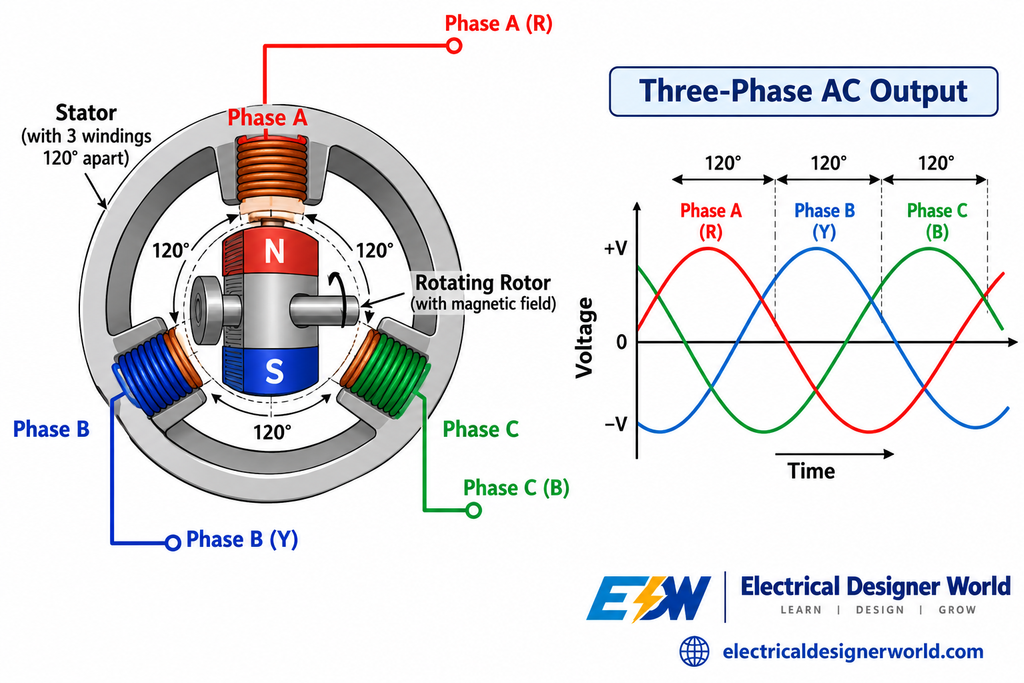
A three-phase alternator contains three stator windings, commonly called Phase A, Phase B, and Phase C.
These windings are physically arranged 120° apart from each other. As the rotor magnetic field rotates, it passes the three windings one after another. Therefore, the voltage reaches its maximum value in each phase at different times.
Because the windings are separated by 120°, the three generated voltages are also separated by 120° electrical degrees.
Three-phase alternator generation diagram
Why Are the Three Voltages 120° Apart?
Imagine three people standing equally around a circle. The angular distance between each person is 120°.
The three stator windings are arranged in a similar way. When the magnetic field rotates, it interacts with each winding at a different position. As a result, the voltage produced in each winding reaches its positive and negative peaks at different times.
The three-phase voltages can be represented as:
Phase A: 0°
Phase B: -120°
Phase C: +120°
This 120° phase displacement is what makes the system a three-phase AC electrical system.
What Does the AC Voltage Look Like?
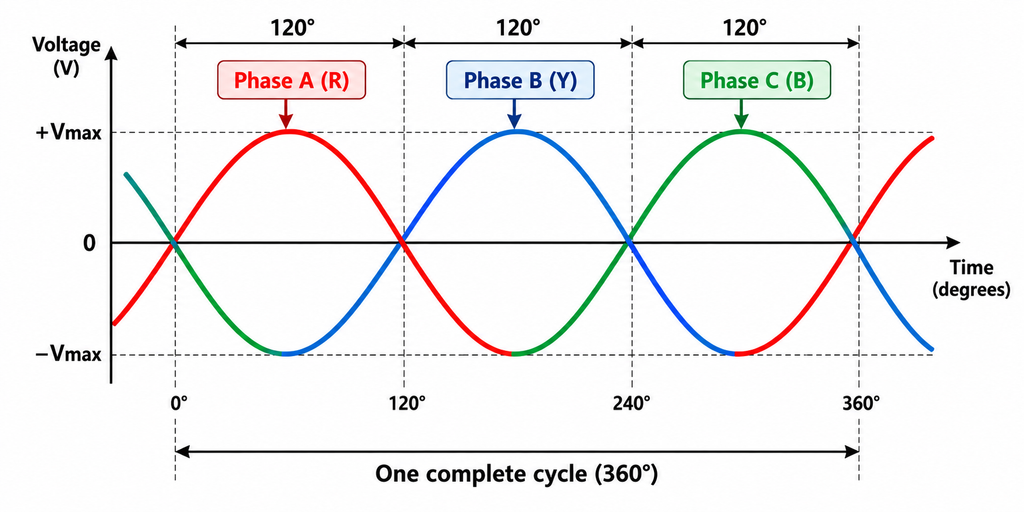
The voltage generated by each stator winding follows an approximately sine-wave shape.
When Phase A reaches its positive maximum, Phases B and C are at different points on their sine waves. As the rotor continues rotating, the voltage continuously changes from positive to negative and back again.
Therefore, the three phases produce three sine waves with the same frequency and approximately the same voltage magnitude, but each waveform is shifted by 120°.
How Does Rotor Speed Affect Frequency?
The frequency of the AC voltage depends on the speed of the rotor and the number of magnetic poles in the alternator.
The relationship is:
Where:
- f = frequency in hertz (Hz)
- P = number of magnetic poles
- N = rotor speed in revolutions per minute (RPM)
For example, a four-pole alternator operating at 1500 RPM produces:
f = (4 × 1500) / 120
f = 50 Hz
This is why alternator speed and pole configuration are important when designing and operating an AC power-generation system.
What Happens to the Generated Power?
The three-phase voltage generated in the stator windings is supplied to the alternator terminals. From there, the electrical power can pass through busbars, switchgear, transformers, cables, and other electrical equipment before reaching the final loads.
A simplified power-generation path is:
Turbine → Alternator → Generator Transformer → Switchgear → Transmission System → Distribution System → Electrical Loads
In an EPC electrical system, understanding this generation process is useful because the generated voltage eventually becomes the starting point for several downstream electrical design activities such as transformer sizing, switchgear selection, cable sizing, cable schedule preparation, and cable tray routing.
Simple Summary
An alternator generates three-phase AC voltage using electromagnetic induction. Mechanical energy rotates the rotor, creating a rotating magnetic field. This magnetic field cuts across the three stator windings and induces AC voltage in them.
Because the three stator windings are positioned 120° apart, the alternator produces three AC voltages that are also 120° apart in phase.
In simple terms:
Mechanical energy → Rotor rotates → Magnetic field rotates → Voltage is induced → Three-phase AC is generated
This simple principle is the foundation of electrical power generation used in many power plants and industrial electrical systems.