
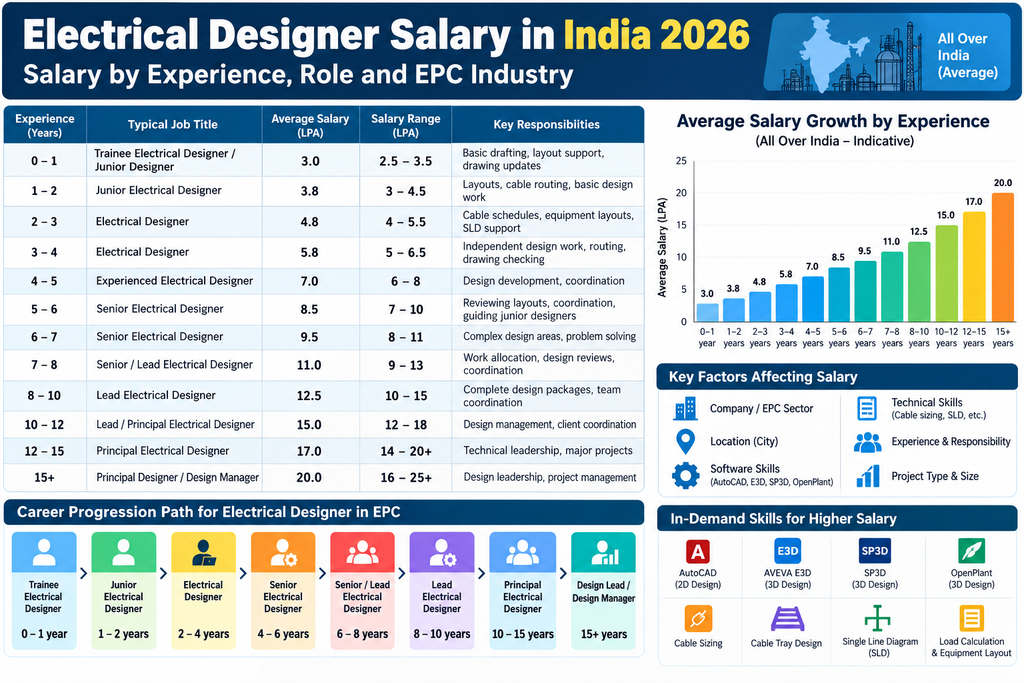
Electrical Designer Salary in India 2026 – Salary by Experience, Role and EPC Industry
If you are planning a career as an Electrical Designer in India, one of the most common questions is: How much does an Electrical Designer earn in India?
The salary of an Electrical Designer depends on several factors, including years of experience, EPC industry, location, company, technical skills, software knowledge and job responsibilities.
In general, a fresher or trainee Electrical Designer may start around ₹2.5–3.5 LPA, while experienced Senior, Lead and Principal Electrical Designers can earn significantly more.
This article provides an indicative overview of Electrical Designer salaries in India in 2026, with a focus on the EPC industry.
Important: The salary figures in this article are indicative market ranges, not guaranteed salaries. Actual compensation can vary considerably between companies, cities, projects and individuals.
Electrical Designer Salary in India
An Electrical Designer working in the EPC industry may be involved in activities such as:
- Electrical Single Line Diagram (SLD)
- Load schedules
- Electrical equipment layout
- Cable schedules
- Cable tray layout
- Cable routing
- Cable sizing
- Cable tray sizing
- Lighting layouts
- Earthing layouts
- Electrical equipment arrangement
- Motor and feeder documentation
- Electrical design calculations
- 2D CAD drafting
- 3D electrical modelling
As experience increases, an Electrical Designer normally takes responsibility for more complex engineering deliverables, coordination and design checking.
Electrical Designer Salary by Experience in India
The following table provides an indicative salary range for Electrical Designers working in India, particularly in the EPC and engineering design sector.
| Experience | Typical Job Title | Approx. Salary Range |
|---|---|---|
| 0–1 year | Trainee Electrical Designer / Junior Designer | ₹2.5–3.5 LPA |
| 1–2 years | Junior Electrical Designer | ₹3–4.5 LPA |
| 2–3 years | Electrical Designer | ₹4–5.5 LPA |
| 3–4 years | Electrical Designer | ₹5–6.5 LPA |
| 4–5 years | Experienced Electrical Designer | ₹6–8 LPA |
| 5–6 years | Senior Electrical Designer | ₹7–10 LPA |
| 6–7 years | Senior Electrical Designer | ₹8–11 LPA |
| 7–8 years | Senior / Lead Electrical Designer | ₹9–13 LPA |
| 8–10 years | Lead Electrical Designer | ₹10–15 LPA |
| 10–12 years | Lead / Principal Electrical Designer | ₹12–18 LPA |
| 12–15 years | Principal / Lead Designer | ₹14–20+ LPA |
| 15+ years | Principal Designer / Design Manager | ₹16–25+ LPA |
These ranges should be considered indicative because there is no single fixed salary for an Electrical Designer at a particular experience level.
0–1 Year Electrical Designer Salary
Typical designation:
Trainee Electrical Designer / Junior Electrical Designer
Approximate salary:
₹2.5–3.5 LPA
Freshers normally begin by learning basic electrical design concepts and company-specific engineering procedures.
Typical responsibilities may include:
- AutoCAD drafting
- Updating electrical drawings
- Preparing basic layouts
- Cable tagging
- Drawing revisions
- Equipment tagging
- Basic SLD understanding
- Preparing drawing registers
- Supporting senior designers
At this stage, learning the fundamentals is more important than focusing only on salary.
A strong understanding of voltage, current, power, power factor, three-phase systems, transformers, breakers, cables and electrical drawings can provide a strong foundation.
1–2 Years Electrical Designer Salary
Typical designation:
Junior Electrical Designer
Approximate salary:
₹3–4.5 LPA
After one year of experience, designers generally start working more independently.
Common responsibilities include:
- Electrical layouts
- Cable routing
- Cable schedules
- Equipment layouts
- Lighting layouts
- Earthing layouts
- Cable tray layouts
- Drawing modifications
- Basic design coordination
At this stage, learning AutoCAD and electrical design standards can be particularly useful.
2–3 Years Electrical Designer Salary
Typical designation:
Electrical Designer
Approximate salary:
₹4–5.5 LPA
At around 2–3 years of experience, an Electrical Designer may begin handling complete portions of electrical design work.
Typical work can include:
- Cable schedule preparation
- Cable tray routing
- Electrical equipment layouts
- Cable sizing support
- Load list coordination
- SLD interpretation
- Electrical material take-off
- Design document preparation
Designers who understand how different engineering documents are connected can become more valuable to EPC projects.
For example:
Load List → Equipment → SLD → Cable Schedule → Cable Routing → Cable Tray Layout
Understanding this workflow is an important part of becoming an effective EPC Electrical Designer.
3–4 Years Electrical Designer Salary
Typical designation:
Electrical Designer
Approximate salary:
₹5–6.5 LPA
At this level, designers may be expected to work independently on assigned areas of a project.
They may handle:
- Cable tray layouts
- Cable routing
- Electrical equipment layouts
- Lighting layouts
- Earthing layouts
- Cable schedules
- Drawing checking
- Engineering coordination
Knowledge of 3D design software can also become valuable.
Popular software used in different EPC environments may include:
- AutoCAD
- AVEVA E3D
- PDMS
- SP3D
- Bentley OpenPlant
The exact software requirement depends on the company and project.
4–5 Years Electrical Designer Salary
Typical designation:
Experienced Electrical Designer
Approximate salary:
₹6–8 LPA
At 4–5 years of experience, an Electrical Designer may begin taking ownership of larger design packages.
Responsibilities can include:
- Electrical design development
- Cable tray routing
- Cable schedule review
- Equipment layout
- Design coordination
- Drawing checking
- Interdisciplinary coordination
- Supporting engineering calculations
- Reviewing junior designers’ work
At this stage, simply knowing drafting software may not be enough.
Understanding why the design is being created in a particular way becomes increasingly important.
5–6 Years Electrical Designer Salary
Typical designation:
Senior Electrical Designer
Approximate salary:
₹7–10 LPA
A Senior Electrical Designer may be responsible for coordinating several design deliverables.
Typical responsibilities may include:
- Reviewing electrical layouts
- Cable routing
- Tray routing
- Equipment arrangement
- Design checking
- Coordination with piping and mechanical teams
- Supporting engineering teams
- Guiding junior designers
- Resolving design issues
Knowledge of E3D, SP3D or OpenPlant can be valuable for projects that use 3D plant design systems.
6–7 Years Electrical Designer Salary
Typical designation:
Senior Electrical Designer
Approximate salary:
₹8–11 LPA
At this level, designers may have significant project experience and may be expected to solve design problems rather than simply create drawings.
They may coordinate:
- Electrical equipment
- Cable trays
- Cable routes
- Electrical rooms
- Substations
- Switchgear
- Motors
- Transformers
- Interdisciplinary interfaces
Strong knowledge of EPC workflows becomes increasingly important.
7–8 Years Electrical Designer Salary
Typical designation:
Senior / Lead Electrical Designer
Approximate salary:
₹9–13 LPA
At 7–8 years, some designers move into lead responsibilities.
A Lead Electrical Designer may:
- Allocate work to designers
- Review drawings
- Coordinate design activities
- Check 3D models
- Coordinate with engineering disciplines
- Attend design review meetings
- Resolve technical design issues
- Support project execution
Leadership and communication skills become increasingly important at this stage.
8–10 Years Electrical Designer Salary
Typical designation:
Lead Electrical Designer
Approximate salary:
₹10–15 LPA
A Lead Electrical Designer may have responsibility for an entire electrical design package or a major portion of a project.
Typical responsibilities include:
- Design planning
- Design checking
- Team coordination
- Model reviews
- Client comments
- Engineering coordination
- Construction support
- Design deliverable management
At this stage, technical knowledge combined with project coordination skills can be valuable.
10–12 Years Electrical Designer Salary
Typical designation:
Lead / Principal Electrical Designer
Approximate salary:
₹12–18 LPA
With more than ten years of experience, professionals may move toward senior technical or leadership positions.
Responsibilities can include:
- Managing design teams
- Reviewing engineering deliverables
- Client coordination
- Design planning
- Technical problem solving
- Design quality control
- Supporting project management
- Mentoring junior designers
Some professionals may also transition toward Design Lead, Engineering Lead or Design Manager positions.
12–15 Years Electrical Designer Salary
Typical designation:
Principal Electrical Designer / Design Lead
Approximate salary:
₹14–20+ LPA
At this level, the role can become more focused on technical leadership and project coordination.
A Principal Electrical Designer may be responsible for:
- Major EPC projects
- Design standards
- Engineering coordination
- Design reviews
- Client interaction
- Team management
- Technical decisions
- Design quality
Salary can vary significantly depending on company, project type, location and leadership responsibilities.
15+ Years Electrical Designer Salary
Typical designation:
Principal Designer / Design Manager / Engineering Design Lead
Approximate salary:
₹16–25+ LPA
Professionals with more than 15 years of experience may move into senior technical and management positions.
Possible roles include:
- Principal Electrical Designer
- Lead Electrical Designer
- Electrical Design Manager
- Engineering Design Manager
- Electrical Engineering Lead
- Project Design Lead
At this stage, salary is influenced heavily by the person’s responsibilities, leadership role, company, project size and technical specialization.
What Skills Can Increase an Electrical Designer’s Salary?
Experience alone does not determine salary.
The skills you develop during your career can also influence the types of positions available to you.
1. AutoCAD
AutoCAD is widely used for 2D electrical drawings and layouts.
An Electrical Designer should be comfortable with:
- Layers
- Blocks
- Xrefs
- Dimensioning
- Drawing standards
- Templates
- Plotting
- Electrical layouts
2. AVEVA E3D
AVEVA E3D is used in many plant design environments for 3D modelling.
Electrical designers may work with:
- Cable trays
- Electrical equipment
- Cable routing
- Electrical rooms
- Equipment modelling
- Supports
- 3D coordination
3. SP3D
SP3D is another plant design platform used for 3D engineering and design coordination.
Experience with 3D plant design software can open opportunities in projects where 3D modelling is an important part of the workflow.
4. Bentley OpenPlant
Bentley OpenPlant is used for plant design and engineering workflows.
Electrical designers may work with equipment, cable trays and other electrical components depending on project requirements.
5. Cable Sizing
Understanding cable sizing is an important electrical design skill.
A designer should understand factors such as:
- Load current
- Voltage
- Power factor
- Cable installation method
- Ambient temperature
- Grouping
- Voltage drop
- Short-circuit considerations
6. Cable Tray Design
Cable tray design is an important part of EPC electrical design.
A designer should understand:
Cable Schedule → Cable Routing → Tray Selection → Tray Filling → Tray Layout → Supports
Understanding this complete process is more valuable than simply knowing how to draw a tray.
7. Single Line Diagram
A good Electrical Designer should be able to read an Electrical Single Line Diagram (SLD).
An SLD provides important information about:
- Incoming power
- Transformers
- Switchgear
- MCCs
- Distribution boards
- Feeders
- Motors
- Loads
- Protection devices
Understanding the SLD helps the designer understand how the electrical system connects together.
Electrical Designer Career Path in EPC
A typical career progression may look like:
Trainee Electrical Designer
↓
Junior Electrical Designer
↓
Electrical Designer
↓
Senior Electrical Designer
↓
Lead Electrical Designer
↓
Principal Electrical Designer
↓
Design Lead / Design Manager
The exact progression is different from company to company.
Some professionals remain highly technical and become specialists, while others move into project coordination and management.
Electrical Designer Salary Depends on Location
Salary can also vary between Indian cities.
Major EPC and engineering employment hubs include:
- Chennai
- Bengaluru
- Hyderabad
- Mumbai
- Pune
- Ahmedabad
- Gurugram
- Noida
- Delhi/NCR
The cost of living, concentration of EPC companies, project type and demand for particular skills can all affect compensation.
Therefore, an Electrical Designer with the same experience may receive different salary offers in different cities.
Electrical Designer vs Electrical Design Engineer
These job titles can sometimes overlap, but they should not automatically be treated as identical.
An Electrical Designer may focus more heavily on:
- Drawings
- Layouts
- Cable routing
- Cable trays
- 3D modelling
- Design documentation
An Electrical Design Engineer may have greater responsibility for:
- Electrical calculations
- Equipment sizing
- Load calculations
- Protection
- Specifications
- Engineering documents
- Design decisions
However, the responsibilities vary from company to company.
Always compare the actual job description, rather than relying only on the job title.
How to Increase Your Salary as an Electrical Designer
If you want to progress faster in an EPC electrical design career, focus on developing a combination of electrical engineering knowledge, design skills and software skills.
A useful learning path is:
Step 1 – Electrical Fundamentals
Learn:
- Voltage
- Current
- Resistance
- Power
- kW
- kVA
- kVAR
- Power factor
- AC and DC
- Three-phase systems
- Transformers
- Motors
Step 2 – Electrical Engineering
Learn:
- Load estimation
- Transformer sizing
- Breaker selection
- Cable sizing
- Voltage drop
- Short-circuit concepts
- Earthing
- Lighting
- Protection
Step 3 – EPC Design
Learn:
- SLD
- Load list
- Equipment layout
- Cable schedule
- Cable routing
- Cable tray design
- Cable tray filling
- Electrical room layout
- Earthing layout
Step 4 – Design Software
Develop skills in:
- AutoCAD
- AVEVA E3D
- SP3D
- Bentley OpenPlant
Step 5 – Project Coordination
Finally, learn how electrical design interacts with:
- Piping
- Mechanical
- Civil
- Structural
- Instrumentation
- Process
This combination can help an Electrical Designer progress from simply producing drawings to taking ownership of complete design packages.
Frequently Asked Questions
What is the average salary of an Electrical Designer in India?
There is no single salary applicable to every Electrical Designer. Indicative salaries can range from around ₹2.5–3.5 LPA for entry-level roles to ₹16–25+ LPA for highly experienced Principal, Lead or Design Manager roles, depending on experience, company, location and responsibilities.
What is the salary of an Electrical Designer with 5 years of experience?
An Electrical Designer with around five years of experience may typically fall within an indicative range of ₹6–8 LPA, although actual offers can be higher or lower.
What is the salary of an Electrical Designer with 10 years of experience?
A Lead or Principal Electrical Designer with around ten years of experience may fall within an indicative range of ₹12–18 LPA, depending on the position and company.
Can an Electrical Designer earn more than ₹20 LPA?
Yes. Experienced professionals in Principal, Lead, Design Manager or senior technical positions can earn ₹20 LPA or more, although this is not applicable to every professional with the same number of years of experience.
Which software is useful for an EPC Electrical Designer?
Commonly useful software includes AutoCAD, AVEVA E3D, PDMS, SP3D and Bentley OpenPlant, depending on the company and project.
Is Electrical Designer a good career in EPC?
EPC electrical design offers a career path from junior design roles to senior designer, lead, principal and design-management positions. Career progression depends on technical knowledge, project experience, software skills, communication and the responsibilities handled.
Conclusion
The salary of an Electrical Designer in India depends on much more than years of experience.
A fresher may begin with basic drafting and design work, while an experienced professional can progress toward Senior Electrical Designer, Lead Electrical Designer, Principal Designer or Design Manager positions.
The most valuable combination is often:
Electrical Engineering Knowledge + EPC Design Knowledge + Software Skills + Project Experience
If you are currently working as an Electrical Designer, don’t focus only on completing drawings. Try to understand the complete engineering workflow:
Load List → SLD → Equipment → Cable Sizing → Cable Schedule → Cable Routing → Cable Tray Design → 3D Model → Construction
The deeper your understanding of this workflow, the more responsibility you can potentially take on as your career progresses.
Electrical Designer World will continue to cover electrical engineering fundamentals, EPC electrical design, cable sizing, cable tray design, SLDs, E3D and other practical skills for electrical designers.