
Electrical Generation, Transmission and Distribution – Complete Guide
Table of Contents
Introduction
Have you ever wondered how electricity reaches your home from a power station?
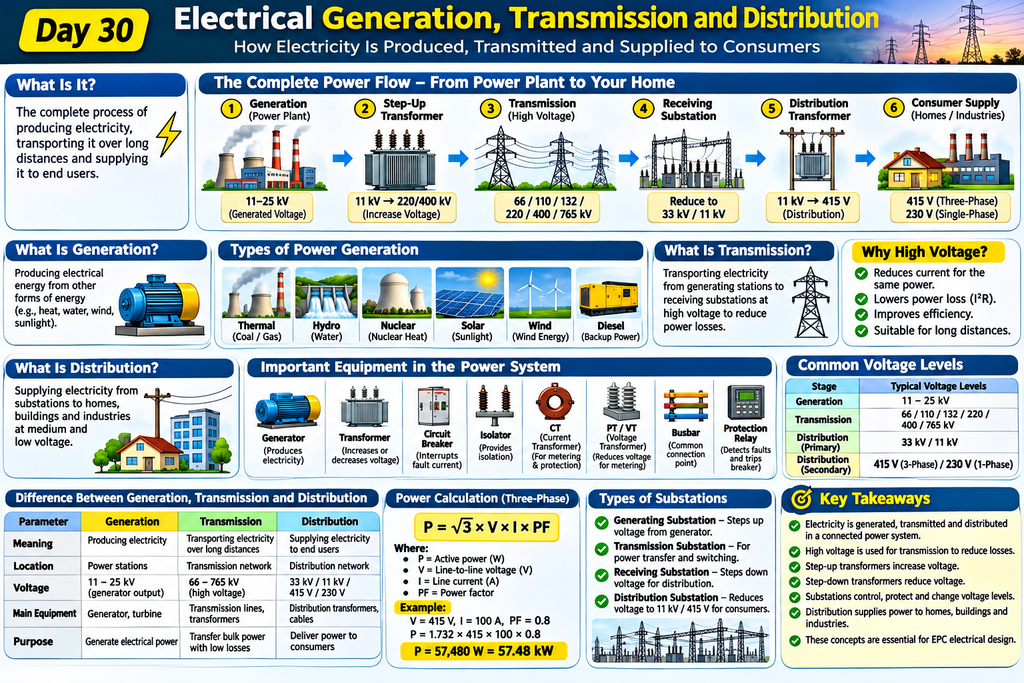
Electricity travels through a complete network called the electrical power system. This system consists of three main stages:
- Electrical Generation
- Electrical Transmission
- Electrical Distribution
In simple words:
- Generation: Electricity is produced at power stations.
- Transmission: Electricity is transported over long distances at high voltage.
- Distribution: Electricity is supplied to homes, buildings and industries.
These three stages work together to provide a continuous and reliable electricity supply.
Understanding this process is important for electrical engineers, especially those working in power plants, substations, industries and EPC projects.
1. What Is Electrical Generation?
Electrical generation is the process of producing electrical energy from other forms of energy.
Power stations use different energy sources to generate electricity.
The most common energy sources include:
1. Thermal Power Plants
Thermal power plants use fuels such as coal or natural gas to produce heat.
The heat is used to generate steam, which rotates a turbine connected to an electrical generator.
2. Hydroelectric Power Plants
Hydroelectric power plants use flowing or falling water to rotate turbines connected to generators.
3. Nuclear Power Plants
Nuclear power plants use heat produced by nuclear reactions to generate steam and rotate turbines.
4. Solar Power Plants
Solar photovoltaic panels convert sunlight directly into electrical energy.
5. Wind Power Plants
Wind turbines convert wind energy into mechanical energy, which is then converted into electrical energy by a generator.
6. Diesel Power Plants
Diesel engines drive generators to produce electrical power. They are commonly used for backup and specific power generation applications.
2. How Is Electricity Generated?
In a conventional power plant, an electrical generator converts mechanical energy into electrical energy through electromagnetic induction.
Let’s understand the process using a thermal power plant.
- Fuel is burned to produce heat.
- Heat converts water into high-pressure steam.
- Steam rotates a turbine.
- The turbine drives an electrical generator.
- The generator produces electrical power.
- The generated electricity is supplied to a transformer.
Example:
A generator in a power station may produce electricity at approximately 11 kV to 25 kV, depending on the generator design.
A step-up transformer increases this voltage for long-distance transmission.
3. What Is Electrical Transmission?
Electrical transmission is the process of transporting electricity from generating stations to receiving substations over long distances.
Electricity is transmitted at high voltage to reduce current and minimize power losses.
Common transmission voltage levels in India include:
- 66 kV
- 110 kV
- 132 kV
- 220 kV
- 400 kV
- 765 kV
The voltage level depends on the power requirement and transmission network design.
Why Is High Voltage Used for Transmission?
Power loss in a conductor depends on the current flowing through it.
The basic power loss formula is:
Power Loss = I² × R
Where:
- I = Current in amperes.
- R = Resistance of the conductor in ohms.
For the same transmitted power, increasing the voltage reduces the current.
Lower current means lower power losses in transmission conductors.
Example:
Suppose a power station needs to transmit a large amount of electrical power over a long distance.
If the voltage is increased using a step-up transformer, the current decreases for the same power transfer.
This reduces transmission losses and improves efficiency.
4. What Is a Step-Up Transformer?
A step-up transformer increases the voltage from a lower level to a higher level.
It is generally installed near the generating station before electricity enters the transmission network.
Example:
Suppose a generator produces electricity at 11 kV.
A step-up transformer increases the voltage to 220 kV for transmission.
This reduces current and helps minimize transmission losses.
5. What Is Electrical Distribution?
Electrical distribution is the final stage of the power system.
It receives electricity from transmission substations and supplies it to consumers such as:
- Residential buildings.
- Commercial buildings.
- Industries.
- Hospitals.
- Shopping malls.
- Offices.
- Educational institutions.
Distribution systems reduce the voltage to levels suitable for different consumers.
Common distribution voltage levels include:
- 33 kV.
- 11 kV.
- 415 V (three-phase).
- 230 V (single-phase).
The actual voltage levels depend on the distribution network and local standards.
6. What Is a Step-Down Transformer?
A step-down transformer reduces voltage from a higher level to a lower level.
It is used in receiving substations and distribution substations.
Example:
Electricity may arrive at a distribution substation at 33 kV or 11 kV.
A distribution transformer reduces the voltage from 11 kV to 415 V for a typical low-voltage distribution system.
From this supply:
- Three-phase consumers may receive 415 V.
- Single-phase consumers may receive approximately 230 V.
This makes electricity suitable for homes, shops and many small commercial installations.
7. How Does Electricity Reach Your Home?
Let’s understand the complete process step by step.
Step 1: Power Generation
Electricity is produced at a power station using thermal, hydro, solar, wind or other energy sources.
Step 2: Voltage Step-Up
A step-up transformer increases the generated voltage to a suitable transmission voltage.
Step 3: Power Transmission
Electricity travels through high-voltage transmission lines over long distances.
Step 4: Receiving Substation
A receiving substation receives electricity and reduces the voltage to a suitable sub-transmission or distribution level.
Step 5: Distribution Substation
The voltage is further reduced, commonly to 11 kV for primary distribution.
Step 6: Distribution Transformer
A distribution transformer reduces 11 kV to 415 V in a typical low-voltage distribution system.
Step 7: Consumer Supply
Electricity is supplied to homes, commercial buildings and other consumers through distribution lines.
8. Important Equipment Used in Generation, Transmission and Distribution
Several electrical equipment items are used throughout the power system.
1. Generator
Converts mechanical energy into electrical energy.
2. Power Transformer
Increases or decreases voltage levels.
3. Circuit Breaker
Interrupts electrical current during faults and switching operations.
4. Isolator
Provides an isolation point for electrical equipment. It is operated under the conditions specified by its design and switching procedure.
5. Current Transformer (CT)
Reduces high current to a suitable value for metering and protection.
6. Potential Transformer (PT) / Voltage Transformer (VT)
Reduces high voltage to a suitable value for metering and protection.
7. Busbar
Provides a common electrical connection point for multiple incoming and outgoing circuits.
8. Protection Relay
Detects abnormal electrical conditions and sends trip commands to circuit breakers.
9. Transmission Lines
Carry electrical power over long distances.
10. Distribution Cables
Supply electricity from substations to consumers.
9. Difference Between Generation, Transmission and Distribution
| Parameter | Generation | Transmission | Distribution |
|---|---|---|---|
| Meaning | Producing electricity | Transporting electricity | Supplying electricity to consumers |
| Main location | Power stations | Transmission network | Distribution network |
| Voltage | Generator voltage | High voltage | Medium and low voltage |
| Main equipment | Generator | Transmission lines, transformers | Distribution transformers, cables |
| Purpose | Generate electrical power | Transfer bulk power | Deliver power to consumers |
10. Importance of Substations in Power Systems
A substation is an important part of the electrical power network.
It is used to change voltage levels, control power flow, protect electrical equipment and connect different parts of the power system.
Common types of substations include:
1. Generating Substation
Receives electrical power from generators and increases voltage for transmission.
2. Transmission Substation
Helps transmit bulk electrical power and provides switching and protection facilities.
3. Receiving Substation
Receives high-voltage power and reduces it to a suitable level for further distribution.
4. Distribution Substation
Reduces voltage to levels suitable for distribution to consumers.
11. Importance of Generation, Transmission and Distribution in EPC Projects
Electrical generation, transmission and distribution are important areas in Engineering, Procurement and Construction (EPC) projects.
Electrical engineers work on different systems depending on the project scope.
Typical engineering activities include:
- Preparation of Single Line Diagrams (SLD).
- Transformer sizing and selection.
- Generator sizing.
- Cable sizing and selection.
- Circuit breaker selection.
- Switchgear design.
- Substation layout.
- Earthing system design.
- Protection relay coordination.
- Electrical load calculations.
- Power system studies.
Practical EPC Example:
Consider an industrial plant that receives power from an external 132 kV transmission network.
The power enters the plant through a receiving substation.
The voltage is stepped down to 33 kV or 11 kV, depending on the plant design.
Further distribution transformers reduce the voltage to 415 V for low-voltage equipment.
Electrical engineers must ensure that transformers, switchgear, cables and protection devices are properly selected for the electrical loads and fault levels.
12. Basic Power Calculation
Electrical engineers use power calculations to understand how much electrical power is generated, transmitted and consumed.
For a three-phase electrical system:
P = √3 × V × I × PF
Where:
- P = Active power in watts (W).
- V = Line-to-line voltage in volts (V).
- I = Line current in amperes (A).
- PF = Power factor.
Example Calculation
Given:
- Voltage = 415 V.
- Current = 100 A.
- Power factor = 0.8.
Formula:
P = √3 × V × I × PF
Substituting the values:
P = 1.732 × 415 × 100 × 0.8
P = 57,480 W
Therefore:
Active Power = 57.48 kW
This calculation is useful for estimating the power consumed by a three-phase electrical load.
13. Key Takeaways
- Electrical generation is the process of producing electricity.
- Transmission carries electricity over long distances.
- High voltage reduces current and transmission losses for the same power transfer.
- Distribution supplies electricity to homes, buildings and industries.
- Step-up transformers increase voltage.
- Step-down transformers reduce voltage.
- Substations play an important role in voltage transformation and power distribution.
- Electrical engineers design and verify equipment used throughout the power system.
- Generation, transmission and distribution work together to provide a reliable electricity supply.
14. Frequently Asked Questions (FAQs)
1. What are the three stages of an electrical power system?
The three main stages are electrical generation, transmission and distribution.
2. Why is electricity transmitted at high voltage?
Electricity is transmitted at high voltage to reduce current and minimize I²R power losses.
3. What is the function of a step-up transformer?
A step-up transformer increases voltage before electricity enters the transmission network.
4. What is the function of a step-down transformer?
A step-down transformer reduces voltage to suitable levels for distribution and consumption.
5. What is the common distribution voltage in India?
A typical low-voltage distribution system in India supplies approximately 415 V three-phase and 230 V single-phase.
6. What is the purpose of a substation?
A substation changes voltage levels, provides switching facilities, controls power flow and protects electrical equipment.
7. What is the difference between transmission and distribution?
Transmission transfers bulk electrical power over long distances, while distribution delivers electricity to individual consumers.
Related Articles
Start learning electrical engineering from the basics with our Electrical Fundamentals – Zero to Advanced Course.
Before understanding power system operation, learn about Three-Phase Power Calculations.
You can also understand electrical protection through our guide on Electrical Faults – Types, Causes, Effects and Protection.
External References
Explore these trusted resources to learn more about electrical power generation, transmission and distribution:
- Power Grid Corporation of India – POWERGRID
- Central Electricity Authority (CEA), India
- National Thermal Power Corporation (NTPC)
Conclusion
Electrical generation, transmission and distribution form the foundation of every modern electrical power system.
Electricity is generated at power stations, transmitted over long distances at high voltage and distributed to consumers at suitable voltage levels.
Understanding this complete process helps electrical engineers understand how power systems operate and how different electrical equipment works together.
These concepts are essential for engineers working in power plants, substations, industrial facilities and EPC electrical design projects.
Congratulations! You have completed Day 30 of the Electrical Fundamentals course.
Continue learning and applying these concepts to real-world electrical engineering projects.