
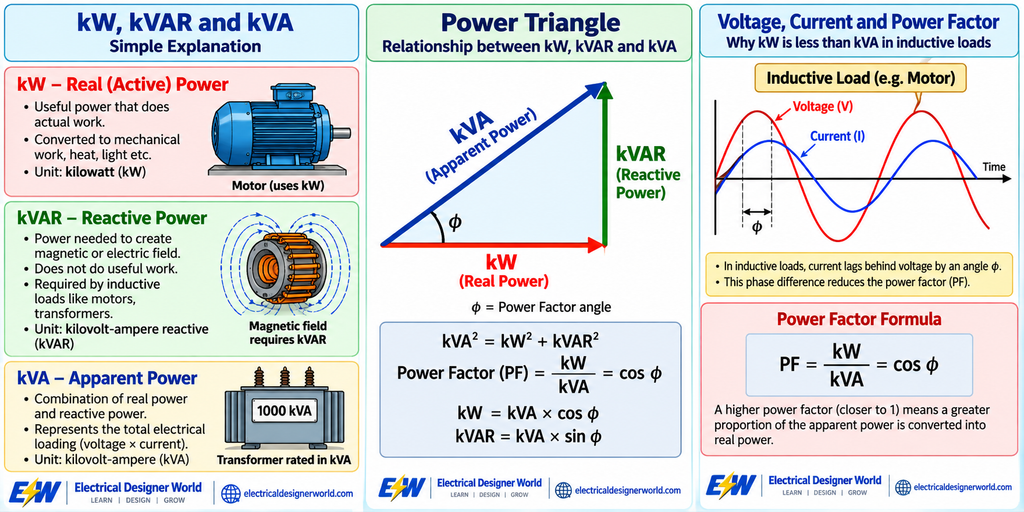
kW, kVAR, kVA and Power Factor:
Electrical power in an AC system can be described using four important terms: kW, kVAR, kVA and power factor. These terms are commonly used when discussing motors, transformers, generators, UPS systems and industrial electrical loads. At first, they may look confusing, but they become much easier when we understand what each one represents and how they are related.
What Is kW?
kW stands for kilowatt and represents real power or active power. Real power is the portion of electrical power that is actually converted into useful work or another useful form of energy. For example, when an electric motor receives electrical power and produces mechanical rotation, the useful power associated with that work is expressed in kW. Similarly, an electric heater uses electrical power and converts it mainly into heat, which is also represented by kW.
In simple words, kW tells us how much useful electrical power a load is consuming. If a motor is consuming 50 kW, it means the motor is using 50 kilowatts of real power. The same concept applies to pumps, compressors, fans, heaters and other electrical equipment.
For a three-phase AC system, real power can be calculated using the formula P = √3 × V × I × PF, where P is power in watts, V is line voltage, I is line current and PF is power factor. This formula shows that power factor is important when calculating the actual kW consumed by an AC load.
What Is kVAR?
kVAR stands for kilovolt-ampere reactive and represents reactive power. Reactive power is mainly associated with the electric and magnetic fields required for the operation of AC equipment. It is particularly important in inductive equipment such as motors, transformers, reactors and coils.
For example, an induction motor needs a magnetic field to operate. Some of the electrical energy associated with the motor continuously moves between the electrical supply and the magnetic field. This component is called reactive power and is measured in kVAR.
Reactive power does not represent the same type of useful work as kW. Instead, it supports the electromagnetic operation of equipment. This is why an industrial motor can require both kW and kVAR at the same time.
A simple way to remember it is that kW represents the useful power component, while kVAR represents the reactive power component needed by many AC loads.
What Is kVA?
kVA stands for kilovolt-ampere and represents apparent power. Apparent power is the combination of the real power and reactive power present in an AC electrical system. It represents the overall electrical loading seen by the source, such as a transformer, generator or UPS.
For a three-phase system, apparent power can be calculated using S = √3 × V × I, where S is apparent power in volt-amperes, V is line voltage and I is line current. Unlike the kW calculation, the basic apparent-power formula does not contain power factor because kVA represents the total apparent electrical loading.
This is why you will commonly see transformers and generators rated in kVA or MVA rather than only in kW. Their electrical capacity is closely related to the voltage and current they must handle.
For example, a transformer rated at 1000 kVA is designed to handle a particular combination of voltage and current within its specified operating conditions. The actual amount of real power that can be delivered depends partly on the power factor of the connected load.
What Is Power Factor?
Power factor is the relationship between real power and apparent power. It tells us how much of the apparent power is being converted into real power.
The basic formula is:
Power Factor = kW / kVA
For example, suppose an electrical load consumes 80 kW of real power and has an apparent power of 100 kVA. The power factor is:
PF = 80 / 100 = 0.80
This means the load has a power factor of 0.80.
A power factor closer to 1 means that a larger proportion of the apparent power is being used as real power. Resistive loads such as ideal heaters can have a power factor close to 1, while many induction motors operate with a lagging power factor below 1.
Why Do Motors Have a Power Factor Less Than 1?
Induction motors are one of the most common electrical loads in industrial plants. A motor requires a magnetic field to produce rotation, and this magnetic field creates a reactive component of power.
Therefore, the motor does not use only real power. It also requires reactive power. Because of this reactive component, the apparent power drawn from the electrical system is greater than the real power converted into useful mechanical output.
For example, a motor may consume 80 kW while requiring 100 kVA from the electrical system. In this case, its power factor is 0.80.
This is one reason power factor is an important parameter in industrial electrical design.
How Are kW, kVAR and kVA Related?
The relationship between kW, kVAR and kVA can be understood using the power triangle. In this triangle, kW represents real power, kVAR represents reactive power, and kVA represents apparent power.
The mathematical relationship is:
kVA² = kW² + kVAR²
This relationship comes from the right-angle relationship between real power and reactive power.
For example, suppose a motor has a real power of 80 kW and reactive power of 60 kVAR. We can calculate its apparent power as:
kVA = √(80² + 60²)
kVA = √(6400 + 3600)
kVA = √10,000
kVA = 100 kVA
Therefore, the motor has 80 kW real power, 60 kVAR reactive power and 100 kVA apparent power.
The power factor can then be calculated using:
PF = kW / kVA
So:
PF = 80 / 100 = 0.80
This example shows how the four terms are connected. Once you understand this relationship, kW, kVAR, kVA and power factor become much easier to understand.
What Is the Difference Between kW and kVA?
The easiest way to understand the difference is that kW represents real power, while kVA represents apparent power.
Suppose a motor requires 100 kVA and operates at a power factor of 0.8. Its real power is:
kW = kVA × PF
kW = 100 × 0.8 = 80 kW
So the equipment is drawing 100 kVA from the electrical system, but only 80 kW represents real power.
This difference becomes important when sizing transformers, generators, cables and other electrical equipment because these components must handle the actual voltage and current associated with the apparent power.
What Happens When Power Factor Is Low?
When power factor decreases, more apparent power is required for the same amount of real power.
For example, consider a load requiring 100 kW.
If the power factor is 1.0, the required apparent power is:
kVA = 100 / 1.0 = 100 kVA
If the power factor is 0.8, the required apparent power becomes:
kVA = 100 / 0.8 = 125 kVA
Therefore, the same 100 kW load requires 125 kVA at a power factor of 0.8.
For a given voltage, higher kVA generally means higher current. Higher current can increase losses and place greater loading on cables, transformers and other electrical equipment.
This is why maintaining a suitable power factor is important in industrial electrical systems.
What Is Power Factor Correction?
Power factor correction is the process of improving the power factor of an electrical system, commonly by supplying reactive power locally rather than requiring the entire reactive component to come from the upstream electrical supply.
For example, induction motors are normally inductive loads and require reactive power. A capacitor bank can provide capacitive reactive power to compensate for part of the motor’s reactive requirement.
As a result, the amount of reactive power supplied from the upstream system can be reduced, which can reduce the current required for the same real-power load.
This is why capacitor banks are commonly installed in industrial electrical systems.
Why Are Transformers Rated in kVA?
Transformers are commonly rated in kVA or MVA because their capacity is fundamentally related to the voltage and current that their windings and associated components must handle.
A transformer does not know whether the connected load is a motor, heater or another type of equipment. It supplies a particular voltage and current, and its heating and operating limits are related to those electrical quantities.
The real power delivered by the transformer depends on the power factor of the connected load. Therefore, a transformer can have a fixed kVA rating while the actual kW supplied changes depending on the load power factor.
For example, a 500 kVA transformer operating at a power factor of 0.8 would supply approximately:
kW = 500 × 0.8 = 400 kW
This is a simplified example; actual transformer loading also requires consideration of the manufacturer’s rating and operating conditions.
Why Are Generators Rated in kVA?
Generators are also commonly rated in kVA or MVA because they must supply both voltage and current to connected loads.
The generator may supply real power to perform useful work while also supplying the reactive component required by inductive loads.
For example, if a generator is rated at 1000 kVA and operates at a power factor of 0.8, the corresponding real power at that operating point would be approximately:
kW = 1000 × 0.8 = 800 kW
The actual generator operating capability depends on the manufacturer’s specified rating and operating conditions.
kW, kVAR, kVA and Power Factor in EPC Electrical Design
These four terms are very important in EPC electrical design because they appear throughout the electrical design process. When preparing an electrical load list, engineers may record equipment ratings in kW, motor power factor, kVA and other electrical parameters.
The calculated load information can then be used for equipment sizing and system studies. For example, transformer and generator capacities are commonly considered in kVA or MVA, while cable and breaker selection depends on the current associated with the electrical load. Power factor is also important when calculating the current and overall loading of the electrical system.
Understanding the relationship between kW, kVAR, kVA and power factor therefore gives you a strong foundation for understanding the next stages of electrical design, including transformer sizing, generator sizing, breaker selection and cable sizing.
Easy Way to Remember
The easiest way to remember these four terms is:
kW = Real power → useful work
kVAR = Reactive power → magnetic/electric field requirement
kVA = Apparent power → combination of kW and kVAR
Power Factor = kW ÷ kVA → relationship between real and apparent power
Once you understand these four concepts, many electrical calculations that initially look complicated become much easier to follow. For someone learning electrical engineering for EPC projects, this relationship is especially important because it connects basic electrical theory with practical equipment sizing and power-system design.