
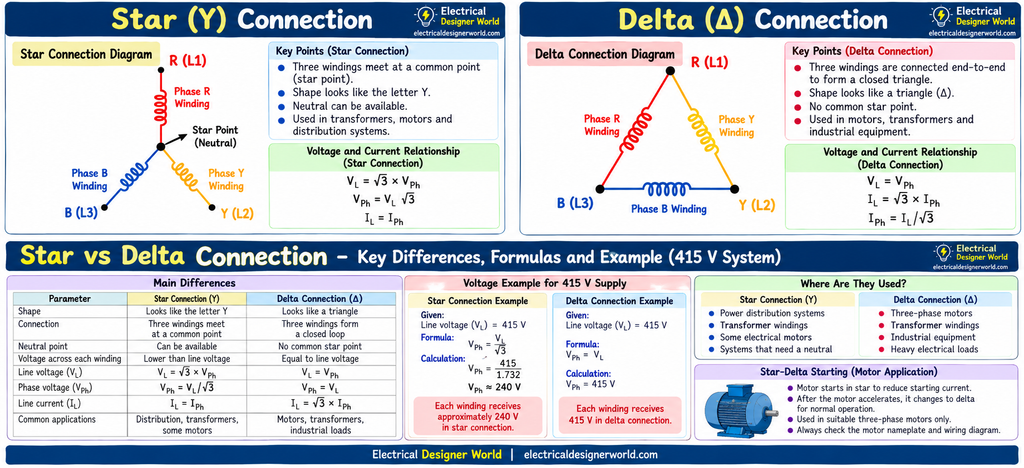
Star and Delta Connections Explained Simply with Examples
Table of Contents
Before learning star and delta connections, read our previous lesson on Single-Phase vs Three-Phase Electricity. It explains how three-phase electricity works and why it is commonly used in industrial electrical systems.
Star and delta connections are commonly used in electrical motors, transformers, and power systems.
Don’t worry if these names sound technical. In this lesson, we will understand them using simple diagrams, easy examples, and basic calculations.
By the end of this lesson, you will understand what star and delta connections are, how they differ, and why they are used in electrical equipment.
What Are Star and Delta Connections?
Imagine you have three electrical windings that need to be connected to a three-phase power supply.
There are two common ways to connect them:
- Star connection (Y): The three windings meet at one common point.
- Delta connection (Δ): The three windings are connected in a closed triangle.
The main difference is how the three windings are connected.
Let’s understand each connection separately.
What Is a Star Connection?
A star connection is also called a Y connection because its shape looks similar to the letter Y.
In this connection, one end of each of the three windings is joined at a common point. The other ends connect to the three electrical supply lines.
Think of three branches meeting at the centre of a Y shape.
This common point is called the star point. In some systems, it is connected to a neutral wire.
Simple Example of a Star Connection
Imagine three electrical windings:
- Winding 1 connects to Phase R.
- Winding 2 connects to Phase Y.
- Winding 3 connects to Phase B.
The other end of each winding joins at one common point.
This arrangement forms a star connection.
Where Is a Star Connection Used?
Star connections are used in many electrical applications, including:
- Three-phase power distribution.
- Transformer windings.
- Electrical motors.
- Systems that need a neutral connection.
The exact connection depends on the equipment design and its voltage rating.
What Is a Delta Connection?
A delta connection is named after the Greek letter Δ because its shape looks like a triangle.
In this connection, the three windings are connected end-to-end to form a closed loop.
Unlike a star connection, there is no common centre point where all three windings meet.
Simple Example of a Delta Connection
Imagine three electrical windings arranged as the three sides of a triangle.
The first winding connects to the second, the second connects to the third, and the third connects back to the first.
The three corners connect to the three-phase supply lines.
This arrangement forms a delta connection.
Where Is a Delta Connection Used?
Delta connections are commonly used in:
- Three-phase electrical motors.
- Transformer windings.
- Industrial electrical equipment.
- Some three-phase power systems.
The correct connection must always match the equipment’s rated voltage and wiring diagram.
Star and Delta Connections: What Is the Difference?
Now let’s compare both connections in a simple table.
| Feature | Star Connection (Y) | Delta Connection (Δ) |
|---|---|---|
| Shape | Looks like the letter Y | Looks like a triangle |
| Connection | Three windings meet at a common point | Three windings form a closed loop |
| Neutral point | Can be available | No common star point |
| Voltage across each winding | Lower than line voltage in a balanced system | Equal to line voltage |
| Common use | Distribution and various motor or transformer applications | Motors and various transformer applications |
Easy way to remember:
- Star = three windings meet at a common point.
- Delta = three windings form a triangle.
Understanding Voltage in Star and Delta Connections
Before learning the formulas, let’s understand two simple terms.
Line voltage: The voltage measured between two supply lines.
Phase voltage: The voltage measured across one individual winding or phase of the load.
For example, in a typical 415 V three-phase supply, the voltage between two lines is 415 V.
The voltage across an individual winding depends on whether the load is connected in star or delta.
Voltage in a Star Connection
In a balanced star connection, the voltage across each winding is lower than the line voltage.
The formula is:
Phase voltage = Line voltage ÷ 1.732
The number 1.732 comes from the square root of 3.
Star Connection Calculation
Suppose the line voltage is 415 V.
Step 1: Write the formula.
Phase voltage = Line voltage ÷ 1.732
Step 2: Substitute the value.
Phase voltage = 415 ÷ 1.732
Step 3: Calculate.
Phase voltage ≈ 240 V
Answer: Each winding receives approximately 240 V in this balanced star-connected example.
Voltage in a Delta Connection
In a delta connection, the voltage across each winding is equal to the line voltage.
The formula is:
Phase voltage = Line voltage
Delta Connection Calculation
Suppose the line voltage is 415 V.
Step 1: Write the formula.
Phase voltage = Line voltage
Step 2: Substitute the value.
Phase voltage = 415 V
Answer: Each winding receives 415 V in this balanced delta-connected example.
Star vs Delta Voltage Example
For the same 415 V supply:
- Star connection: approximately 240 V across each winding.
- Delta connection: 415 V across each winding.
This difference is important when connecting electrical motors. The motor must be designed for the intended connection and supply voltage.
What Is the Difference Between Current in Star and Delta?
Current is the flow of electrical charge through a conductor.
For a balanced star connection, the current flowing through a supply line is equal to the current through its corresponding winding.
For a balanced delta connection, the line current is approximately 1.732 times the current through each winding.
You do not need to memorise every formula immediately. First, understand the connection shapes and the voltage difference.
The basic relationships are:
Star connection:
Line current = Phase current
Delta connection:
Line current = 1.732 × Phase current
These relationships apply to balanced three-phase loads.
What Is Star-Delta Starting in an Electrical Motor?
You may have heard the term star-delta starter when discussing electrical motors.
A star-delta starter is a method used to start certain three-phase motors with reduced starting current.
The motor initially starts in star and then changes to delta for normal operation.
Why is this useful?
When the motor starts in star, each winding receives a lower voltage than it would receive in delta at the same supply voltage. This reduces the starting current, but it also reduces the starting torque.
After the motor accelerates, the starter changes the winding connection to delta, provided the motor is designed for this arrangement.
Simple Star-Delta Starting Example
Imagine an industrial pump driven by a suitable three-phase motor.
- The motor starts in star to reduce starting current.
- The motor accelerates.
- The starter changes the connection to delta.
- The motor continues running under its intended operating conditions.
A star-delta starter cannot be used with every motor. Always check the motor nameplate, rated voltages, and manufacturer’s wiring diagram before selecting this starting method.
Where Will You See Star and Delta Connections in Real Life?
You may find star and delta connections in:
- Industrial motors.
- Transformers.
- Generators.
- Electrical distribution systems.
- Manufacturing plants.
- Pumps and compressors.
For electrical engineering students, understanding these connections is a useful step toward learning how electrical equipment is connected to a three-phase supply.
Frequently Asked Questions About Star and Delta Connections
1. What is a star connection?
A star connection is a method of connecting three electrical windings so that one end of each winding meets at a common point.
2. What is a delta connection?
A delta connection joins three electrical windings end-to-end to form a closed triangle.
3. Why is the voltage lower in a star connection?
In a balanced star connection, the voltage across each winding equals the line voltage divided by the square root of 3, approximately 1.732.
4. Why is a star-delta starter used?
It reduces the starting current of suitable three-phase motors. It also reduces starting torque, so the method is not suitable for every application.
5. Can any motor be connected in star or delta?
No. The motor must be designed for the selected connection and supply voltage. Always follow the motor nameplate and manufacturer’s instructions.
Practice Questions: Star and Delta Connections
Test what you have learned.
Question 1: Which connection looks like the letter Y?
A. Delta connection
B. Star connection
C. Series connection
D. Parallel connection
Question 2: Which connection forms a triangle?
A. Star connection
B. Delta connection
C. Single-phase connection
D. Neutral connection
Question 3: In a balanced star connection, what is the phase voltage for a 415 V line supply?
A. 120 V
B. Approximately 240 V
C. 415 V
D. 830 V
Question 4: In a delta connection, the voltage across each winding is:
A. Equal to line voltage
B. Half the line voltage
C. Line voltage divided by 1.732
D. Always zero
Question 5: What is the main purpose of a star-delta starter?
A. To increase supply frequency
B. To reduce motor starting current
C. To convert AC into DC
D. To eliminate the need for protection
Answers
- B — Star connection.
- B — Delta connection.
- B — Approximately 240 V.
- A — Equal to line voltage.
- B — To reduce motor starting current.
Conclusion
Star and delta connections are two common ways to connect three electrical windings in a three-phase system.
In a star connection, the three windings meet at a common point. In a delta connection, they form a closed triangle.
For a balanced 415 V system, the voltage across each winding is approximately 240 V in star and 415 V in delta.
Understanding this difference will help you learn more about electrical motors, transformers, and three-phase power systems.
Keep practising the simple diagrams and calculations. You do not need to memorise everything in one day.
Continue the 30 Day Electrical Fundamentals Course
This lesson is part of the Electrical Fundamentals – Zero to Advanced course on Electrical Designer World.
- Previous lesson: Day 13 – Single-Phase vs Three-Phase Electricity
- Current lesson: Day 14 – Star and Delta Connections
- Next lesson: Day 15 – Three-Phase Power: kW, kVA, kVAR and Power Factor
Further reading: All About Circuits – Textbook for additional learning resources on electrical and AC circuit fundamentals.