
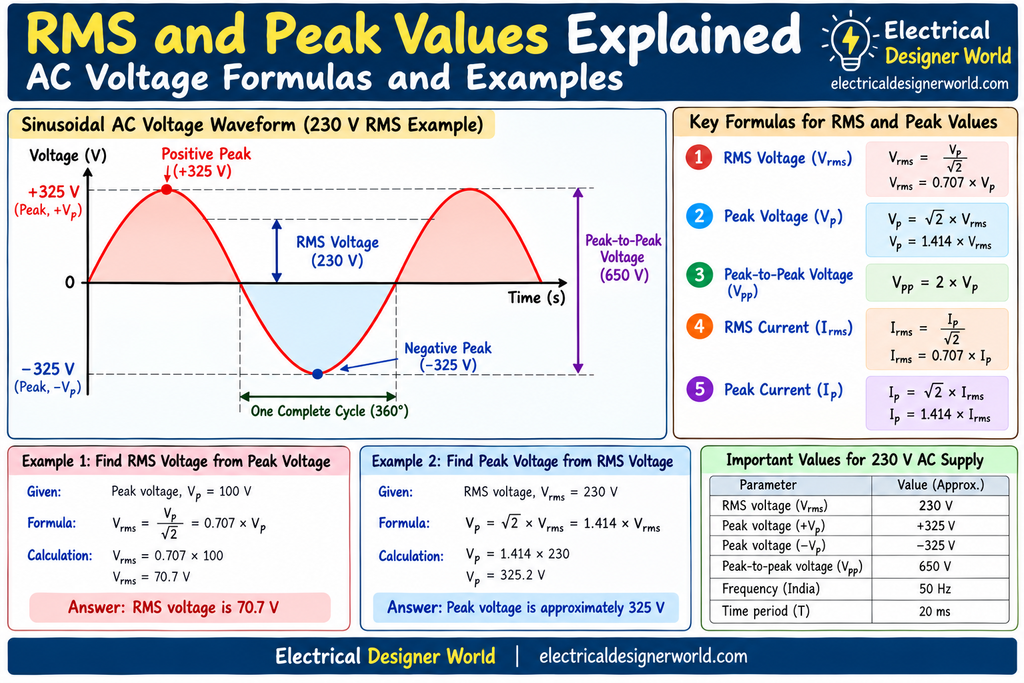
RMS and Peak Values Explained – AC Voltage Formulas and Examples
Table of Contents
In electrical engineering, alternating voltage and current change continuously with time. Therefore, we need different ways to describe their values, including peak value, RMS value, and average value.
RMS and peak values are two important concepts used to understand AC voltage and current. They help electrical engineers calculate electrical power, analyse waveforms, and understand the ratings of electrical equipment.
For example, when we say that a household electrical supply is approximately 230 V AC, we normally mean its RMS voltage, not its maximum instantaneous voltage.
In this lesson of our 30 Day Electrical Fundamentals course, you will learn the difference between RMS and peak values, the formulas used to convert between them, and how to solve practical electrical calculations.
What Are RMS and Peak Values?
RMS and peak values describe different characteristics of an alternating voltage or current.
The peak value represents the maximum magnitude reached by a waveform, while the RMS value represents its effective value for producing the same heating effect in a resistor as an equivalent DC value.
Let’s understand these concepts separately.
What Is the Peak Value of AC Voltage?
The peak value is the maximum instantaneous voltage reached by an alternating voltage waveform.
It is represented by the symbol Vp and measured in volts (V).
For a symmetrical sinusoidal waveform, the voltage reaches a positive peak and a negative peak of equal magnitude.
For example, a sine wave may vary between:
- Positive peak: +325 V
- Negative peak: -325 V
In this example, the peak voltage is 325 V.
The peak-to-peak voltage is the difference between the positive and negative peaks.
Formula:
Peak-to-peak voltage = 2 × Peak voltage
Vpp = 2 × Vp
If the peak voltage is 325 V:
Vpp = 2 × 325
Vpp = 650 V
Therefore, the peak-to-peak voltage is 650 V.
Where Is Peak Voltage Used?
Peak voltage is useful when studying:
- AC waveforms and instantaneous voltage.
- Insulation requirements and voltage stress.
- Rectifier circuits and electronic components.
- Electrical measurement instruments.
- The relationship between peak and RMS voltage.
Remember that peak voltage is not the same as the nominal AC supply voltage normally specified for household electrical systems.
What Is the RMS Value of AC Voltage?
RMS stands for Root Mean Square.
The RMS value of an AC voltage is the equivalent DC voltage that produces the same average heating effect in a resistor under the same conditions.
RMS values are commonly used because alternating voltage and current change continuously throughout each cycle.
For example, the nominal voltage of a typical household AC supply in India is approximately 230 V RMS.
This does not mean that the instantaneous voltage remains at 230 V. The voltage rises and falls throughout each cycle.
For a pure sinusoidal waveform, the RMS voltage is calculated using the following formula:
Vrms = Vp / √2
Since √2 is approximately 1.414:
Vrms ≈ 0.707 × Vp
Where:
- Vrms = RMS voltage
- Vp = Peak voltage
- √2 = Approximately 1.414
This relationship applies to a pure sinusoidal waveform.
Why Is RMS Voltage Important?
RMS voltage is important because it allows engineers to calculate the power dissipated in resistive loads using familiar electrical formulas.
For a resistor:
P = Vrms × Irms
When the voltage and current are in phase, this also equals:
P = Vrms² / R
Where:
- P = Power in watts
- Vrms = RMS voltage
- R = Resistance in ohms
These formulas assume a resistive load and the appropriate RMS values.
RMS and Peak Values: What Is the Difference?
The main difference is that peak voltage represents the maximum instantaneous voltage, whereas RMS voltage represents the effective value of a sinusoidal AC voltage.
| Parameter | Peak value | RMS value |
|---|---|---|
| Meaning | Maximum instantaneous magnitude | Effective value for resistive heating |
| Symbol | Vp | Vrms |
| Measurement | Volts (V) | Volts (V) |
| For a 230 V RMS sine wave | Approximately 325 V | 230 V |
| Main application | Waveform and peak-voltage analysis | Power calculations and AC ratings |
For a pure sine wave:
Vrms = 0.707 × Vp
Vp = 1.414 × Vrms
These conversion formulas are among the most useful relationships in basic AC electrical engineering.
How to Calculate RMS Voltage from Peak Voltage
Let’s work through a practical example.
Suppose an AC voltage waveform has a peak voltage of 100 V. Calculate its RMS voltage.
Given:
Peak voltage, Vp = 100 V
Step 1: Write the formula.
Vrms = Vp / √2
Step 2: Substitute the value.
Vrms = 100 / 1.414
Step 3: Calculate.
Vrms ≈ 70.71 V
Answer: The RMS voltage is approximately 70.7 V.
This means that the sinusoidal AC voltage produces the same average heating effect in a resistor as approximately 70.7 V DC would under the same conditions.
How to Calculate Peak Voltage from RMS Voltage
Now let’s calculate peak voltage when the RMS voltage is known.
Suppose an AC supply has an RMS voltage of 230 V.
Given:
RMS voltage, Vrms = 230 V
Step 1: Write the formula.
Vp = √2 × Vrms
Step 2: Substitute the value.
Vp = 1.414 × 230
Step 3: Calculate.
Vp ≈ 325.2 V
Answer: The peak voltage is approximately 325 V.
Therefore, a 230 V RMS sinusoidal supply reaches a peak of approximately +325 V and a negative peak of approximately -325 V.
This is why the maximum instantaneous voltage is higher than the nominal RMS voltage.
RMS and Peak Values in a 230 V AC Supply
Let’s summarise the important values for a sinusoidal AC supply rated at 230 V RMS.
Given:
Vrms = 230 V
Peak voltage:
Vp = 1.414 × 230
Vp ≈ 325.2 V
Negative peak:
Approximately -325.2 V.
Peak-to-peak voltage:
Vpp = 2 × 325.2
Vpp ≈ 650.4 V
Therefore, the approximate waveform values are:
- RMS voltage = 230 V
- Positive peak voltage = +325 V
- Negative peak voltage = -325 V
- Peak-to-peak voltage = 650 V
These values describe an ideal sinusoidal waveform. Actual supply voltage can vary with operating conditions.
Safety note: Household AC voltage is hazardous. Never measure exposed mains conductors or attempt live electrical work without appropriate training, instruments, and safety procedures.
What Is the Difference Between RMS, Peak and Average Values?
Peak, RMS, and average values describe different properties of an AC waveform.
Peak value: The maximum magnitude reached by the waveform.
RMS value: The effective value that produces the same heating effect in a resistor as an equivalent DC value.
Average value: The arithmetic mean of the instantaneous values over a specified interval.
For a symmetrical sinusoidal waveform:
- The average over one complete cycle is zero.
- The average over the positive half-cycle is approximately 0.637 times the peak value.
- The RMS value is approximately 0.707 times the peak value.
For example, if the peak voltage is 100 V:
RMS voltage = 0.707 × 100 = 70.7 V.
Average over the positive half-cycle = 0.637 × 100 = 63.7 V.
Average over a complete cycle = 0 V.
The average value depends on the interval used for the calculation. For non-sinusoidal waveforms, the RMS-to-peak relationship may be different.
Important RMS and Peak Value Formulas
Remember these formulas when solving basic AC circuit problems.
| Quantity | Formula |
|---|---|
| RMS voltage from peak | Vrms = Vp / √2 |
| Peak voltage from RMS | Vp = √2 × Vrms |
| RMS current from peak | Irms = Ip / √2 |
| Peak current from RMS | Ip = √2 × Irms |
| Peak-to-peak voltage | Vpp = 2 × Vp |
| Average over positive half-cycle | Vavg = 2 × Vp / π |
These formulas apply to a pure sinusoidal waveform, except the peak-to-peak relationship, which assumes equal positive and negative peaks.
Practice Questions: RMS and Peak Values
Test your understanding with these five questions.
Question 1: What does RMS stand for?
A. Rated Measurement System
B. Root Mean Square
C. Resistance Measurement Scale
D. Rotating Magnetic System
Question 2: What is the approximate peak voltage of a 230 V RMS sinusoidal supply?
A. 115 V
B. 230 V
C. 325 V
D. 460 V
Question 3: If the peak voltage is 200 V, what is the RMS voltage?
A. 100 V
B. 141.4 V
C. 200 V
D. 282.8 V
Question 4: What is the peak-to-peak voltage of a sine wave with a peak voltage of 50 V?
A. 25 V
B. 50 V
C. 70.7 V
D. 100 V
Question 5: What is the average value of a symmetrical sine wave over one complete cycle?
A. Zero
B. 0.637 times peak
C. 0.707 times peak
D. Equal to peak
Answers
- B — Root Mean Square.
- C — Approximately 325 V.
- B — Approximately 141.4 V.
- D — 100 V.
- A — Zero.
Frequently Asked Questions About RMS and Peak Values
1. Why is AC voltage usually expressed as an RMS value?
RMS voltage provides an effective value for resistive heating and allows engineers to calculate electrical power using standard AC formulas.
2. Is 230 V AC the peak voltage?
No. A 230 V RMS sinusoidal supply has a peak voltage of approximately 325 V.
3. What is the relationship between RMS and peak voltage?
For a pure sinusoidal waveform, RMS voltage equals peak voltage divided by √2. Peak voltage equals RMS voltage multiplied by √2.
4. Is RMS voltage always 0.707 times peak voltage?
No. This relationship applies to a pure sine wave. Other waveform shapes have different RMS-to-peak relationships.
5. Can RMS voltage be greater than peak voltage?
For a waveform measured over the same interval, the RMS value cannot exceed the peak magnitude. For a pure sine wave, RMS voltage is approximately 70.7% of the peak voltage.
Conclusion
RMS and peak values are essential concepts for understanding alternating voltage and current.
Peak voltage describes the maximum instantaneous magnitude, while RMS voltage represents the effective value used in common AC power calculations.
For a pure sinusoidal waveform, RMS voltage is approximately 0.707 times peak voltage, and peak voltage is approximately 1.414 times RMS voltage.
Practise these conversions using different voltage values to build confidence before moving on to single-phase and three-phase electricity.
Continue the 30 Day Electrical Fundamentals Course
Previous Lesson: AC Waveforms
Before learning RMS and peak values, it is helpful to understand the basics of an AC waveform. In the previous lesson, we explored amplitude, frequency, time period, and phase. These concepts will help you understand how peak voltage and RMS voltage are related in a sinusoidal AC circuit.
This lesson is part of the Electrical Fundamentals – Zero to Advanced course on Electrical Designer World.
- Previous lesson: Day 11 – AC Waveforms
- Current lesson: Day 12 – RMS and Peak Values
- Next lesson: Day 13 – Single-Phase and Three-Phase Electricity
Explore the other lessons in our electrical fundamentals course to build your understanding step by step.
Further reading: All About Circuits – Textbook provides additional learning resources on AC circuit fundamentals.