
Electromagnetic Induction – How Changing Magnetic Fields Produce Voltage
Introduction
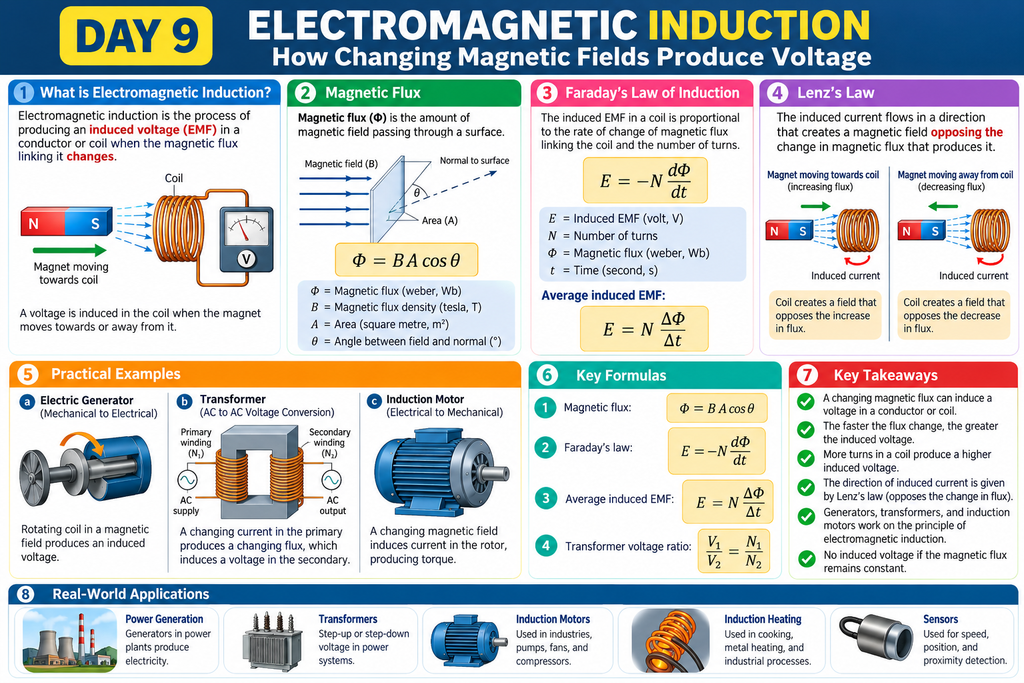
Have you ever wondered how a power station produces electricity? How does a generator convert mechanical movement into electrical energy? And how can a transformer transfer electrical energy from one circuit to another without a direct electrical connection between its windings?
Table of Contents
The answer involves an important principle called electromagnetic induction.
In Day 8, we learned that electric current can produce a magnetic field. In Day 9, we will learn the reverse idea: a changing magnetic field can produce a voltage in a conductor.
This principle is one of the foundations of electrical engineering. It is used in generators, transformers, induction motors, and many other electrical devices.
1. What Is Electromagnetic Induction?
Electromagnetic induction is the process of producing an induced voltage, also called electromotive force (EMF), when the magnetic flux linking a conductor or coil changes.
Let us understand this in simple words.
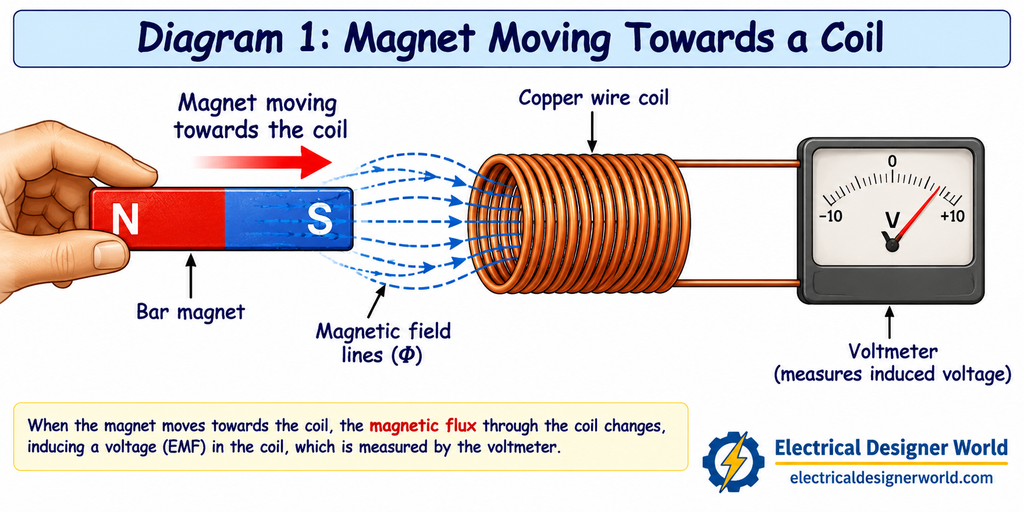
Imagine a coil made from insulated copper wire. Connect the coil to a sensitive voltmeter. Now move a magnet towards the coil.
The voltmeter may show a voltage while the magnet is moving. If you move the magnet away, the direction of the induced voltage reverses. If the magnet remains stationary relative to the coil, the voltage becomes zero, provided the magnetic field linking the coil is no longer changing.
This is electromagnetic induction.
Remember: It is the change in magnetic flux linking the coil—not simply the presence of a magnet—that produces the induced voltage.
How does it work?
- A magnet is moved towards or away from a coil.
- The magnetic field linking the coil changes.
- A voltage is induced across the coil.
- If the circuit is closed, the induced voltage can drive an electric current.
A voltage can be induced even when the magnet and coil do not touch each other. The important condition is a change in the magnetic flux linking the conductor.
2. What Is Magnetic Flux?
Before learning Faraday’s law, we need to understand magnetic flux.
Magnetic flux is a measure of the magnetic field passing through a particular surface, such as the area enclosed by a coil.
Think of a coil as a window and magnetic field lines as arrows passing through that window. If more magnetic field passes through the window, the magnetic flux increases. If less passes through it, the flux decreases.
Magnetic flux depends on three main factors:
- Magnetic field strength: A stronger magnetic field can produce greater flux.
- Area: A larger surface can allow more magnetic field to pass through it.
- Angle: The orientation of the surface relative to the magnetic field affects the flux.
For a uniform magnetic field, magnetic flux can be calculated using:
Formula:
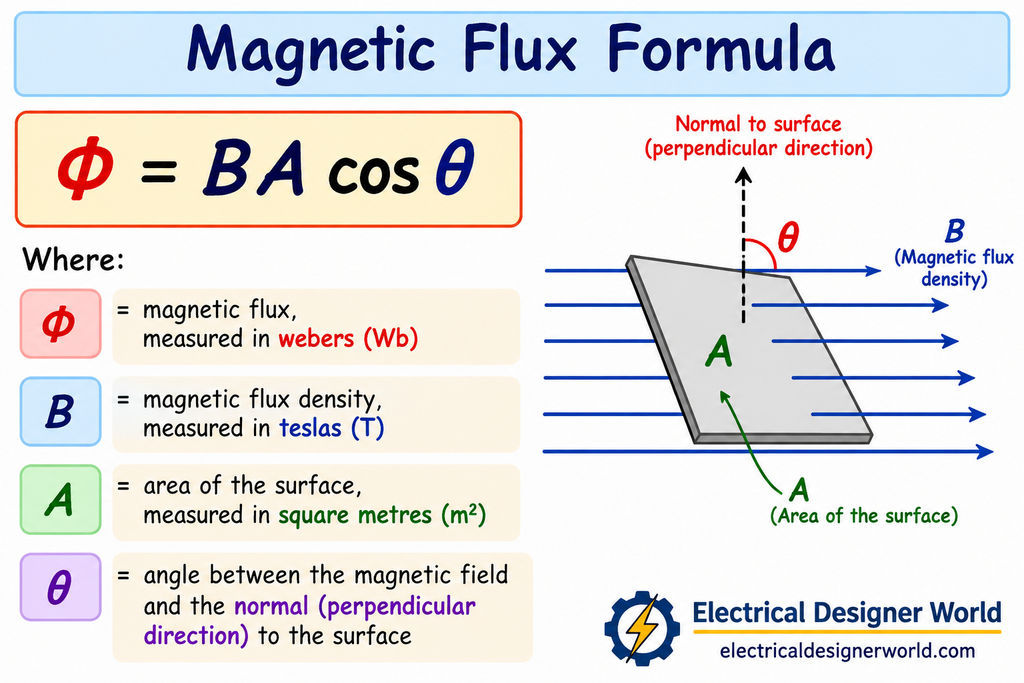
When the magnetic field is perpendicular to the surface, the flux is at its maximum for a given field strength and area. When the field is parallel to the surface, the flux through that surface is zero.
Important: Magnetic flux and magnetic flux density are different quantities. Flux is measured in webers, while flux density is measured in teslas.
3. When Is Voltage Induced?
An induced voltage occurs when the magnetic flux linking a conductor or coil changes.
This change can happen in several ways.
Method 1: Move a magnet near a coil
Moving a magnet towards or away from a coil changes the magnetic flux linking the coil.
Method 2: Move the coil through a magnetic field
If a coil moves through a magnetic field in a way that changes the flux linking it, a voltage can be induced.
Method 3: Change the magnetic field strength
A changing magnetic field can induce voltage even when the coil and magnet do not physically move relative to each other.
For example, an alternating current in one coil produces a changing magnetic field. This changing field can induce a voltage in a nearby coil.
Key point: Physical movement is not always necessary. What matters is a change in magnetic flux linking the circuit.
4. Faraday’s Law of Electromagnetic Induction
Michael Faraday discovered the relationship between changing magnetic flux and induced voltage. This relationship is known as Faraday’s law of electromagnetic induction.
Faraday’s law tells us that the magnitude of the induced EMF depends on how quickly the magnetic flux linking a coil changes and on the number of turns in the coil.
For a coil with (N) turns:
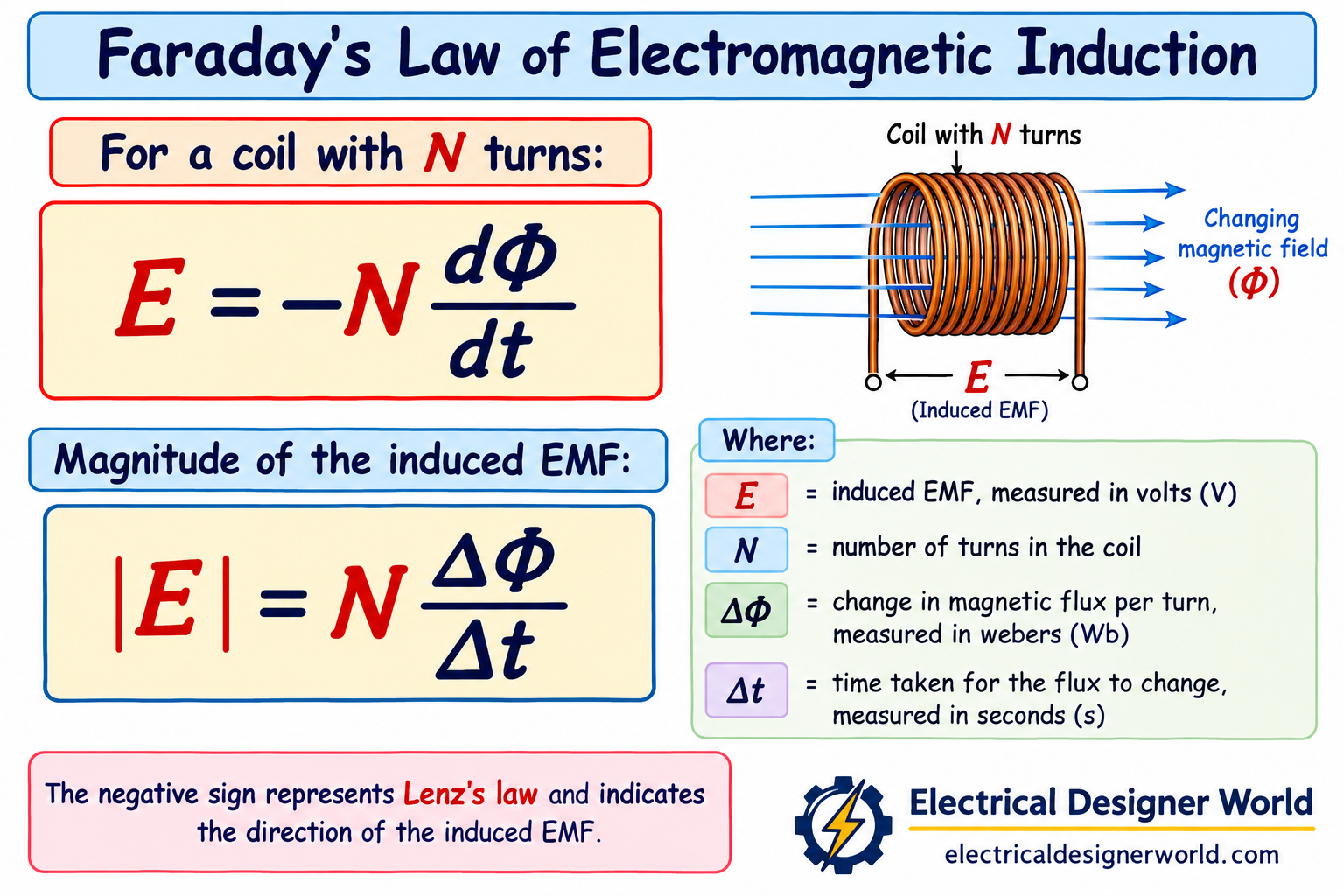
For a simple average calculation over a time interval, we commonly use the magnitude:
The negative sign in Faraday’s law represents Lenz’s law, which explains the direction of the induced EMF.
What does Faraday’s law tell us?
1. Faster flux change produces greater voltage.
If the magnet moves faster, the flux linking the coil may change more rapidly, producing a larger induced voltage.
2. More turns can produce greater voltage.
If the same flux change occurs at the same rate through each turn, increasing the number of turns increases the induced EMF.
3. No change in flux means no induced EMF from that flux.
If the magnetic flux linking the coil remains constant, there is no induced EMF due to a changing flux.
Worked example: Calculate induced voltage
A coil has 200 turns. The magnetic flux through each turn increases from 0.02 Wb to 0.06 Wb in 0.1 seconds.
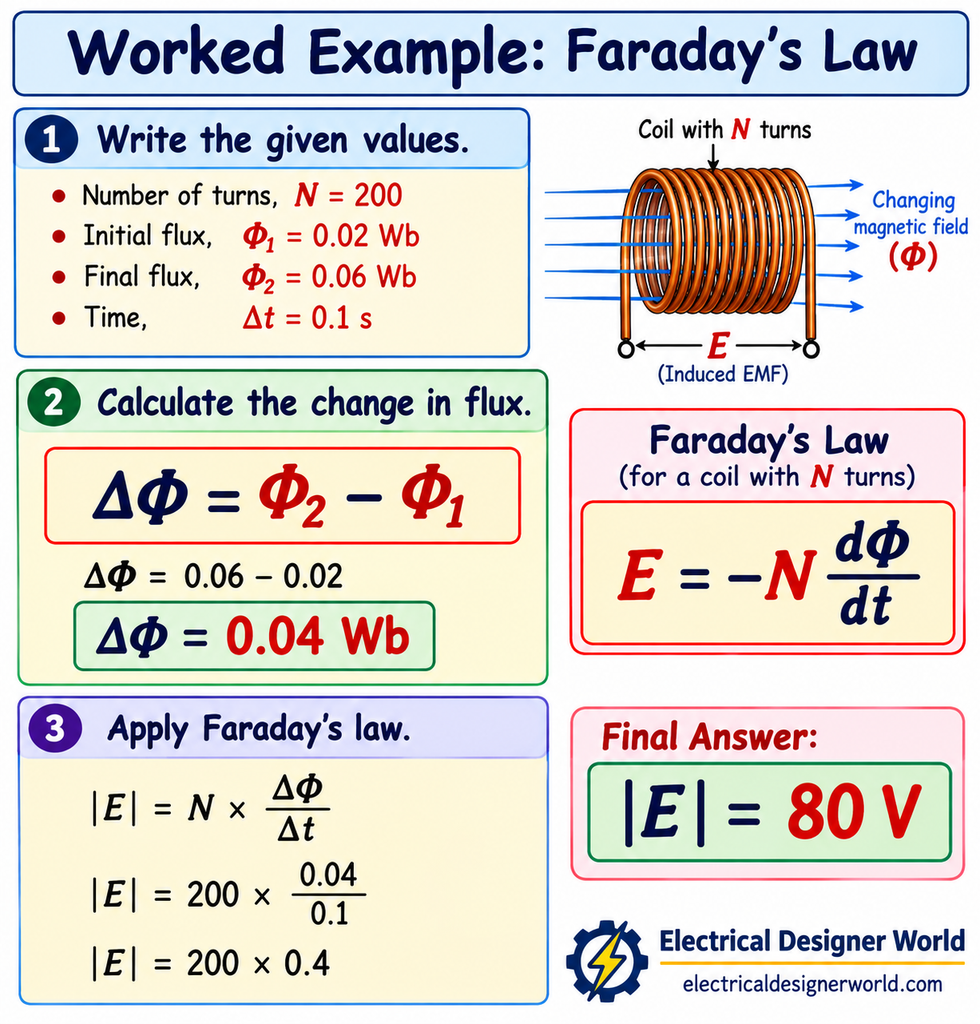
Answer: The magnitude of the average induced EMF is 80 volts.
This example assumes the stated flux is the flux linking each turn and changes uniformly over the given interval.
5. What Is Lenz’s Law?
Faraday’s law helps us calculate the magnitude of induced voltage. But how do we determine its direction?
This is explained by Lenz’s law.
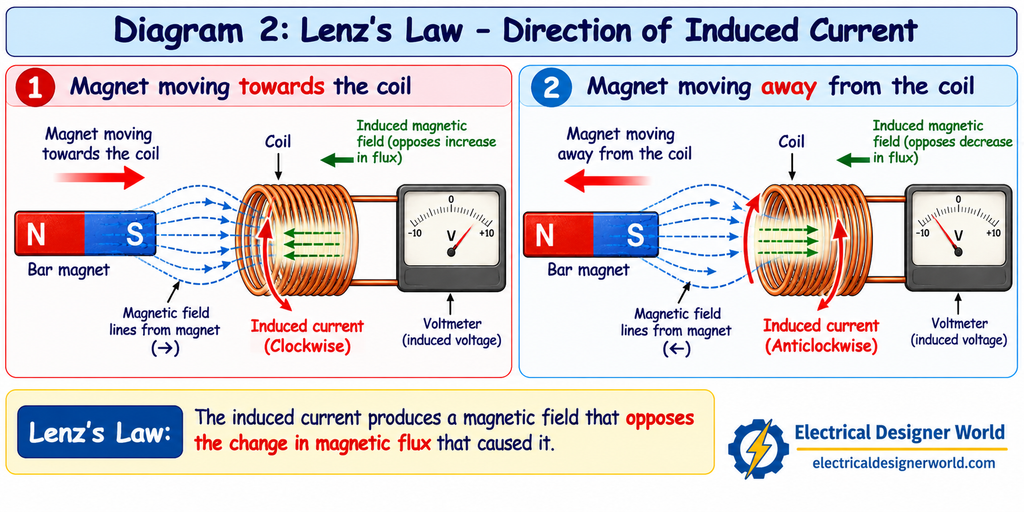
Lenz’s law states that the induced current flows in a direction that creates a magnetic field opposing the change in magnetic flux that produced it.
Notice the important wording: the induced magnetic field opposes the change in flux, not necessarily the original magnetic field itself.
Example 1: Magnet moving towards a coil
When the magnet approaches the coil, the magnetic flux linking the coil increases.
The induced current creates a magnetic field that opposes this increase. As a result, the coil acts to resist the approaching magnet.
Example 2: Magnet moving away from a coil
When the magnet moves away, the magnetic flux linking the coil decreases.
The induced current reverses direction so that its magnetic field opposes the decrease. The coil acts to resist the magnet moving away.
Why is Lenz’s law important?
Lenz’s law is consistent with the principle of conservation of energy. For example, work must be done to push a magnet towards a coil when the induced effects oppose the motion.
The negative sign in Faraday’s law represents this opposing direction.
6. How Does an Electric Generator Work?
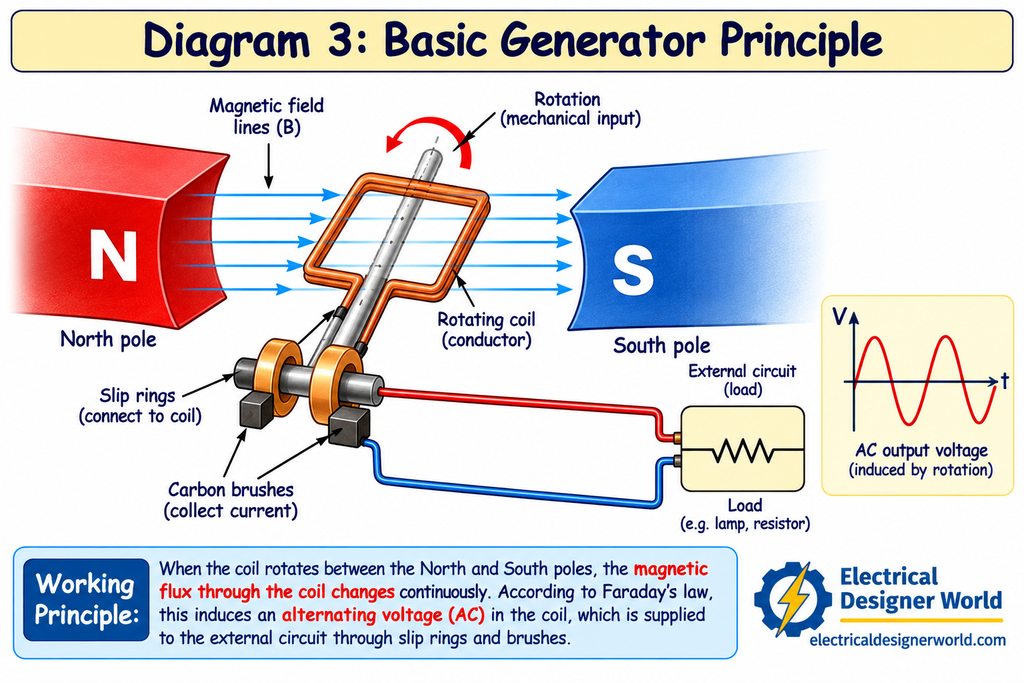
An electric generator converts mechanical energy into electrical energy using electromagnetic induction.
A basic generator contains a magnetic field and a coil or conductors arranged so that the magnetic flux linking them changes as the machine rotates.
Working principle
- A prime mover, such as a turbine or engine, rotates the generator shaft.
- The coil or magnetic field rotates relative to the other part of the machine.
- The magnetic flux linking the conductors changes.
- An induced voltage is produced.
- The generator supplies electrical energy to a connected circuit.
In an AC generator, the induced voltage typically changes direction periodically, producing alternating voltage.
In a power station, a turbine may be driven by steam, water, wind, or another energy source. The turbine rotates the generator, which converts mechanical energy into electrical energy.
Remember: A generator does not create energy from nothing. It converts mechanical energy into electrical energy.
7. How Does a Transformer Work?
A transformer transfers electrical energy between circuits through electromagnetic induction.
It normally has two windings:
- Primary winding: Connected to the AC supply.
- Secondary winding: Connected to the load.
The windings are usually placed around a magnetic core that provides a path for magnetic flux.
Transformer working principle
- An alternating voltage is applied to the primary winding.
- Alternating current flows in the primary winding.
- This current produces a changing magnetic flux in the core.
- The changing flux links the secondary winding.
- An induced voltage appears across the secondary winding.
For an ideal transformer, the voltage ratio is related to the turns ratio:
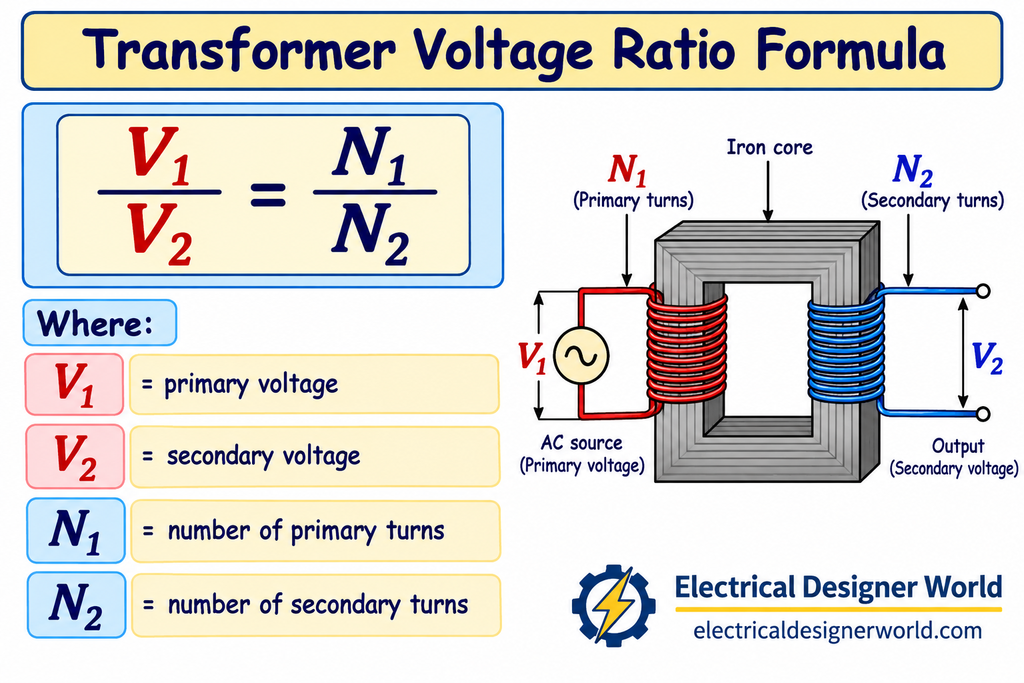
If the secondary winding has more turns than the primary winding, the transformer is a step-up transformer. If it has fewer turns, it is a step-down transformer.
A conventional transformer requires changing magnetic flux, which is why it works with AC under normal operating conditions. A steady DC supply does not continuously produce the changing flux needed for normal transformer action and can cause excessive current and overheating.
8. What Is the Difference Between a Generator and a Transformer?
| Feature | Generator | Transformer |
|---|---|---|
| Main purpose | Converts mechanical energy into electrical energy | Transfers electrical energy between circuits |
| How flux changes | Commonly through rotation | Commonly through alternating current |
| Moving parts | Usually has rotating parts | Usually has no moving parts |
| Typical application | Power generation | Voltage conversion and electrical isolation |
Both devices rely on electromagnetic induction, but they use it in different ways.
9. Practical Applications in Electrical Engineering
Electromagnetic induction is used in many electrical systems.
Generators
Generators use changing magnetic flux to produce electrical voltage and supply power to electrical networks.
Transformers
Transformers use changing magnetic flux to transfer energy between windings and increase or decrease voltage.
Induction motors
Induction motors use a changing magnetic field to induce currents in the rotor. The interaction between these currents and the magnetic field produces torque.
Induction heating
Changing magnetic fields induce currents in conductive materials. These currents produce heat, which can be used in industrial heating and cooking equipment.
Sensors
Some sensors use electromagnetic induction to detect movement, speed, or changes in magnetic conditions.
10. Common Beginner Mistakes
Mistake 1: Thinking that a magnet alone always produces voltage.
A stationary magnet near a stationary coil does not produce a continuous induced voltage simply because the magnetic field exists. The flux linking the coil must change.
Mistake 2: Confusing magnetic flux with magnetic flux density.
Magnetic flux is measured in webers (Wb), while magnetic flux density is measured in teslas (T).
Mistake 3: Forgetting the number of turns in Faraday’s law.
For a coil with multiple turns, the induced EMF depends on the flux change linking each turn and the number of turns.
Mistake 4: Thinking Lenz’s law always opposes the magnetic field.
It opposes the change in magnetic flux that causes the induced current.
Mistake 5: Thinking a transformer works normally from steady DC.
A conventional transformer relies on changing magnetic flux, normally created by AC in its primary winding.
11. Practice Questions
Try answering these questions before checking your understanding.
- What is electromagnetic induction?
- What must change for an EMF to be induced in a coil?
- What is the SI unit of magnetic flux?
- State Faraday’s law of electromagnetic induction.
- What does Lenz’s law tell us?
- Why does moving a magnet faster towards a coil often produce a larger induced voltage?
- How does a transformer induce voltage in its secondary winding?
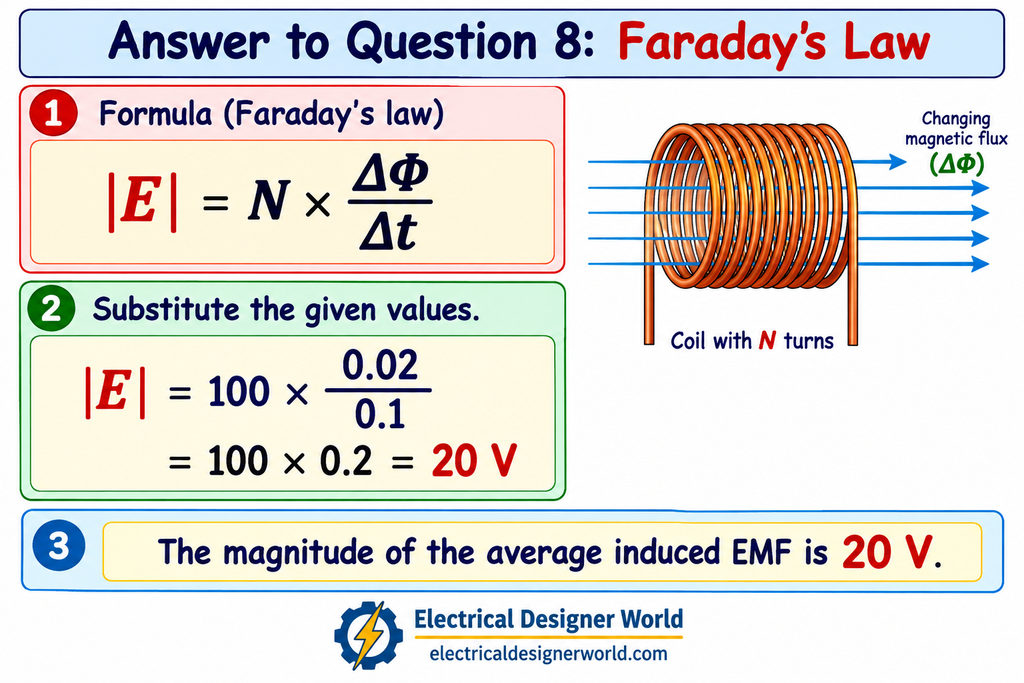
- A coil has 100 turns, and the flux through each turn changes by 0.02 Wb in 0.1 seconds. What is the magnitude of the average induced EMF?
Answer to Question 8:
12. Frequently Asked Questions
What is electromagnetic induction in simple words?
It is the production of voltage when the magnetic flux linking a conductor or coil changes.
Can a stationary magnet produce voltage in a coil?
Not if the magnet and coil remain stationary relative to each other and the magnetic flux linking the coil stays constant. A changing magnetic field can still induce voltage without physical movement.
What is the difference between Faraday’s law and Lenz’s law?
Faraday’s law gives the relationship between induced EMF and the rate of change of magnetic flux. Lenz’s law determines the direction of the induced effect.
Why is electromagnetic induction important?
It is the basic operating principle behind generators and transformers and is also used in induction motors, heating systems, and sensors.
What is the unit of induced EMF?
The induced EMF is measured in volts (V).
Conclusion
Electromagnetic induction explains how a changing magnetic flux can produce voltage in a conductor or coil. Faraday’s law helps us calculate the magnitude of the induced EMF, while Lenz’s law explains its direction.
These principles are essential for understanding generators, transformers, induction motors, and many other electrical devices used in homes, industries, and power systems.
If you understand one key idea from this lesson, remember this: a change in magnetic flux can induce voltage, and the faster the change, the greater the induced voltage, all else being equal.
Next lesson — Day 10: Self-Induction and Mutual Induction. We will learn how a changing current induces voltage in the same coil or in a nearby coil.
References for Further Learning
- OpenStax, University Physics Volume 2 — Faraday’s Law: https://openstax.org/books/university-physics-volume-2/pages/13-1-faradays-law
- OpenStax, University Physics Volume 2: https://openstax.org/details/books/university-physics-volume-2
For more beginner-friendly electrical engineering lessons, visit Electrical Designer World.