
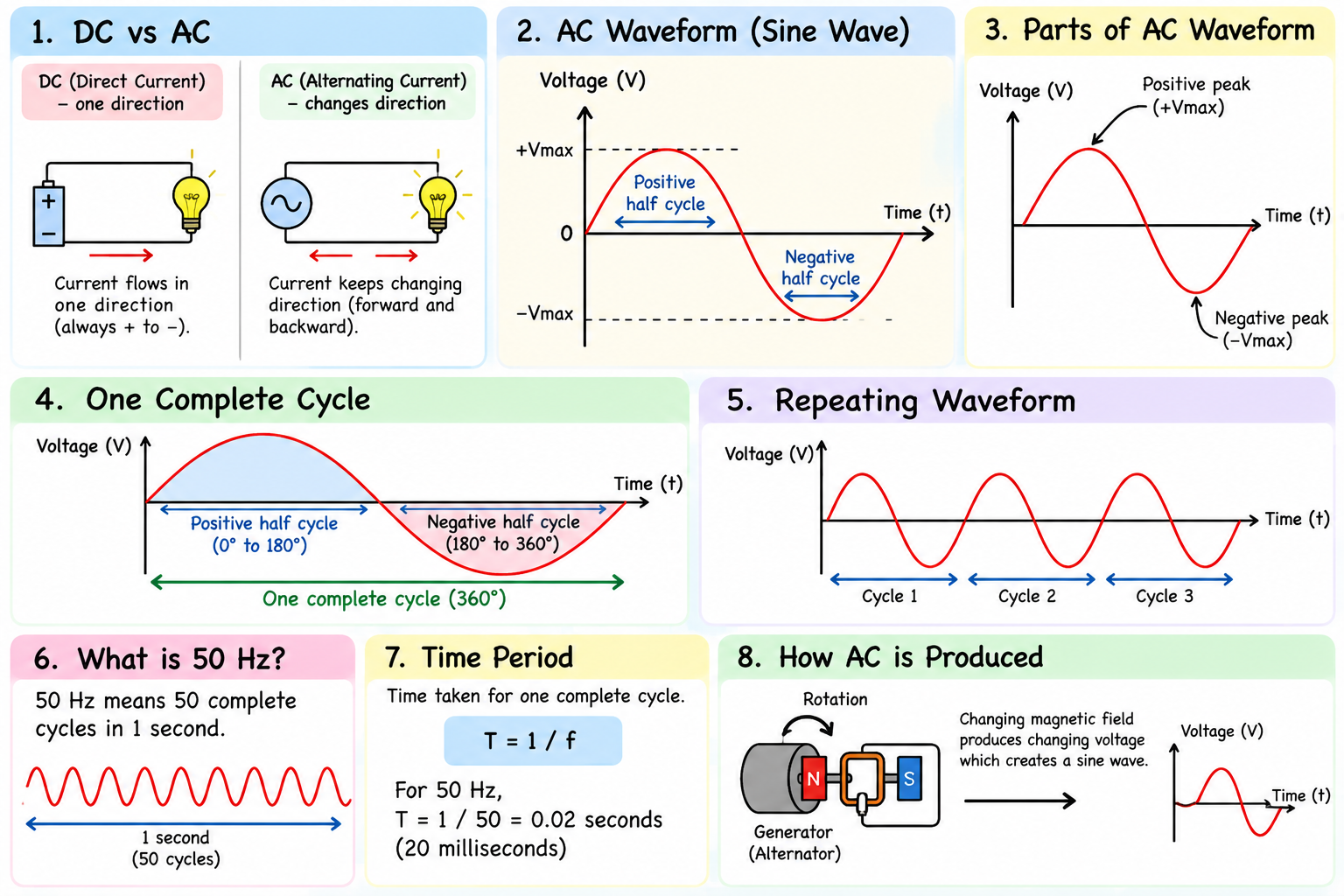
What Is AC Waveform? Simple Explanation of AC Sine Wave
Introduction
If you are new to electrical engineering, the term AC waveform can look confusing at first. You may see a curved line going above and below zero and wonder: What does this wave actually mean?
The good news is that an AC waveform is quite simple once you understand what the graph represents.
An AC waveform is a graph that shows how AC voltage or current changes with time.
In this article, we will understand the AC waveform from the basics, including the meaning of the positive and negative portions of the wave, one complete cycle, frequency, and why AC has a sine-wave shape.
What Is AC?
AC stands for Alternating Current.
The word alternating is important because the direction of AC changes continuously with time.
In DC, or Direct Current, the current normally flows in one direction.
For example, a battery supplies DC:
Battery → Load
The direction of current remains the same.
AC is different because its direction alternates:
→ → → ← ← ← → → → ← ← ←
The direction keeps changing.
Simple Example
Think about moving your hand forward and backward.
You move:
Forward → Backward → Forward → Backward
AC behaves in a similar alternating manner.
However, the actual electrical process is much faster and happens continuously.
What Is an AC Waveform?
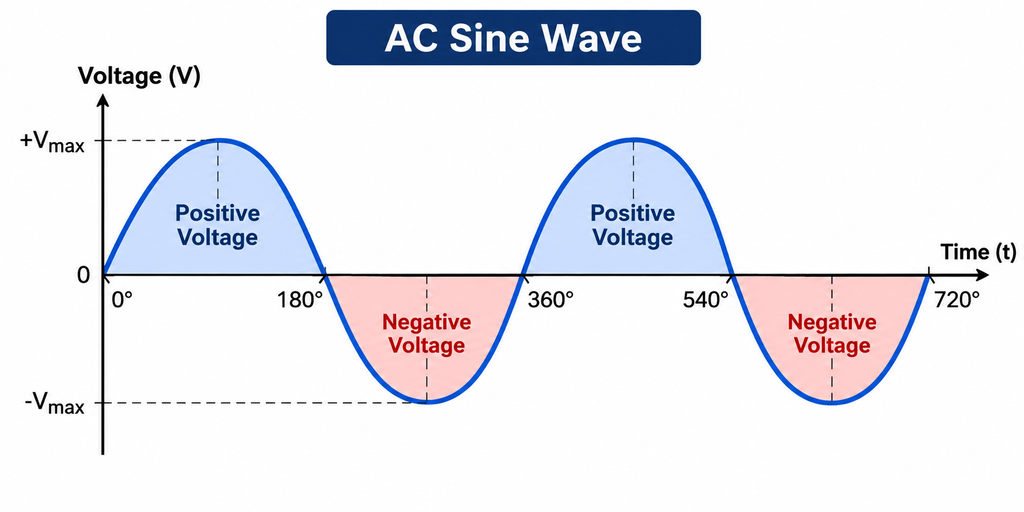
An AC waveform is simply a graphical representation of how AC voltage or current changes with time.
A typical AC waveform looks like this:
The horizontal axis represents time.
The vertical axis represents voltage or current.
The curved line shows how the electrical value changes as time passes.
For a typical AC supply, the waveform is approximately a sine wave.
Therefore, another common name for an AC waveform is an AC sine wave.
Why Does the AC Waveform Go Up and Down?
This is one of the most important things to understand.
Suppose we start measuring an AC voltage at zero.
The voltage increases:
0 → positive value → maximum positive value
Then it decreases:
maximum positive value → positive value → 0
After reaching zero, the polarity reverses.
The voltage becomes negative:
0 → negative value → maximum negative value
Then it returns to zero again.
This process continues repeatedly.
So the waveform looks approximately like:
             Positive peak
                  /\
                 /  \
                /    \
---------------/------\--------------- 0 V
              /        \
             /          \
            /            \
           \/
       Negative peak
The actual waveform is smooth rather than having sharp corners.
Understanding the Positive Half-Cycle
The portion of the sine wave above the zero line is called the positive half-cycle.
It starts at zero, rises to a positive maximum, and then returns to zero.
             Positive
                /\
               /  \
              /    \
-------------/------\------------- 0
During this portion, the voltage has one polarity.
The important point is that positive does not mean that the electricity is simply “stronger.”
The positive and negative signs indicate the instantaneous polarity of the AC voltage.
Understanding the Negative Half-Cycle
After the positive half-cycle finishes, the waveform crosses zero and moves below the zero line.
This is called the negative half-cycle.
-------------\------/------------- 0
              \    /
               \  /
                \/
             Negative
The polarity has now reversed compared with the positive half-cycle.
This reversal of polarity is what gives AC its alternating nature.
Positive Half-Cycle + Negative Half-Cycle = One Cycle
A complete AC cycle contains both portions:
Positive half-cycle + Negative half-cycle = One complete cycle
A complete cycle looks like this:
             Positive
                /\
               /  \
--------------/----\--------------
                     \
                      \
                       \/
                    Negative
After one complete cycle, the waveform returns to the same starting condition.
The same pattern then repeats again and again.
Why Does AC Keep Repeating?
AC is produced by electrical generators, also called alternators.
Inside an alternator, mechanical rotation and magnetic fields work together to produce a changing electrical voltage.
As the generator rotates, the voltage changes continuously.
The polarity also changes during the rotation.
This produces an alternating voltage.
In a simplified form:
Generator rotation
↓
Changing magnetic conditions
↓
Changing voltage
↓
Polarity reverses
↓
Alternating voltage
↓
AC waveform
The resulting voltage can be represented by a sine wave.
Is the AC Waveform a Physical Wave?
This is an important point for beginners.
When we look at a sine wave on paper, it may appear that a physical wave is traveling through the electrical cable.
But an AC waveform is primarily a graphical representation.
It shows how voltage or current changes with time.
For example, if we measure the voltage at different moments and plot those measurements on a graph, we can obtain a sine-wave pattern.
So:
AC waveform = graphical representation of changing AC voltage or current
It is not simply a physical wave shape inside the wire.
What Does 50 Hz Mean in AC?
If you work with electrical systems in India, you will commonly encounter 50 Hz AC supply.
The term Hz, or hertz, represents frequency.
Frequency tells us how many complete cycles occur in one second.
Therefore:
50 Hz = 50 complete cycles per second
We can imagine it like this:
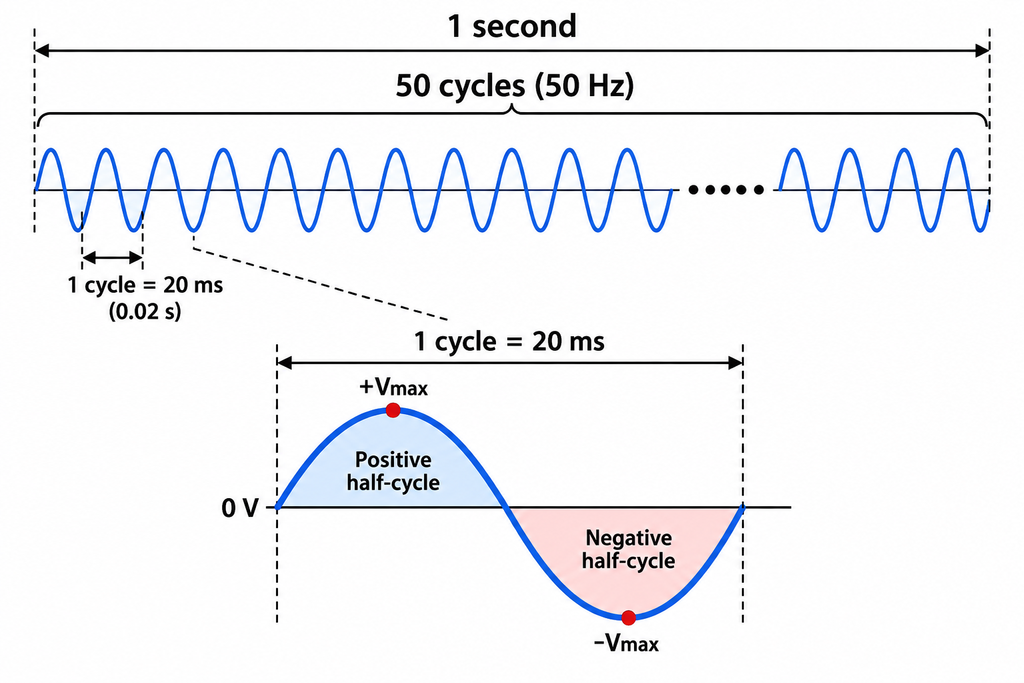
The waveform is repeating extremely quickly.
You cannot see the individual cycles with your eyes, but instruments such as oscilloscopes can display the waveform.
What Is the Time Period of an AC Waveform?
The time period is the time required to complete one full cycle.
The relationship between frequency and time period is:
T = 1 / f
Where:
- T = time period in seconds
- f = frequency in hertz
For a 50 Hz supply:
T = 1 / 50
T = 0.02 seconds
Therefore, one complete cycle takes:
0.02 seconds = 20 milliseconds
So a 50 Hz AC waveform completes one full cycle every 20 milliseconds.
What Is Peak Voltage?
Look at the highest point of the AC sine wave.
This is called the positive peak.
The lowest point is the negative peak.
The maximum magnitude reached by the waveform is called the peak value.
A simplified waveform looks like:
                 + Peak
                   /\
                  /  \
                 /    \
----------------/------\----------------
                \      /
                 \    /
                  \  /
                   \/
                 - Peak
Peak voltage is important when designing and analyzing electrical equipment because the instantaneous voltage can be higher than the commonly stated AC supply voltage.
This leads to an important concept called RMS voltage, which should be learned separately.
AC Waveform vs DC
The easiest way to understand the difference is to compare their behavior.
| Feature | DC | AC |
|---|---|---|
| Full form | Direct Current | Alternating Current |
| Direction | Generally one direction | Continuously alternates |
| Typical graph | Constant level | Usually sinusoidal |
| Polarity | Normally remains the same | Changes periodically |
| Frequency | Normally 0 Hz for steady DC | Common power systems use 50 Hz or 60 Hz |
For a simple DC supply, the voltage may look approximately like a straight horizontal line.
AC looks like a repeating waveform.
Why Is the AC Waveform Called a Sine Wave?
The mathematical shape of a typical ideal AC voltage is described using the sine function.
That is why it is called a sine wave or sinusoidal waveform.
For beginners, you do not need to start with the mathematical equation.
First understand the physical idea:
Voltage changes smoothly → reaches a positive maximum → returns to zero → reverses polarity → reaches a negative maximum → returns to zero → repeats.
Once this concept is clear, the mathematical sine-wave equation becomes much easier to understand.
AC Waveform in Simple Words
You can remember the entire concept using this sequence:
Starts at zero
↓
Voltage increases
↓
Reaches positive peak
↓
Returns to zero
↓
Polarity reverses
↓
Reaches negative peak
↓
Returns to zero
↓
The cycle repeats
This repeating pattern is the AC waveform.
Why Is Understanding AC Waveform Important for Electrical Engineers?
Understanding the AC waveform is not just a basic theory topic.
It forms the foundation for many electrical engineering concepts.
Once you understand the waveform, it becomes easier to learn:
- RMS voltage
- Peak voltage
- Average value
- Frequency
- Time period
- Phase
- Phase angle
- Three-phase AC
- 120° phase difference
- Power factor
- Transformers
- Motors
- Alternators
- Electrical protection
- Switchgear
- Electrical measurements
For EPC electrical design, these concepts eventually connect to equipment such as transformers, motors, generators, switchgear, UPS systems, and distribution panels.
AC Waveform: Simple Example
Imagine watching the voltage of an AC supply for a short period.
At one moment, the voltage is:
0 V
A little later:
+100 V
Then:
+200 V
Then:
Positive maximum
Then it comes back:
+200 V → +100 V → 0 V
Then the polarity reverses:
0 V → -100 V → -200 V
Then it reaches its negative maximum and returns:
-200 V → -100 V → 0 V
The same pattern repeats.
That changing value is what the AC waveform represents.
Frequently Asked Questions About AC Waveform
What is an AC waveform?
An AC waveform is a graph that shows how alternating voltage or current changes with time. A typical AC power waveform has a sinusoidal shape.
Why does an AC waveform go positive and negative?
The positive and negative portions represent the changing polarity of the alternating voltage. When the polarity reverses, the waveform crosses the zero line and moves into the negative portion.
What is one AC cycle?
One complete positive and negative sequence is called one cycle.
What does 50 Hz mean?
50 Hz means the AC waveform completes 50 complete cycles every second.
How long does one 50 Hz cycle take?
A 50 Hz cycle takes 0.02 seconds, or 20 milliseconds.
Is the AC sine wave actually moving through the wire?
The sine wave is a graphical representation of how voltage or current changes with time. It should not be interpreted simply as a physical wave shape inside the cable.
What is the difference between AC and DC?
DC generally maintains one direction of current, while AC periodically changes direction and polarity.
Conclusion
The AC waveform is simply a way of showing how alternating voltage or current changes with time.
The waveform rises from zero to a positive value, reaches a positive peak, returns to zero, reverses polarity, reaches a negative peak, and returns to zero. This complete process is called one AC cycle.
For a 50 Hz AC system, this cycle repeats 50 times every second.
Once you understand this simple waveform, concepts such as RMS voltage, peak voltage, frequency, phase, and three-phase AC become much easier to learn.
The most important idea to remember is:
AC waveform = a graph showing the continuous change of AC voltage or current with time.