
How Is Electrical Power Generated?
Have you ever wondered how electricity is actually produced at a power plant? We use electricity every day for lights, fans, motors, computers, pumps, compressors and thousands of other applications, but the electricity coming from a wall socket did not simply appear there. It was produced by converting another form of energy into electrical energy.
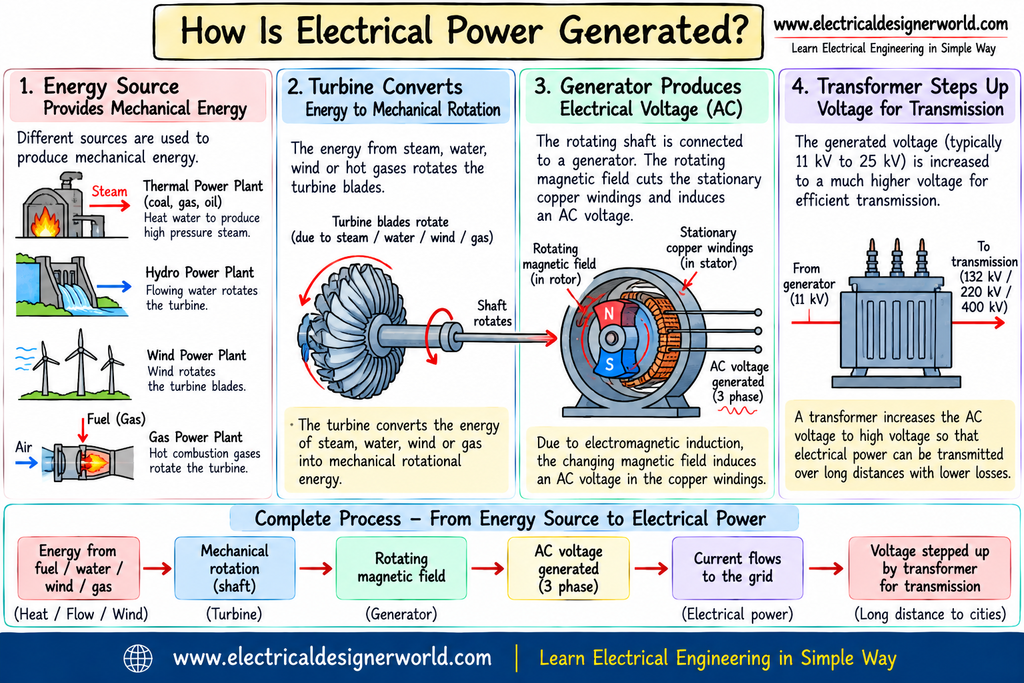
The basic idea behind most large-scale electricity generation is surprisingly simple. Some form of energy is first used to create mechanical rotation. That rotation drives a generator, and the generator converts the mechanical energy into electrical energy using electromagnetic induction. The generated electricity is then passed through transformers and electrical networks before reaching industries, buildings and homes.
The complete process can be remembered as:
Energy Source → Mechanical Rotation → Generator → Electrical Power → Transformer → Transmission → Distribution → Load
This article explains each step in simple language.
What Does It Mean to Generate Electricity?
When we say that a power plant generates electricity, it does not mean that energy is created from nothing.
Instead, one form of energy is converted into another form.
For example, a thermal power plant uses the energy stored in fuel. A hydroelectric plant uses the energy of moving water. A wind turbine uses the kinetic energy of wind. These different energy sources can ultimately be used to rotate a generator and produce electrical energy. Electricity is therefore considered a secondary energy source because it is produced by converting other energy sources into electrical power.
A very simple way to understand this is:
Energy source → Mechanical energy → Electrical energy
The generator is the important machine in the middle of this process.
Where Does the Energy Come From?
Different power plants start with different energy sources, but their purpose is generally the same: provide mechanical energy to the generator.
In a thermal power plant, fuel such as coal or natural gas can be used to produce heat. That heat is used to produce steam, and the steam rotates a steam turbine. In a hydroelectric plant, flowing or falling water directly rotates a hydraulic turbine. In a wind turbine, moving air rotates the turbine blades. Gas turbines use hot combustion gases to rotate turbine blades. These turbine-driven systems are widely used for electricity generation.
So although the energy source may be different, the next important step is often the same:
Something must rotate the generator.
The important thing to understand from this diagram is that the energy source itself does not usually produce the electrical voltage directly in a conventional turbine-generator plant. Instead, it provides the mechanical energy needed to rotate the generator.
How Does a Turbine Produce Rotation?
A turbine is a machine that converts the energy of a moving fluid or air into mechanical rotational energy.
Imagine a bicycle wheel. If you push the wheel with your hand, it rotates. A turbine works on a similar basic idea, but instead of a person pushing the wheel, a powerful flow of steam, water, gas or air pushes specially designed blades.
In a steam power plant, high-pressure steam enters the turbine and pushes the turbine blades. The blades rotate, and this rotation is transferred through a shaft.
In a hydroelectric plant, water flowing through the turbine creates the force required to rotate the turbine.
In a wind turbine, moving air pushes the blades and causes the rotor to turn.
The turbine therefore acts as the mechanical link between the energy source and the generator.
The simple sequence is:
Steam / Water / Gas / Wind → Turbine → Rotating Shaft
The Turbine Shaft Is Connected to the Generator
The rotating turbine shaft is connected to a generator.
This is where the process becomes electrical.
The turbine provides mechanical rotation, while the generator converts that mechanical rotation into electrical energy.
Think of the generator as a machine that takes rotation as its input and produces electrical power as its output.
Input to generator: Mechanical rotation
Output from generator: Electrical power
This is one of the most important concepts to understand in electrical engineering.
What Is Inside an Electrical Generator?
A typical electromagnetic generator contains two major parts called the rotor and the stator.
The rotor is the rotating part of the machine.
The stator is the stationary part.
In many large generators, the rotor produces a rotating magnetic field while the stator contains the stationary electrical windings. As the magnetic field rotates relative to the stator windings, a voltage is induced in those windings.
This principle is called electromagnetic induction.
A simple representation is:
Rotating magnetic field → Stationary copper windings → Induced voltage
How Does a Magnetic Field Produce Voltage?
This is the most important part of understanding how electricity is generated.
You may remember from the earlier article that voltage creates an electric field and can cause current to flow when a closed circuit is available.
But where does the generator’s voltage come from?
The answer is electromagnetic induction.
When a magnetic field moves relative to a conductor, it can induce an electromotive force, or EMF, in that conductor.
Imagine a copper coil placed near a magnet. If the magnetic field remains completely unchanged relative to the coil, there is no continuous induced voltage simply from that static condition.
But if the magnet moves relative to the coil, the magnetic flux through the coil changes. This changing magnetic condition induces voltage in the conductor.
A generator continuously creates this changing magnetic relationship by rotating its magnetic field.
The easiest way to remember it is:
Rotation + Magnetic Field + Conductors = Induced Voltage
The generator does not manufacture electrons. The copper windings already contain free electrons. The changing magnetic field creates the electrical force that causes charge to move when the circuit is connected.
This is why electromagnetic induction is at the heart of conventional electrical generation.
How Does the Generator Produce AC Electricity?
In a large AC generator, the magnetic field rotates continuously.
As the magnetic field rotates, the magnetic influence experienced by the stator windings changes continuously.
The induced voltage therefore changes with time.
The voltage rises, falls, changes polarity and repeats.
This produces an alternating voltage, or AC voltage.
That is why most large conventional generators produce AC electricity.
The waveform can be represented approximately as:
Positive → Zero → Negative → Zero → Positive
The number of complete cycles produced every second is the frequency.
For a 50 Hz system, the electrical waveform completes approximately 50 cycles every second.
This connects directly to the previous article about electrical frequency.
Why Do Generators Produce Three-Phase Electricity?
Large power systems commonly use three-phase AC generation.
A three-phase generator has three sets of electrical windings arranged so that the generated voltages are separated by 120 electrical degrees.
As the rotor rotates, each winding experiences the changing magnetic field and produces an alternating voltage.
The result is three sinusoidal voltages with the same frequency but different phase positions.
This is called a three-phase AC system.
Three-phase electricity is especially useful for industrial applications because it can efficiently transfer power and is well suited for operating three-phase motors.
This is why you frequently see electrical systems described as:
415 V, 3 Phase, 50 Hz
in industrial projects.
What Determines Generator Frequency?
The frequency produced by a synchronous generator depends mainly on the rotor speed and the number of magnetic poles.
The relationship is:
f = P × N / 120
where:
f = Frequency in Hz
P = Number of poles
N = Generator speed in RPM
For example, a two-pole generator rotating at 3000 RPM produces:
f = 2 × 3000 / 120
f = 50 Hz
A four-pole generator operating at 1500 RPM also produces:
f = 4 × 1500 / 120
f = 50 Hz
This is why generator speed and electrical frequency are closely connected.
What Happens When Current Is Drawn From the Generator?
Once the generator produces voltage, it can supply a connected electrical circuit.
When the circuit is closed and a load is connected, electrical current flows through the circuit.
For example, if a generator supplies a motor, current flows from the generator through the electrical system to the motor and returns through the appropriate circuit path.
The generator is therefore supplying electrical power to the connected load.
In simple terms:
Generator produces voltage → Circuit is connected → Current flows → Load receives electrical power
The amount of electrical power depends on the voltage, current and power factor of the system.
For a three-phase AC system, a commonly used power relationship is:
P = √3 × V × I × cos φ
where:
P = Active power
V = Line-to-line voltage
I = Line current
cos φ = Power factor
This is an important equation that you will use later when learning electrical load calculations and EPC design.
Is the Generator Creating Energy?
No.
The generator is converting energy.
For example, imagine a gas turbine power plant.
Chemical energy in the fuel is converted into thermal energy during combustion. The hot gases produce mechanical rotation in the turbine. The turbine rotates the generator. The generator converts the mechanical energy into electrical energy.
The overall chain becomes:
Chemical Energy → Thermal Energy → Mechanical Energy → Electrical Energy
In a hydroelectric plant, the chain is different:
Water Energy → Mechanical Energy → Electrical Energy
In a wind turbine:
Wind Energy → Mechanical Energy → Electrical Energy
The generator is therefore an energy conversion machine.
What Happens After Electricity Leaves the Generator?
The voltage produced by a large generator is not normally the same voltage used for long-distance transmission.
The generated voltage is sent to a step-up transformer.
The transformer increases the voltage to a much higher transmission level.
Why?
Because for approximately the same amount of transmitted power, increasing voltage allows the current to be lower.
Since conductor losses are related to current, reducing current can significantly reduce transmission losses.
The simplified relationship is:
P ≈ V × I
So for a given power:
Higher voltage → Lower current
And lower current means lower I²R losses in transmission conductors.
This is why electrical power systems use high voltages for transmission.
The complete path can now be understood as:
Energy Source → Turbine → Generator → Step-Up Transformer → Transmission Lines → Substation → Distribution → Consumer
The electrical grid connects generating stations, substations, transformers and consumers into a large interconnected system.
Why Is a Transformer Needed?
Suppose a generator produces electrical power at a certain voltage.
A transformer can increase that voltage before the electricity enters the transmission network.
Later, substations use transformers to reduce the voltage to suitable levels for distribution and consumption.
Therefore, transformers act as important voltage-changing equipment throughout the electrical power system.
The basic sequence is:
Generator → Step-Up Transformer → Transmission
Then:
Transmission → Step-Down Transformer → Distribution → Load
This is one of the most important concepts for understanding a power-system single-line diagram.
How Does This Appear in an EPC Electrical SLD?
If you are an EPC electrical designer, you will often see this entire process represented in a Single Line Diagram (SLD).
A simplified power-generation SLD may look like:
Generator
↓
Generator Circuit Breaker
↓
Step-Up Transformer
↓
HV Switchgear / Substation
↓
Transmission Line
↓
Receiving Substation
↓
Step-Down Transformer
↓
MV/LV Switchgear
↓
Cable
↓
Motor / Pump / Compressor / Other Load
The SLD does not show every physical conductor. Instead, it gives you a simplified representation of how electrical power moves through the system.
This is why understanding power generation is extremely useful when learning how to read an SLD.
How Does a Power Plant Control Generator Output?
A generator must operate according to the requirements of the electrical system.
Two important quantities are voltage and frequency.
The generator’s mechanical input and electrical output must be controlled so that the power system remains stable.
For a synchronous generator connected to a large grid, the grid frequency is closely related to the system’s generation-demand balance. If demand changes, generators and grid controls respond to maintain system operation.
Power-system operators continuously balance generation and demand because electricity generation and consumption must be matched very closely in real time.
This is one reason power generation is much more than simply rotating a generator.
What About Diesel Generators?
Not every generator uses a large steam, hydro or gas turbine.
A diesel generator, commonly called a DG set, uses a diesel engine to provide mechanical rotation.
The basic arrangement is:
Diesel Fuel → Diesel Engine → Rotating Shaft → Alternator → Electrical Power
Here, the diesel engine acts as the prime mover.
The alternator is the electrical generator.
The engine burns fuel and produces mechanical rotation. The alternator converts that mechanical rotation into electrical power through electromagnetic induction.
Diesel generators are widely used as backup power sources for buildings, industries, construction sites and other facilities.
What About Solar Power?
Solar photovoltaic generation works differently.
A solar PV panel does not normally use a rotating turbine and conventional electromagnetic generator.
Instead, photovoltaic cells convert sunlight directly into electrical energy.
The electricity produced by solar PV is DC. Power electronic equipment such as an inverter can convert that DC electricity into AC for grid connection or AC loads.
So there are two important generation paths to remember:
Conventional rotating generation:
Energy → Turbine/Engine → Generator → AC
Solar PV generation:
Sunlight → PV Cell → DC Electricity → Inverter → AC
This distinction becomes important when studying modern electrical power systems.
The Complete Story of How Electrical Power Is Generated
Now we can connect everything together.
First, an energy source provides the energy required by the power plant. Depending on the plant, this may come from fuel, water, wind, nuclear energy or another source.
Next, that energy is converted into mechanical rotation in systems that use turbines or engines. The rotating shaft is connected to a generator.
Inside the generator, the rotating magnetic field moves relative to stationary electrical windings. This changing magnetic condition induces an electrical voltage in the windings through electromagnetic induction.
When an electrical load is connected, current flows and electrical power is delivered.
The generated electrical power then passes through a transformer, which can increase the voltage for efficient transmission. The electricity travels through the transmission network to substations, where transformers reduce the voltage for distribution and ultimately for use by electrical loads.
So the entire journey can be remembered as:
Energy Source
↓
Mechanical Energy
↓
Turbine / Engine
↓
Rotating Shaft
↓
Generator
↓
Electromagnetic Induction
↓
AC Voltage
↓
Current Flows to Load
↓
Step-Up Transformer
↓
Transmission
↓
Substation
↓
Distribution
↓
Electrical Load
How Is Electrical Power Generated? — The Simplest Explanation
If you remember only one thing from this article, remember this:
A generator converts mechanical energy into electrical energy.
The mechanical energy comes from something that rotates the generator, such as a steam turbine, gas turbine, water turbine, wind turbine or diesel engine.
The generator uses a changing magnetic field and electrical windings to produce voltage through electromagnetic induction.
When a load is connected, current flows and electrical power is delivered.
The basic idea is therefore:
Rotation + Magnetic Field + Conductors → Electrical Voltage
And:
Electrical Voltage + Current → Electrical Power
That simple concept is the foundation of large-scale electrical power generation.
Frequently Asked Questions
How is electricity generated?
Electricity is generated by converting another form of energy into electrical energy. In conventional power plants, an energy source rotates a turbine or engine, which drives a generator. The generator uses electromagnetic induction to produce electrical voltage.
What is the main principle used in an electrical generator?
The main principle is electromagnetic induction. A changing magnetic field relative to a conductor induces voltage in the conductor.
Does a generator create electrons?
No. Conductors already contain free electrons. The generator’s changing magnetic field creates an electrical force that causes charge to move through the circuit.
What rotates a generator?
A generator can be rotated by a steam turbine, gas turbine, water turbine, wind turbine, diesel engine or another mechanical prime mover.
Why does a power plant use a turbine?
A turbine converts the energy of moving steam, water, gas or air into mechanical rotational energy that can drive a generator.
Why is electricity generated as AC?
Large electromagnetic generators can naturally produce alternating voltage as their magnetic field rotates relative to the stator windings. AC is also well suited to transformer-based transmission and distribution systems.
Why is a transformer used after a generator?
A step-up transformer increases voltage so that electrical power can be transmitted at lower current, reducing resistive losses in transmission conductors.
What is the difference between a generator and a turbine?
The turbine produces mechanical rotation, while the generator converts that mechanical rotation into electrical energy.
How does a diesel generator work?
A diesel engine burns fuel and produces mechanical rotation. The rotating engine shaft drives an alternator, which converts the mechanical energy into electrical power.
How does solar power generate electricity?
Solar photovoltaic cells convert sunlight directly into DC electrical energy. An inverter can then convert the DC output into AC for suitable loads or grid connection.
Conclusion
Electrical power generation is basically an energy-conversion process.
A power plant starts with an energy source. That energy is converted into mechanical rotation, usually through a turbine or engine. The rotating shaft drives a generator. Inside the generator, a changing magnetic field interacts with electrical windings and produces voltage through electromagnetic induction.
When a load is connected, current flows and electrical power is delivered. Transformers then change the voltage to appropriate levels for transmission and distribution.
For an EPC electrical designer, understanding this complete process makes it much easier to understand generators, transformers, switchgear, substations, SLDs, cables, motors and electrical distribution systems.
The complete electrical power journey can be remembered in one line:
Energy Source → Turbine/Engine → Generator → Transformer → Transmission → Substation → Distribution → Load
⚡ Once you understand this flow, the next important question is:
What exactly happens inside the generator when the rotor starts rotating?
That leads to the next fundamental concept: How an Alternator Generates Three-Phase AC Voltage.