
What Is Frequency in Electrical?
When we learn about AC and DC, we learn that AC voltage changes with time and repeatedly changes its polarity. This leads to an important question: how quickly does the AC voltage change?
The answer is frequency.
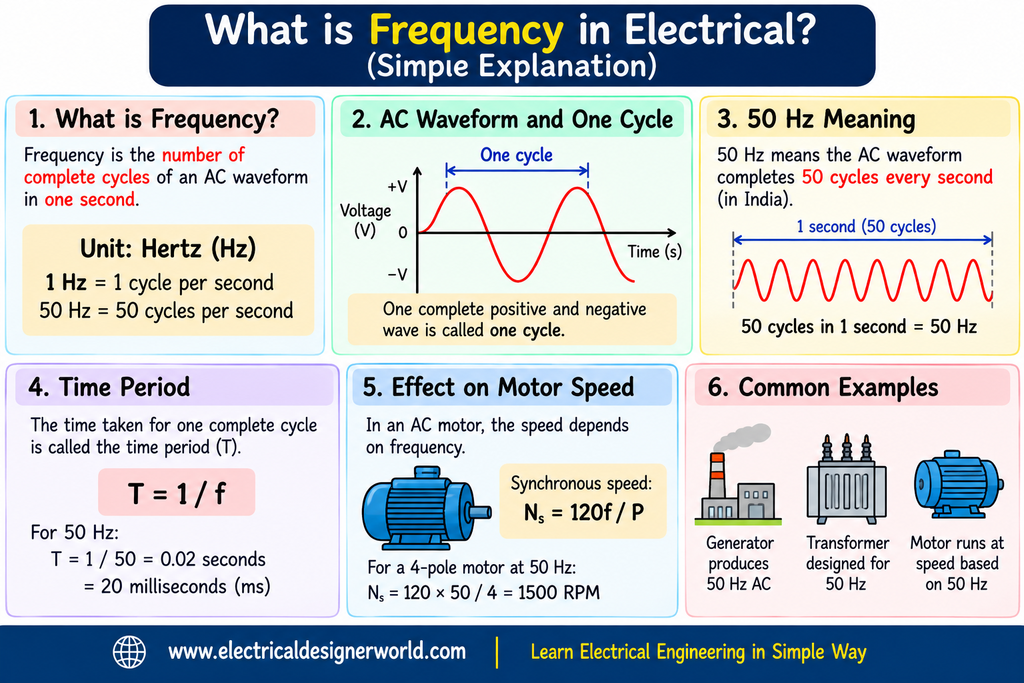
In simple terms, frequency tells us how many complete repetitions, or cycles, an AC waveform makes in one second. Frequency is measured in Hertz (Hz). Therefore, 1 Hz means one cycle per second, while 50 Hz means 50 cycles per second.
Frequency is an important part of electrical engineering because it affects generators, motors, transformers, VFDs, power systems and many other electrical equipment.
What Is a Cycle in AC?
To understand frequency, we first need to understand a cycle.
An AC voltage continuously changes its value and polarity. Starting from zero, the voltage can rise to a positive peak, return to zero, become negative, reach a negative peak and finally return to zero.
The complete pattern is one cycle.
It can be represented simply as:
Zero → Positive → Zero → Negative → Zero
Once the waveform returns to the same point and begins repeating, another cycle starts.
A typical AC waveform therefore looks approximately like this:
Voltage

   +V        /‾‾\        /‾‾\
            /    \      /    \
    0 -----/------\----/------\------ Time
          /        \  /
   -V    /          \/
The number of these complete cycles occurring in one second is the frequency.
What Does 50 Hz Mean?
When you see 50 Hz on an electrical system, it means the AC waveform completes 50 complete cycles every second.
It is important not to confuse frequency with voltage.
For example:
230 V, 50 Hz
means:
230 V → Rated voltage
50 Hz → Rated frequency
The voltage tells us about the electrical potential difference, while the frequency tells us how quickly the AC waveform repeats.
Similarly, an industrial supply may be described as:
415 V, 3 Phase, 50 Hz
Here, 415 V refers to the rated line-to-line voltage, 3 Phase describes the type of AC system, and 50 Hz is the nominal frequency.
Why Is Frequency Measured in Hertz?
The unit of frequency is Hertz, abbreviated as Hz.
It is named after the physicist Heinrich Hertz.
For electrical engineering, the important thing to remember is simply:
Hz = cycles per second
So:
1 Hz = 1 cycle/second
50 Hz = 50 cycles/second
60 Hz = 60 cycles/second
The number tells us how frequently a periodic waveform repeats.
What Is the Time Period?
Frequency and time period are directly related.
The time period is the amount of time required for one complete cycle.
It is represented by the symbol T.
The relationship is:
T = 1/f
where:
T = Time period in seconds
f = Frequency in Hertz
For a 50 Hz supply:
T = 1/50
T = 0.02 seconds
Therefore, one complete 50 Hz cycle takes:
20 milliseconds
For a 60 Hz supply:
T = 1/60
T ≈ 0.0167 seconds
or approximately:
16.67 milliseconds
This shows that a higher frequency means each cycle takes less time.
Why Is the Indian Power System 50 Hz?
India’s electrical grid operates around a nominal frequency of 50 Hz. Grid standards define the acceptable operating range around this nominal value.
This means electrical equipment designed for the Indian power system is commonly designed around a 50 Hz supply.
For example, you will commonly see equipment ratings such as:
415 V, 3 Phase, 50 Hz
or:
11 kV, 3 Phase, 50 Hz
The 50 Hz value becomes part of the design basis for equipment connected to the AC system.
It is important to understand that the actual grid frequency can vary slightly around its nominal value. The grid is continuously controlled so that frequency remains within the required operating limits.
Why Does Grid Frequency Matter?
The electrical grid contains generators and loads that must operate together.
Generators supply electrical power while industrial facilities, buildings and other consumers take electrical power from the system.
If electrical demand suddenly increases and generation does not immediately increase to match it, the system frequency tends to decrease.
If generation exceeds demand, the frequency tends to increase.
In simple terms:
Generation < Demand → Frequency tends to decrease
Generation > Demand → Frequency tends to increase
This is a simplified explanation, but it helps us understand why grid operators continuously monitor system frequency.
Frequency is therefore not just a number written on an equipment nameplate. It is also an important indicator of the balance between generation and demand in an interconnected power system.
How Does a Generator Produce a Specific Frequency?
To understand the connection between frequency and generators, we need to look at the rotating machine.
An AC generator converts mechanical energy into electrical energy using electromagnetic induction.
As the generator rotates, its magnetic field interacts with the stator windings and produces a changing electrical voltage.
The speed of rotation and the number of magnetic poles determine the frequency of the generated voltage.
For a synchronous generator:
f = P × N / 120
where:
f = Frequency in Hz
P = Number of poles
N = Speed in RPM
For example, consider a two-pole generator rotating at 3000 RPM:
f = 2 × 3000 / 120
f = 50 Hz
Now consider a four-pole generator rotating at 1500 RPM:
f = 4 × 1500 / 120
f = 50 Hz
Both machines produce a 50 Hz electrical frequency, but they operate at different mechanical speeds because they have different numbers of poles.
This relationship is very important when studying generators and power plants.
Frequency and Motor Speed
Frequency is also closely related to the speed of AC motors.
The synchronous speed of an AC machine can be calculated using:
Ns = 120f / P
where:
Ns = Synchronous speed in RPM
f = Frequency in Hz
P = Number of poles
For example, consider a four-pole motor operating at 50 Hz:
Ns = 120 × 50 / 4
Ns = 1500 RPM
Therefore, the synchronous speed is 1500 RPM.
An induction motor normally operates slightly below its synchronous speed because of slip.
For example, a four-pole induction motor connected to a 50 Hz supply may have a rated speed around 1480 RPM rather than exactly 1500 RPM.
This is one reason frequency is very important when working with industrial motors.
What Happens When Motor Frequency Changes?
If the frequency supplied to an AC motor changes, its operating speed also changes.
This is the basic principle behind a Variable Frequency Drive (VFD).
A VFD can control the frequency supplied to an AC motor, allowing the motor speed to be adjusted according to the application.
For example, a motor operating around 50 Hz may run at a lower speed when the VFD reduces the frequency, subject to the motor’s characteristics and control method.
This is extremely useful in industrial equipment such as:
- Pumps
- Fans
- Compressors
- Conveyors
- HVAC systems
Instead of running a motor continuously at one fixed speed, a VFD can allow the motor to operate at different speeds when required.
Why Is Frequency Important for Transformers?
Frequency is also an important consideration in transformer design.
A transformer works using alternating magnetic flux in its core. The relationship between voltage, frequency, winding turns and magnetic flux means the transformer must be designed for its intended frequency.
A simplified relationship is:
V ∝ f × N × Φ
where:
V = Voltage
f = Frequency
N = Number of turns
Φ = Magnetic flux
One important practical point is that reducing frequency while keeping voltage unchanged can increase the magnetic flux in the transformer core.
If the flux becomes too high, the core can approach saturation, causing excessive magnetizing current and heating.
This is why transformer nameplates specify a rated frequency.
For example:
Transformer: 11 kV / 415 V, 50 Hz
The 50 Hz rating is part of the transformer’s intended operating conditions.
Frequency in Three-Phase Systems
Frequency is also important in three-phase electrical systems.
A three-phase system contains three AC voltages having the same frequency but separated from each other by 120 electrical degrees.
For example, an industrial electrical system may be specified as:
415 V, 3 Phase, 50 Hz
The three values describe different characteristics.
415 V tells us the rated line-to-line voltage.
3 Phase tells us the phase arrangement.
50 Hz tells us the nominal frequency.
Understanding these three terms is essential when reading electrical equipment datasheets and single-line diagrams.
Frequency in EPC Electrical Design
If you are working in EPC electrical design, you will see frequency repeatedly throughout project documents.
Equipment datasheets may specify:
Voltage
Frequency
Number of phases
Power
Current
Power factor
For example, a motor datasheet might specify:
415 V / 3 Phase / 50 Hz / 110 kW
The electrical designer needs to ensure that the electrical system supplying the motor matches the equipment requirements.
Frequency can therefore appear in:
Motor datasheets
Transformer datasheets
Generator specifications
Switchgear specifications
UPS specifications
VFD specifications
Electrical load lists
Single-line diagrams
Equipment schedules
This makes frequency an important part of practical EPC electrical engineering.
Frequency and Switchgear
Switchgear is designed for a particular electrical system and has several important ratings.
A switchgear specification may include:
Rated voltage
Rated current
Short-circuit withstand rating
Number of phases
Frequency
For example:
11 kV, 3 Phase, 50 Hz
means the switchgear is intended for a three-phase 11 kV system with a nominal frequency of 50 Hz.
Frequency is therefore one of the parameters that must be considered when checking equipment compatibility with the electrical system.
Frequency and VFD Applications
VFDs make the relationship between frequency and motor speed particularly easy to understand.
A simplified system looks like:
AC Supply → VFD → Motor
The VFD controls the electrical output supplied to the motor.
One of the important variables is frequency.
When the frequency changes, the motor’s rotating magnetic field speed changes.
This allows industrial equipment to operate at different speeds.
For example, a pump may not need to operate at full speed all the time. Instead of controlling the flow only by restricting the discharge, a VFD can be used to adjust motor speed according to the process requirement.
The exact control strategy depends on the motor, VFD, load and process.
Frequency and Electrical Equipment Selection
When selecting electrical equipment, the frequency must match the system and equipment requirements.
For example, suppose an electrical system is designed as:
415 V, 3 Phase, 50 Hz
The connected equipment should be checked for compatibility with these electrical characteristics.
This includes motors, transformers, generators, switchgear, UPS systems and other equipment.
Frequency is particularly important for equipment whose operation depends strongly on electromagnetic behavior or rotational speed.
50 Hz vs 60 Hz
Some electrical systems around the world operate at 50 Hz, while others operate at 60 Hz.
The basic difference is the number of cycles completed per second.
At 50 Hz:
One cycle = 20 ms
At 60 Hz:
One cycle ≈ 16.67 ms
The difference can affect equipment design and operating characteristics.
For example, motor synchronous speed depends directly on frequency.
Consider a four-pole machine.
At 50 Hz:
Ns = 120 × 50 / 4 = 1500 RPM
At 60 Hz:
Ns = 120 × 60 / 4 = 1800 RPM
So changing the frequency changes the synchronous speed.
This is why equipment designed for a particular frequency must be checked before being connected to another frequency system.
Does Frequency Mean Speed?
Frequency and speed are not the same thing.
Frequency is measured in:
Hertz (Hz)
Mechanical rotational speed is measured in:
RPM
However, they can be related.
For a synchronous machine:
Ns = 120f/P
This relationship explains why changing electrical frequency affects the rotating magnetic field speed of an AC motor.
So frequency and speed are different quantities, but they can be mathematically connected in electrical machines.
Does Frequency Affect Cable Sizing?
For normal industrial power cables operating at 50 Hz, frequency is generally not the main parameter used to determine the cable’s current-carrying capacity.
Cable sizing normally involves factors such as:
Load current
Installation method
Ambient temperature
Grouping
Voltage drop
Short-circuit withstand
Cable construction
Insulation
However, frequency can become important in special applications involving higher frequencies, harmonics and other electromagnetic effects.
For normal EPC power distribution at 50 Hz, the designer follows the project’s electrical design criteria and applicable standards when selecting cables.
Frequency and Harmonics
Frequency also becomes important when studying harmonics.
The fundamental frequency of an Indian AC power system is nominally 50 Hz.
A harmonic is a sinusoidal component whose frequency is an integer multiple of the fundamental frequency.
For a 50 Hz system:
1st harmonic = 50 Hz
2nd harmonic = 100 Hz
3rd harmonic = 150 Hz
5th harmonic = 250 Hz
Harmonics can be produced by nonlinear loads such as variable frequency drives, power electronic converters, UPS systems and other electronic equipment.
This is why frequency becomes even more important when you move from basic electrical engineering into power quality.
A Simple Practical Example
Imagine you are working on an industrial project and receive a motor datasheet stating:
Motor: 415 V, 3 Phase, 50 Hz, 110 kW
The voltage tells you the motor’s rated supply voltage.
The three-phase rating tells you the type of AC supply.
The 50 Hz rating tells you the intended electrical frequency.
The 110 kW value tells you the motor’s rated power.
These values are then used throughout the electrical design process.
The motor may appear in the load list, then contribute to the load calculation, and eventually affect equipment selection, cable sizing, breaker selection and other parts of the electrical design.
So a simple value such as 50 Hz can connect directly to many EPC electrical design activities.
The Complete Story of Frequency
The easiest way to connect everything is to start with the AC generator.
A generator converts mechanical energy into electrical energy.
The generator produces a periodically changing voltage.
One complete repetition of that waveform is one cycle.
The number of cycles completed every second is the frequency.
The frequency depends on the generator’s speed and number of poles.
That frequency becomes part of the electrical power system.
The same frequency affects the operation of motors and is an important design parameter for transformers and other equipment.
So the basic chain is:
Generator → AC Voltage → Frequency → Transmission → Transformer → Switchgear → Cable → Motor/Load
This is how a simple concept from basic electrical engineering connects to a complete industrial electrical system.
The Simplest Way to Remember Frequency
You do not need to memorize a complicated definition.
Remember this:
Frequency tells us how many complete cycles an AC waveform makes every second.
The unit is Hertz (Hz).
For the Indian power system, the nominal frequency is 50 Hz.
That means the AC waveform completes approximately 50 cycles every second.
The time period of each cycle is:
T = 1/f
Therefore:
50 Hz → 20 ms per cycle
And frequency is connected to electrical machines through:
Generator: f = P × N / 120
Motor: Ns = 120f / P
Once these relationships are clear, frequency becomes much easier to understand.
Frequently Asked Questions About Electrical Frequency
What is frequency in electrical engineering?
Frequency is the number of complete cycles of a periodic electrical waveform occurring per second. It is measured in Hertz.
What does 50 Hz mean?
50 Hz means an AC waveform completes 50 complete cycles every second.
What is the frequency of AC supply in India?
The nominal frequency of the Indian power system is 50 Hz, with grid standards defining the permitted operating range around the nominal value.
What is the formula for frequency?
The relationship between frequency and time period is:
f = 1/T
where f is frequency in Hertz and T is the time period in seconds.
What is the time period of 50 Hz?
For a 50 Hz waveform:
T = 1/50 = 0.02 seconds
Therefore, the time period is 20 milliseconds.
How does frequency affect motor speed?
The synchronous speed of an AC machine is related to frequency by:
Ns = 120f/P
Increasing frequency increases synchronous speed for the same number of poles.
Why does a VFD change frequency?
A VFD changes the frequency supplied to an AC motor to control its operating speed, subject to the motor, drive and load characteristics.
Why is frequency important in transformers?
Transformer operation depends on alternating magnetic flux. Frequency is therefore an important part of transformer design, and operating at an unsuitable frequency can affect magnetic flux and core performance.
Is frequency the same as voltage?
No. Voltage and frequency are different electrical quantities. Voltage is measured in volts, while frequency is measured in Hertz.
Is frequency the same as motor RPM?
No. Frequency is measured in Hz and rotational speed is measured in RPM. However, the two are related in AC machines through the number of poles.
Conclusion
Frequency is a fundamental property of an AC electrical system.
It tells us how frequently the electrical waveform repeats. The unit of measurement is Hertz, where one Hertz represents one cycle per second.
The Indian electrical power system operates around a nominal 50 Hz frequency.
Understanding frequency helps you understand why generators operate at particular speeds, why motors have different synchronous speeds, why transformers have frequency ratings, why VFDs can control motor speed and why power-system operators continuously monitor grid frequency.
For an EPC electrical designer, frequency is something you will encounter throughout the project — from equipment datasheets and load lists to motors, transformers, generators, switchgear, VFDs and electrical distribution systems.
The key relationships to remember are:
f = 1/T
f = P × N / 120
Ns = 120f / P
Once frequency is clear, the next natural concept is phase.
You can then understand why a three-phase system has three waveforms separated by 120°, and why three-phase power is so widely used for industrial motors and electrical distribution.
⚡ Next topic: What Is Phase in Electrical? Understanding Single-Phase and Three-Phase AC