
What Is Ampacity? Simple Explanation of Cable Current-Carrying Capacity
What Is Ampacity?
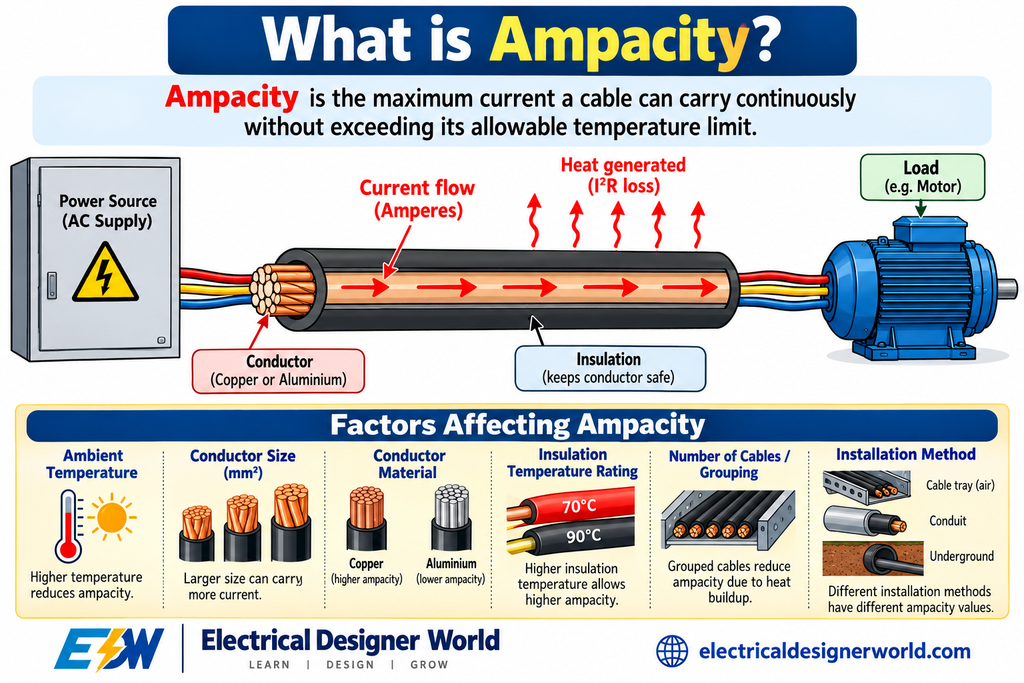
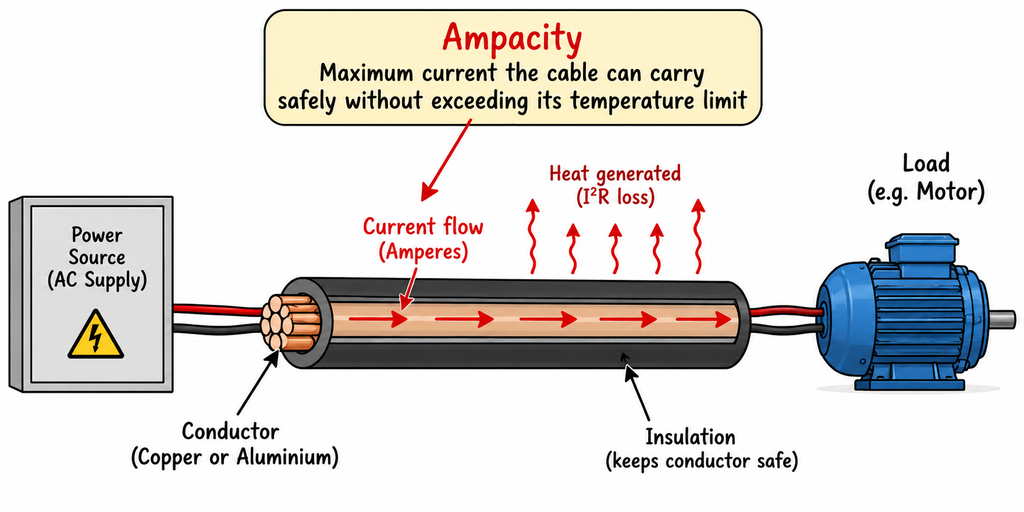
Ampacity means the maximum amount of electrical current that a conductor or cable can carry continuously without exceeding its allowable temperature.
In simple words, ampacity tells us how much current a cable can safely carry.
For example, suppose a cable has an ampacity of 100 A. This means the cable can carry up to approximately 100 A under the particular installation conditions for which that ampacity applies.
But there is an important point:
A cable does not have one fixed ampacity for every installation condition.
The allowable current can change depending on temperature, installation method, grouping of cables, conductor material, insulation temperature rating and other conditions.
Why Is Ampacity Important?
When current flows through a cable, the conductor has electrical resistance.
Because of this resistance, some electrical energy is converted into heat.
The basic relationship is:
Power loss = I²R
Where:
- I = current in amperes
- R = conductor resistance in ohms
This means that when current increases, cable heating increases significantly.
For example, if the current increases from 50 A to 100 A, the current has doubled. Because heating is proportional to I², the resistive heating can become approximately four times higher, assuming resistance remains the same.
Therefore, we cannot simply select a cable based on whether it can physically carry the required current. We must make sure the conductor temperature remains within the permitted limit.
Ampacity vs Current
These two terms are easy to confuse.
Load current is the current required by the equipment.
Ampacity is the current that the cable is capable of carrying safely under specified conditions.
For example:
Suppose a motor requires:
Load current = 80 A
And a particular cable has:
Ampacity = 100 A
The cable has sufficient ampacity for the 80 A load, assuming the 100 A value is applicable after considering the actual installation conditions and other design requirements.
Simple way to remember
Load current → What the equipment needs
Ampacity → What the cable can safely carry
Does Cable Size Affect Ampacity?
Yes.
Generally, a larger conductor can carry more current because it has a larger cross-sectional area and generally lower resistance.
For example, consider a simplified comparison:
| Cable Size | Typical Current-Carrying Capability |
|---|---|
| Small conductor | Lower |
| Medium conductor | Higher |
| Large conductor | Higher still |
However, you should not assume that a particular cable size always has a particular ampacity.
The actual value depends on the cable construction and installation conditions.
For example, the same conductor size may have different allowable current values depending on whether it is installed:
- In air
- In a tray
- In conduit
- Underground
- With other loaded cables
- At different ambient temperatures
What Factors Affect Ampacity?
Several factors affect the current-carrying capacity of a cable.
The most important ones are:
- Conductor size
- Conductor material
- Insulation temperature rating
- Ambient temperature
- Number of current-carrying conductors
- Cable grouping
- Installation method
- Underground thermal conditions
- Cable spacing
- Termination temperature limitations
Let’s understand them one by one.
1. Conductor Size
The first major factor is the cross-sectional area of the conductor.
A larger conductor generally has lower electrical resistance and can dissipate heat differently than a smaller conductor.
For example:
10 mm² → smaller conductor
16 mm² → larger conductor
25 mm² → larger again
Therefore, increasing conductor size generally increases its current-carrying capacity.
But cable selection should not be based on ampacity alone.
Voltage drop, short-circuit withstand, installation method and protection requirements must also be checked.
2. Conductor Material
The conductor material also affects cable performance.
The two common conductor materials used in power cables are:
- Copper
- Aluminium
Copper has lower electrical resistivity than aluminium, so for the same conductor size, copper generally has lower resistance.
However, aluminium conductors are widely used in power distribution because they can provide a practical and economical solution for larger power cables.
Therefore, when selecting a cable, always check the manufacturer’s data and the applicable design standard.
3. Insulation Temperature Rating
Cable insulation has a maximum permitted operating temperature.
Common temperature ratings encountered in cable design include values such as:
- 70°C
- 75°C
- 90°C
The actual permissible value depends on the cable type, insulation system, installation and applicable standard.
This is important because the conductor may be capable of carrying a certain current, but the insulation and connected equipment must also remain within their permitted temperature limits.
NEC ampacity provisions, for example, require temperature correction and adjustment to be considered and also place limits based on termination temperature ratings. NFPA Document Information
4. Ambient Temperature
Ambient temperature has a major effect on ampacity.
Imagine two identical cables.
Cable A
Installed in a cool environment.
Cable B
Installed in a hot environment.
Cable B has less ability to release additional heat because the surrounding temperature is already high.
Therefore, its allowable current may need to be reduced.
This reduction is called a temperature correction factor or temperature derating factor, depending on the applicable standard.
Image ALT Text: Diagram showing how high ambient temperature reduces cable ampacity
5. Number of Current-Carrying Cables
Now imagine one cable installed by itself.
It can release heat relatively easily.
But imagine 20 loaded cables installed close together inside the same cable tray.
Each cable produces heat.
The surrounding temperature around the cables increases, making heat dissipation more difficult.
Therefore, the allowable current of each cable may need to be reduced.
This is commonly handled using a grouping or adjustment factor.
Image ALT Text: Cable tray showing grouped cables and the effect of cable grouping on ampacity
This is particularly important in EPC cable tray design, where many power cables may be routed together.
6. Installation Method
The way a cable is installed also affects its current-carrying capacity.
For example, a cable installed:
- In free air
- On a cable tray
- In conduit
- Underground
- Directly buried
may have different current-carrying capacities.
Why?
Because each installation method provides a different path for heat to escape.
Therefore, when calculating cable ampacity, you must know the actual installation method.
7. Cable Spacing
Cable spacing can also influence heat dissipation.
Consider two situations:
Case 1:
Cables are installed with adequate spacing.
Case 2:
Cables are packed closely together.
The closely packed cables can retain more heat around each other.
Therefore, spacing and arrangement can become important when designing cable trays and cable routes.
What Is Cable Derating?
Cable derating means reducing the allowable current-carrying capacity of a cable because of actual installation conditions.
For example, suppose the base ampacity of a cable is:
100 A
Now assume the applicable correction factors are:
Ambient temperature factor = 0.90
Grouping factor = 0.80
Then:
Corrected ampacity = 100 × 0.90 × 0.80
Corrected ampacity = 72 A
So although the original cable ampacity was 100 A under the reference conditions, its allowable capacity under these conditions becomes 72 A.
Image ALT Text: Simple cable ampacity calculation showing temperature and grouping derating factors
This is why simply looking at a cable size is not enough.
Simple Ampacity Calculation Example
Let’s take a simple example.
Suppose a cable has a reference ampacity of:
120 A
The installation requires two correction factors:
Temperature factor = 0.90
Grouping factor = 0.80
Therefore:
Corrected ampacity = 120 × 0.90 × 0.80
Corrected ampacity = 86.4 A
If the design load current is 80 A, the corrected ampacity of 86.4 A is above the load current, subject to the other applicable cable-sizing checks.
If the design load current were 95 A, this cable would not satisfy the ampacity check under these assumed conditions.
Important: This is a simplified educational example. Actual cable sizing must use the correction/derating factors and installation method required by the applicable project standard and cable manufacturer’s data.
Ampacity in EPC Electrical Design
Ampacity is especially important in EPC electrical engineering because cable selection is not simply:
Load → Pick cable
There are several checks involved.
A simplified cable-sizing workflow is:
Load List
↓
Calculate Load Current
↓
Select Preliminary Cable Size
↓
Check Ampacity / Current-Carrying Capacity
↓
Apply Derating Factors
↓
Check Voltage Drop
↓
Check Short-Circuit Withstand
↓
Check Cable Installation
↓
Check Cable Gland and Termination
↓
Finalize Cable Size
Image ALT Text: EPC electrical cable sizing workflow showing ampacity, voltage drop and short-circuit checks
This is why ampacity is an important part of the cable schedule and cable sizing process.
Ampacity and Cable Schedule
In an EPC project, cable information is usually organized in a cable schedule.
A simplified cable schedule may contain information such as:
| Parameter | Example |
|---|---|
| Cable Tag | P-101-CBL-001 |
| From | MCC |
| To | Motor |
| Load | Motor |
| Voltage | 415 V |
| Load Current | 80 A |
| Cable Size | 4C × 35 mm² |
| Conductor | Copper |
| Installation | Cable Tray |
| Length | 120 m |
| Derating | Applicable |
| Voltage Drop | Checked |
| Short Circuit | Checked |
Ampacity is one of the important technical checks used when selecting the cable size.
Ampacity vs Voltage Drop
A cable can pass the ampacity check and still fail the voltage-drop check.
For example:
A cable may be capable of carrying the required current without exceeding its temperature limit.
However, if the cable is extremely long, its voltage drop may become too high.
Therefore:
Ampacity check ≠ complete cable sizing
You should check both.
Ampacity asks:
Can the cable safely carry the current?
Voltage-drop check asks:
Will the required voltage reach the equipment?
Both are important.
Ampacity vs Short-Circuit Rating
There is another important distinction.
Ampacity deals mainly with the cable’s ability to carry current continuously under specified conditions.
Short-circuit withstand deals with the cable’s ability to withstand the much higher current that can occur during a fault for a specified duration.
For example:
Normal operating current:
80 A
Possible short-circuit current:
25 kA
These are completely different conditions.
Therefore, a cable must be checked for both continuous current-carrying capacity and short-circuit withstand, where applicable.
What Happens If a Cable Is Undersized?
If a cable is selected with insufficient current-carrying capacity, excessive heating can occur.
Depending on the installation and protection, excessive temperature can lead to:
- Insulation deterioration
- Reduced cable life
- Increased losses
- Damage to cable components
- Unsafe operating conditions
That is why cable sizing must be based on the actual installation conditions rather than simply choosing a cable based on its conductor size.
Is Ampacity the Same as Cable Rated Current?
Not exactly.
A cable catalogue may provide a current-carrying capacity for a particular installation condition.
But when the actual project conditions change, the allowable value may also change.
For example:
Reference ampacity = 150 A
After applying the applicable correction factors:
Allowable ampacity = 112 A
Therefore, saying simply “this cable is a 150 A cable” can be misleading unless the installation conditions are also specified.
Ampacity in IEC and NEC Systems
The terminology can differ between standards.
In NEC/NFPA 70, the term ampacity is explicitly used for conductor current-carrying capacity. NEC ampacity provisions include tables and adjustment/correction requirements based on installation conditions. NFPA Document Information
In many IEC-based electrical projects, engineers commonly use the term current-carrying capacity rather than ampacity. The calculation is similarly dependent on installation conditions and correction factors.
For an EPC project, always follow the project specification, applicable IEC/BS/NEC standard, cable manufacturer data and client requirements.
A Simple Way to Remember Ampacity
Think of a cable like a pipe.
A water pipe has a limit on how much water can flow through it.
Similarly, a cable has a limit on how much electrical current it can carry safely.
But the cable’s current-carrying capability depends not only on the conductor itself but also on its surroundings.
Cable size + installation conditions + temperature + grouping = allowable current-carrying capacity
That is the basic idea behind ampacity.
Frequently Asked Questions About Ampacity
1. What is ampacity in simple words?
Ampacity is the maximum continuous current a conductor can safely carry under specified conditions without exceeding its allowable temperature.
2. Is ampacity the same as current?
No.
Current is the amount of electrical current flowing through the circuit.
Ampacity is the maximum current the conductor is permitted to carry under specified conditions.
3. Does a larger cable have higher ampacity?
Generally, a larger conductor can carry more current, but the actual ampacity depends on conductor material, insulation, installation method, temperature and other factors.
4. What is cable derating?
Cable derating means reducing the allowable current-carrying capacity because of conditions such as high ambient temperature or grouping of cables.
5. Why is ampacity important in cable sizing?
Ampacity helps ensure that the selected cable can carry the required load current without exceeding its allowable operating temperature.
6. Can a cable pass ampacity but fail voltage drop?
Yes. Ampacity and voltage drop are separate cable-sizing checks.
7. Does cable tray affect ampacity?
Yes. Cable installation on trays and the number and arrangement of cables can affect heat dissipation and therefore the allowable current-carrying capacity.
Conclusion
Ampacity is one of the most important concepts in electrical cable sizing.
In simple terms:
Ampacity tells us how much current a cable can safely carry continuously under specified installation conditions.
But the actual allowable current is affected by several factors, including:
- Cable size
- Copper or aluminium conductor
- Insulation temperature rating
- Ambient temperature
- Number of current-carrying cables
- Cable grouping
- Installation method
- Cable spacing
- Termination limitations
In EPC electrical design, ampacity is only one part of cable selection. After determining the load current, the cable should also be checked for derating, voltage drop, short-circuit withstand and the actual installation conditions.
Understanding ampacity makes the next stages of electrical design—cable sizing, cable schedule and cable tray routing—much easier to understand.