
Power Factor Explained – kW, kVA and kVAR in Simple English
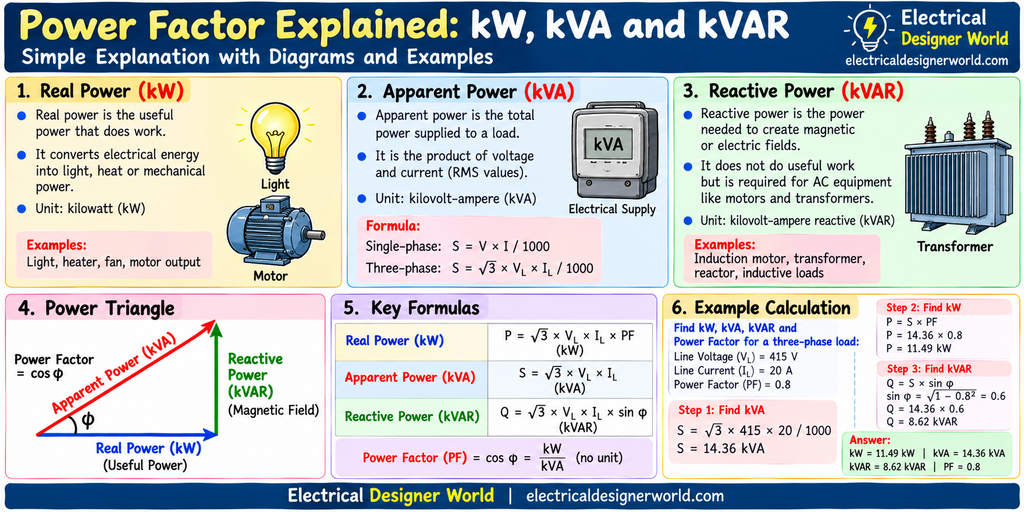
Table of Contents
Have you ever wondered why electrical equipment is rated in kVA while the useful power it consumes is often measured in kW?
To understand this, we need to learn three important electrical terms: kW, kVA and kVAR.
Power factor is another important concept that helps us understand how effectively electrical power is being used.
In this lesson of our 30 Day Electrical Fundamentals course, we will explain these concepts in simple English with everyday examples, easy formulas and practical calculations.
By the end of this lesson, you will understand the difference between kW, kVA and kVAR, what power factor means, and why it matters in electrical systems.
What Is Electrical Power?
Electrical power is the rate at which electrical energy is transferred or converted into another form of energy.
For example:
- A light converts electrical energy into light and heat.
- A fan converts electrical energy into mechanical movement.
- An electric heater converts electrical energy into heat.
- An electric motor converts electrical energy into mechanical power.
Electrical power is commonly measured in watts (W) or kilowatts (kW).
One kilowatt equals 1,000 watts.
For example, a 2 kW heater has a rated power of 2,000 W.
In AC electrical systems, we use kW, kVA and kVAR to describe different aspects of power.
What Is kW in Electrical Engineering?
kW stands for kilowatt. It represents real power, also called active power.
Real power is the power that performs useful work, such as producing heat, turning a motor, or lighting a lamp.
Simple Example of kW
Imagine an electric heater rated at 2 kW.
When operating at its rated conditions, it converts approximately 2 kW of electrical power into heat.
Similarly, a motor uses real power to produce mechanical output, although some of the input power is lost through heat, friction and other losses.
Remember:
kW = Real or active power
It is commonly used when discussing energy consumption and electricity bills.
What Is kVA in Electrical Engineering?
kVA stands for kilovolt-ampere. It represents apparent power in an AC electrical system.
Apparent power is calculated using RMS voltage and RMS current.
For a single-phase system:
kVA = Voltage × Current ÷ 1,000
For a three-phase balanced system:
kVA = √3 × Line Voltage × Line Current ÷ 1,000
Where voltage is measured in volts and current in amperes.
Simple Example of kVA
Suppose a single-phase electrical load operates at:
- Voltage = 230 V
- Current = 10 A
Apparent power is:
S = 230 × 10
S = 2,300 VA
Converting to kVA:
S = 2.3 kVA
Therefore, the apparent power is 2.3 kVA.
This calculation tells us the apparent power drawn by the load. It does not automatically mean the load consumes 2.3 kW of real power.
The real power depends on the power factor.
What Is kVAR in Electrical Engineering?
kVAR stands for kilovolt-ampere reactive. It represents reactive power.
Reactive power is associated with the energy exchanged between the electrical supply and the magnetic or electric fields of inductive and capacitive equipment.
For example, motors and transformers need magnetic fields to operate. These fields involve reactive power.
Reactive power does not represent net useful work over a complete cycle in the ideal sense, but it is important for the operation of AC equipment.
Simple Example of kVAR
An induction motor uses real power to produce mechanical output and also draws reactive power to establish its magnetic field.
Therefore, the motor may require both kW and kVAR from the electrical supply.
Remember:
- kW = Real power
- kVA = Apparent power
- kVAR = Reactive power
These three quantities describe different aspects of AC power.
Understanding kW, kVA and kVAR
Power factor describes the relationship between real power and apparent power.
For a sinusoidal AC system:
Power factor = kW ÷ kVA
Power factor has no unit. It is commonly expressed as a decimal or percentage.
For example:
If real power is 8 kW and apparent power is 10 kVA:
Power factor = 8 ÷ 10
Power factor = 0.8
Therefore, the power factor is 0.8, or 80%.
What Does a Power Factor of 0.8 Mean?
A power factor of 0.8 means that real power is 80% of apparent power under the stated conditions.
It does not mean that the remaining 20% of the electricity is simply wasted. The difference represents the relationship between real and reactive power in the AC system.
For sinusoidal voltage and current, power factor is related to the phase angle between them.
Power factor = cos φ
Where φ is the phase angle between voltage and current.
For distorted waveforms, the overall power factor may also be affected by waveform distortion.
What Is the Power Triangle?
The power triangle is a simple diagram that shows the relationship between kW, kVAR and kVA.
Think of a right-angled triangle:
- The horizontal side represents real power (kW).
- The vertical side represents reactive power (kVAR).
- The sloping side represents apparent power (kVA).
The relationship is:
kVA² = kW² + kVAR²
This relationship applies to the conventional power triangle for sinusoidal conditions.
Simple Power Triangle Example
Suppose an electrical load has:
Real power = 8 kW
Reactive power = 6 kVAR
Apparent power is calculated as:
kVA = √(kW² + kVAR²)
kVA = √(8² + 6²)
kVA = √(64 + 36)
kVA = √100
kVA = 10 kVA
Therefore, the apparent power is 10 kVA.
Power factor is:
PF = kW ÷ kVA
PF = 8 ÷ 10
PF = 0.8
This example shows how kW, kVAR and kVA are related.
What Is the Difference Between kW, kVA and kVAR?
Let’s compare these three electrical power quantities.
| Parameter | Meaning | Unit | Simple explanation |
|---|---|---|---|
| Real power | Active power | kW | Power used to perform useful work |
| Apparent power | Combined voltage-current rating | kVA | Product of RMS voltage and current |
| Reactive power | Reactive component of AC power | kVAR | Power associated with energy exchange in electric and magnetic fields |
| Power factor | Real power divided by apparent power | No unit | Relationship between real and apparent power |
These quantities are useful when studying motors, transformers, generators, power supplies and electrical distribution systems.
How to Calculate Electrical Power: A Simple Example
Suppose an electrical load has the following values:
- Real power = 12 kW
- Apparent power = 15 kVA
Find the power factor.
Step 1: Write the formula.
Power factor = kW ÷ kVA
Step 2: Substitute the values.
Power factor = 12 ÷ 15
Step 3: Calculate.
Power factor = 0.8
Answer: The power factor is 0.8, or 80%.
This calculation is useful when real power and apparent power are already known.
Why Is electrical Power Factor Important?
Power factor matters because it affects the amount of current needed to supply a given amount of real power at a specified voltage.
For a balanced three-phase system:
P = √3 × VL × IL × PF
Rearranging the formula:
IL = P ÷ (√3 × VL × PF)
This means that, for the same real power and line voltage, a lower power factor generally requires higher line current.
Higher current can increase conductor losses and place additional demands on electrical equipment.
Power factor is therefore important when engineers assess electrical installations and power distribution systems.
What Causes Low Power Factor?
Low power factor is commonly associated with inductive loads operating under certain conditions.
Examples include:
- Induction motors.
- Transformers.
- Some welding equipment.
- Inductive industrial machinery.
- Motors operating lightly loaded.
Inductive equipment requires reactive power to establish magnetic fields.
The actual power factor depends on the equipment, its operating condition, and the electrical supply.
A low power factor does not necessarily mean the equipment is faulty.
How Can Power Factor Be Improved?
Power factor can sometimes be improved by using suitable power factor correction equipment.
A common method is to install capacitors that supply reactive power locally to inductive loads.
Other systems may use automatic capacitor banks or electronic power factor correction equipment.
The correct solution depends on the load, the existing power factor, harmonic conditions, operating pattern, and applicable electrical requirements.
Power factor correction should be properly designed and protected. Capacitors must not be selected solely by guessing a required kVAR value.
Frequently Asked Questions About Power Factor, kW, kVA and kVAR
1. What is the difference between kW and kVA?
kW represents real power, while kVA represents apparent power. Their relationship depends on power factor.
2. What does kVAR mean?
kVAR measures reactive power associated with the exchange of energy in electric and magnetic fields in AC systems.
3. What is a good power factor?
A power factor close to 1 generally means that apparent power is being used more effectively to deliver real power. The appropriate target depends on the equipment and the utility or project requirements.
4. Why do motors draw reactive power?
Motors commonly need magnetic fields to operate. Establishing these fields requires reactive power in an AC system.
5. Does a low power factor increase current?
For the same real power and voltage in a typical AC system, a lower power factor generally means higher current.
Practice Questions: Power Factor, kW, kVA and kVAR
Question 1: What does kW represent?
A. Reactive power
B. Real power
C. Apparent power
D. Frequency
Question 2: What does kVA represent?
A. Real power
B. Resistance
C. Apparent power
D. Reactive power only
Question 3: If real power is 8 kW and apparent power is 10 kVA, what is the power factor?
A. 0.5
B. 0.6
C. 0.8
D. 1.25
Question 4: Which equipment commonly requires reactive power to establish a magnetic field?
A. Induction motor
B. Simple resistor
C. Heating element only
D. Incandescent lamp only
Question 5: What can a lower power factor mean for a load delivering the same real power at the same voltage?
A. Lower current in every case
B. Higher current
C. Zero reactive power
D. Higher frequency
Answers
- B — Real power.
- C — Apparent power.
- C — 0.8.
- A — Induction motor.
- B — Higher current.
Conclusion
Power factor, kW, kVA and kVAR are important concepts for understanding AC electrical systems.
kW represents real power, kVA represents apparent power, and kVAR represents reactive power.
Power factor describes the relationship between real power and apparent power. Understanding these concepts helps electrical engineering students understand motors, transformers, generators and power distribution systems.
Practise the formulas and power triangle example before moving to the next lesson in our Electrical Fundamentals course.
Continue the 30 Day Electrical Fundamentals Course
This lesson is part of the Electrical Fundamentals – Zero to Advanced course on Electrical Designer World.
- Previous lesson: Day 14 – Star and Delta Connections
- Current lesson: Day 15 – Power Factor, kW, kVA and kVAR
- Next lesson: Day 16 – Electrical Energy, kWh and Electricity Consumption
Further reading: All About Circuits – Textbook for additional learning resources on AC circuits and electrical power.