
what is voltage and current in simple words
Electricity is everywhere around us. We use it to operate motors, transformers, pumps, computers, lighting systems and almost every electrical system used in modern life.
Where does electricity actually come from?
To understand this properly, we can start from the smallest level:
Atoms → Electrons → Charge Separation → Voltage → Electric Field → Current → Electrical Energy
In this article, we will understand what voltage is, where voltage comes from, how current is created, why electrons move and how electrical energy reaches a load.
1. Everything Is Made of Atoms
Everything around us is made of extremely small particles called atoms.
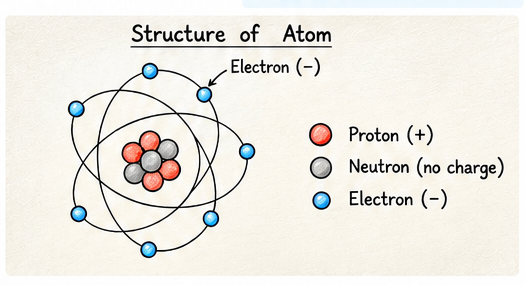
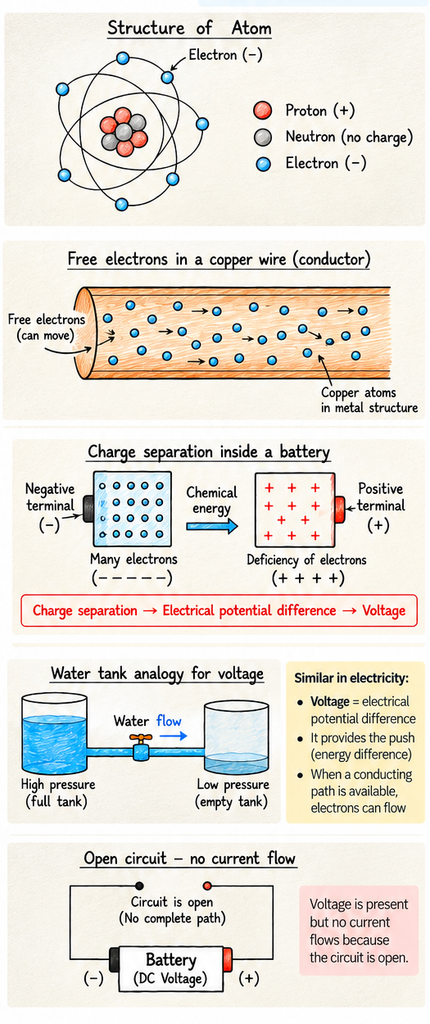
An atom contains three important particles:
- Protons → Positive charge (+)
- Electrons → Negative charge (−)
- Neutrons → No electrical charge
The electron is especially important when we study electricity because electrons can move through certain materials.
Simple way to think about an atom
Imagine an atom as having a central region called the nucleus and electrons associated with that atom around it.
Protons and neutrons are in the nucleus, while electrons occupy regions around the nucleus.
2. What Is Special About Electrons?
Not all electrons behave in exactly the same way in every material.
In metals such as copper and aluminium, some electrons are relatively free to move through the material.
These are commonly called free electrons or mobile electrons.
This is one reason copper and aluminium are widely used as electrical conductors.
For example, a copper cable contains an enormous number of atoms and mobile charge carriers.
You can imagine the copper wire as a path containing many electrons that are capable of moving when an electric field is established.
Simple idea
Copper wire + mobile electrons = conducting path
This is important because current requires moving electric charge.
3. Where Does Voltage Come From?
Now we reach the most important part.
Where does voltage come from?
A voltage source uses energy to establish an electrical potential difference between two points.
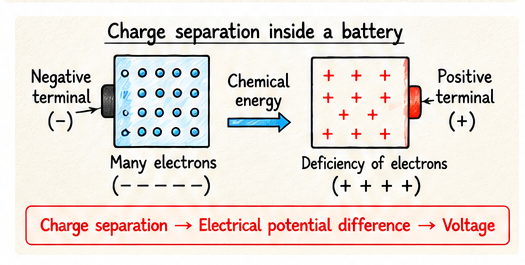
For example, a battery uses chemical energy to drive internal chemical processes that maintain a difference in electrical potential between its terminals.
One terminal has an excess of electrons relative to the other terminal, while the other terminal has a relative deficiency of electrons.
This creates an electrical potential difference between the two terminals.
That potential difference is called voltage.
Remember this sequence:
Energy → Charge separation → Electrical potential difference → Voltage
A more precise electrical-engineering description is:
Voltage is the electrical potential difference between two points.
The important thing is to understand what that means physically rather than simply memorizing the definition.
4. Think of Voltage as Electrical Pressure
One of the easiest ways for a beginner to understand voltage is to compare it with water pressure.
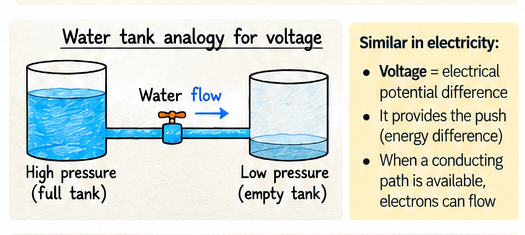
Imagine two water tanks.
One tank is full of water.
The other tank contains very little water.
There is a difference between the two tanks.
If we connect the tanks with a pipe, water can flow from the higher-pressure side toward the lower-pressure side.
Electric circuits have a similar concept.
Water analogy
Water pressure difference → can cause water to flow
Electrical analogy
Voltage → can cause electric charge to move
This does not mean voltage and water pressure are exactly the same thing. The water analogy is simply a useful way to build intuition.
In simple words:
Voltage provides the electrical potential difference that can drive current when a conducting path exists.
5. A Battery Can Have Voltage Even When the Circuit Is Open
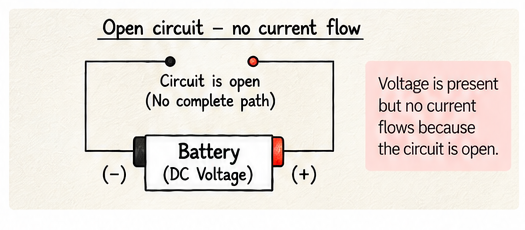
Consider a battery sitting on a table.
The battery has two terminals:
- Negative (−)
- Positive (+)
There is a voltage between these terminals.
But suppose we do not connect anything between the terminals.
There is no complete external conducting path.
Therefore, there is no sustained external current through a load.
Think about it this way:
Voltage can exist without a complete circuit.
But for a sustained current to flow through an external load, there must be a suitable conducting path.
Example
A 12 V battery can have approximately 12 V between its terminals even when nothing is connected to it.
So:
Open circuit → voltage exists → no sustained external load current
6. What Happens When We Close the Circuit?
Now let’s connect a bulb to the battery.
The circuit now has a complete conducting path.
The battery maintains a voltage difference between its terminals.
This establishes an electric field in the circuit.
The mobile charge carriers in the conductor respond to that electric field and acquire a small average drift motion.
The movement of electric charge is called electric current.
The basic sequence is:
Voltage + Complete conducting path → Electric field → Charge movement → Current
This is a much better way to understand current than simply saying:
“Voltage creates current.”
Voltage does not automatically guarantee current.
A complete conducting path and the properties of the circuit also matter.
7. What Is Electric Current?
Electric current is the rate of flow of electric charge.
It is represented by the symbol:
I
The SI unit of current is:
Ampere (A)
The basic relationship is:
I = Q / t
Where:
- I = current in amperes
- Q = electric charge in coulombs
- t = time in seconds
So if more charge passes a point in a given amount of time, the current is greater.
Simple definition
Electric current is the rate at which electric charge flows through a circuit.
8. Very Important: Electrons Do Not Come From the Battery and Travel All the Way to the Bulb
This is one of the most common misunderstandings among beginners.
It is easy to imagine the battery producing electrons and sending them through the wire to the bulb.
That is not the right mental picture.
The conductor already contains mobile charge carriers.
For example, a copper wire already contains an enormous number of electrons.
When the circuit is connected, the battery establishes the electrical conditions that cause these mobile charge carriers to drift through the conductor.
So don’t think:
❌ Battery creates electrons → electrons travel all the way to the bulb → bulb lights.
Think:
✅ The conductor already contains mobile electrons.
✅ The battery maintains a voltage difference.
✅ The voltage establishes an electric field in the circuit.
✅ The electric field causes charge carriers to have a net drift.
✅ That charge movement constitutes electric current.
This is an important foundation for understanding electrical engineering.
9. Then Why Does the Bulb Glow?
Now we know that current flows through the circuit.
But what actually makes the bulb produce light?
The electrical circuit transfers energy to the load.
The load converts electrical energy into other forms of energy.
For example, in an incandescent lamp:
Electrical energy → Heat → Light
In an LED:
Electrical energy → Light + Heat
The exact physical mechanism is different for different types of loads, but the important idea is the same:
Electrical energy is transferred from the source through the circuit and converted by the load.
10. Voltage and Current Are Not the Same Thing
This is another important concept.
Voltage
Voltage is the electrical potential difference between two points.
Unit:
Volt (V)
Symbol:
V
Current
Current is the rate of flow of electric charge.
Unit:
Ampere (A)
Symbol:
I
Simple comparison
| Electrical quantity | Meaning | Unit |
|---|---|---|
| Voltage | Electrical potential difference | Volt (V) |
| Current | Rate of flow of electric charge | Ampere (A) |
A useful beginner analogy is:
Voltage = potential difference / electrical push
Current = movement of charge
But remember that the analogy is only for understanding the concept. Voltage is not literally a fluid pressure.
11. The Complete Story From Electrons to Current
Now let’s put everything together.
Step 1 — Atoms
Matter is made of atoms.
↓
Step 2 — Electrons
Electrons carry negative electric charge.
↓
Step 3 — Conductors
Materials such as copper contain mobile charge carriers that can respond to an electric field.
↓
Step 4 — Energy Source
A battery or generator uses energy to establish an electrical potential difference.
↓
Step 5 — Voltage
The electrical potential difference between two points is voltage.
↓
Step 6 — Complete Circuit
When a conducting path is available, an electric field is established throughout the circuit.
↓
Step 7 — Current
The mobile charge carriers acquire a net drift, producing electric current.
↓
Step 8 — Load
The circuit transfers electrical energy to the load.
↓
Step 9 — Energy Conversion
The load converts electrical energy into useful forms such as:
- Light
- Heat
- Mechanical energy
- Sound
- Chemical energy
14. One Simple Example
Let’s take a small DC circuit.
Suppose we have:
- A 12 V battery
- Copper wires
- A lamp
- A switch
When the switch is open:
Battery → Voltage exists → Circuit incomplete → No sustained lamp current
When the switch is closed:
Battery → Voltage → Electric field → Charge movement → Current → Lamp → Light
This simple circuit contains the fundamental idea behind much larger electrical systems.
The same basic concepts eventually lead to:
Generator → Transformer → Switchgear → Cable → Motor
This is why understanding the basics is important before starting EPC electrical design.
15. Why This Concept Is Important in Electrical Engineering
If you understand the relationship between voltage, current and electrical energy, many electrical engineering topics become easier to understand.
For example:
Ohm’s Law
You will learn the relationship:
V = I × R
Where:
- V = Voltage
- I = Current
- R = Resistance
Electrical Power
You will learn:
P = V × I
Where:
- P = Power
- V = Voltage
- I = Current
Transformers
You will learn how transformers transfer electrical energy and change voltage and current levels.
Motors
You will learn how electrical energy is converted into mechanical energy.
Circuit Breakers
You will understand why breakers are selected according to voltage, current and fault conditions.
Cable Sizing
You will understand why the expected load current is one of the important factors when selecting a cable.
So the basic concept of voltage → current → energy transfer is connected to many areas of electrical engineering.
16. The Simplest Way to Remember Voltage and Current
Don’t just memorize:
“Voltage is potential difference.”
Understand the physical idea.
Voltage
Voltage is the electrical potential difference between two points.
It represents an energy difference per unit charge and can drive charge movement when a suitable conducting path exists.
Current
Current is the rate of flow of electric charge.
The simple chain
Energy source
↓
Electrical potential difference
↓
Voltage
↓
Electric field in a conducting circuit
↓
Charge movement
↓
Current
↓
Energy transferred to the load
⚡ This is the foundation of electrical engineering.
17. Important Points to Remember
Let’s summarize the entire concept.
1. Matter is made of atoms
Atoms contain protons, neutrons and electrons.
2. Electrons carry negative charge
Electrons are important in electrical circuits because mobile charge carriers can move through conductors.
3. Conductors contain mobile charge carriers
Copper and aluminium are commonly used as electrical conductors.
4. Energy can establish an electrical potential difference
A battery uses chemical processes, while a generator uses electromagnetic induction.
5. Voltage is electrical potential difference
Voltage exists between two points.
6. A complete circuit allows sustained current
A voltage source can have voltage across its terminals even when the external circuit is open.
7. Current is movement of electric charge
More precisely, current is the rate of flow of electric charge.
8. Electrical energy is transferred to the load
The load converts electrical energy into useful forms such as light, heat or mechanical energy.
Conclusion
Understanding electricity becomes much easier when we start from the basics instead of immediately memorizing formulas.
Start with:
Atoms
↓
Electrons
↓
Mobile charge carriers
↓
Energy source
↓
Charge separation / electromagnetic induction
↓
Voltage
↓
Electric field
↓
Current
↓
Electrical energy transferred to the load
Once you understand this sequence, concepts such as Ohm’s Law, electrical power, transformers, motors, switchgear, circuit breakers, cable sizing and EPC electrical design become much easier to learn.
The most important thing to remember is:
Voltage is the electrical potential difference between two points, while current is the rate of flow of electric charge.
⚡ Understand the concept first. Memorize the formula later.
This basic understanding is the foundation for everything that follows in electrical engineering.